PEROTTI, Niccolò.
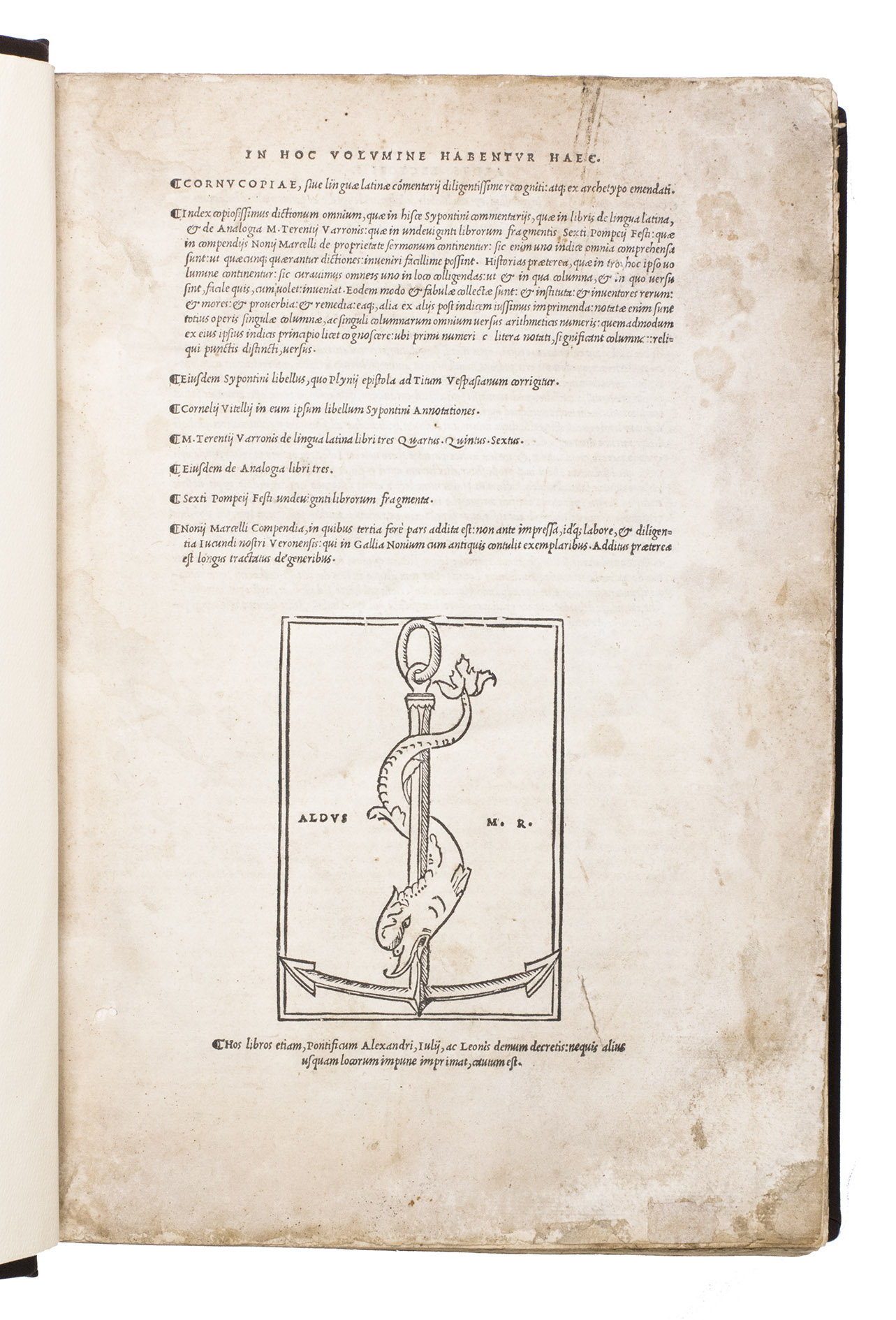
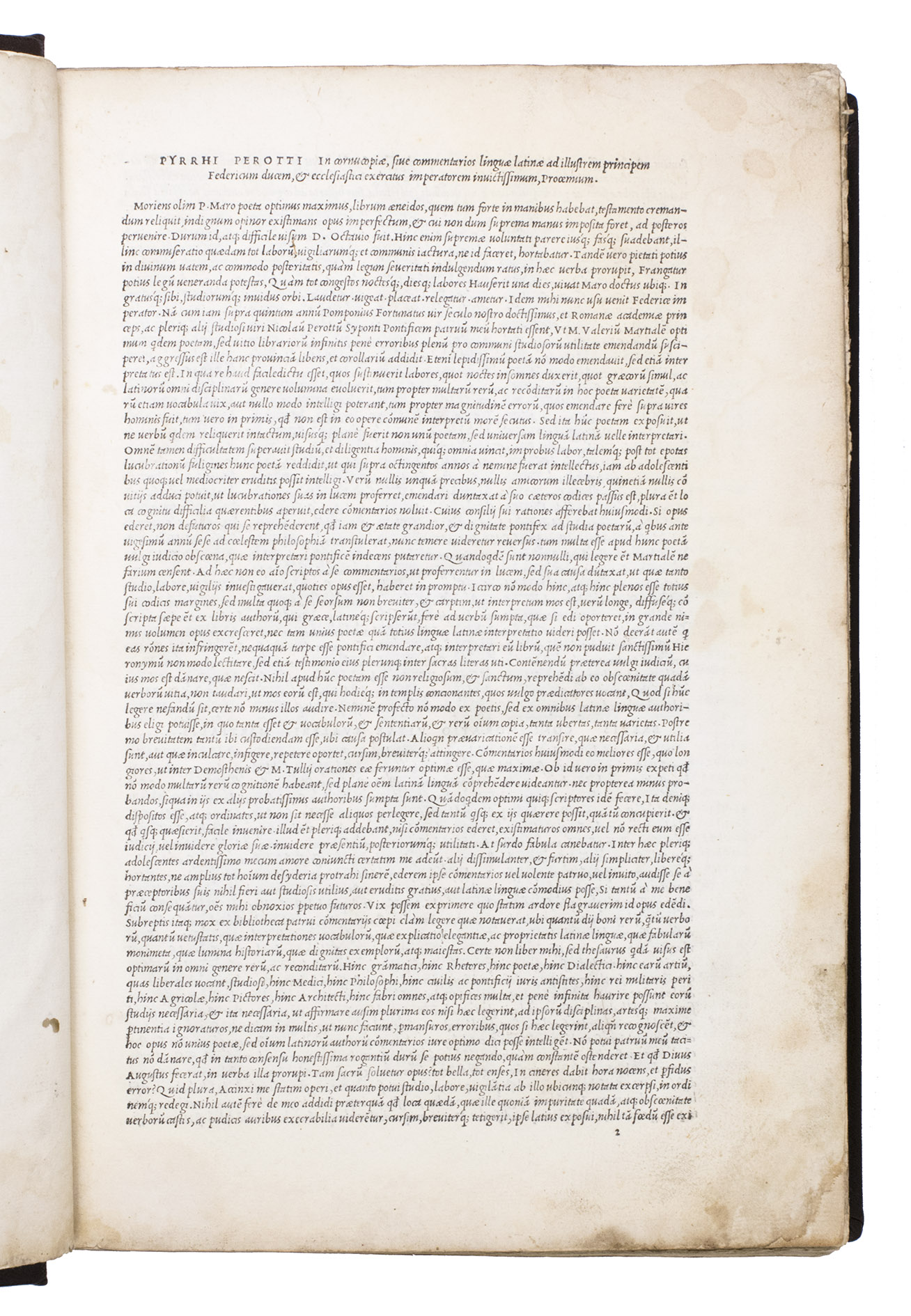
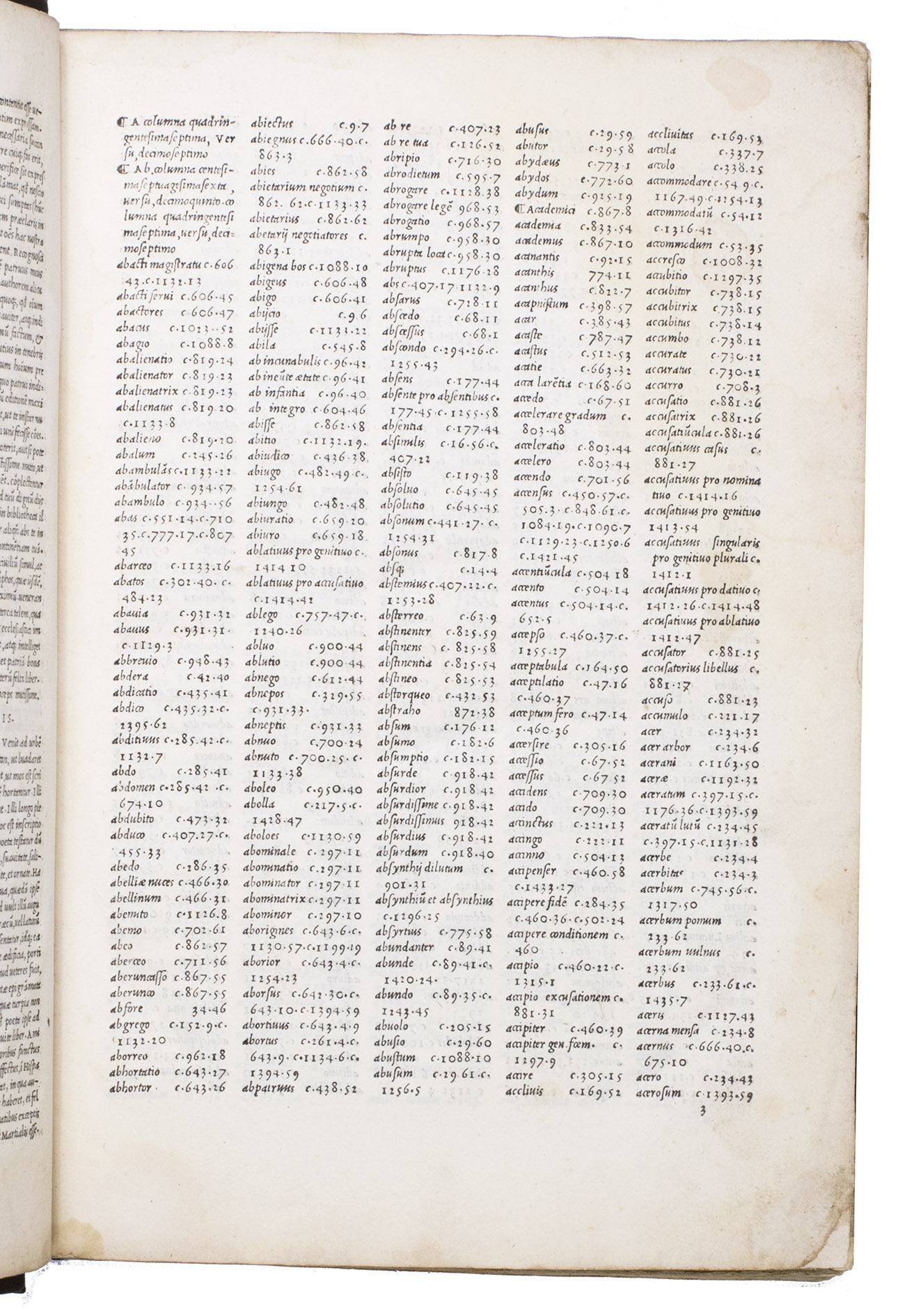
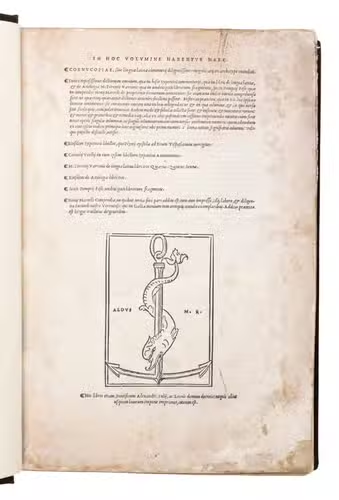
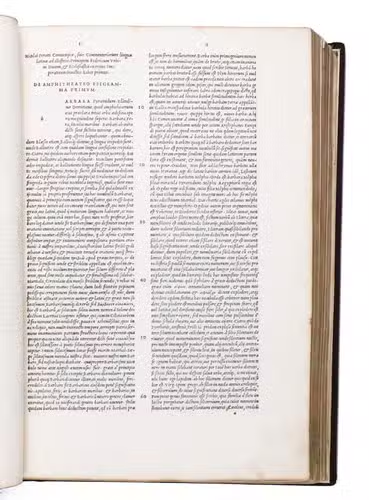
In hoc volumine habentur haec. # Cornucopiae, sive linguae Latinae commentarij diligentissime recogniti: atque ex archetypo emendati. # Index copiosissimus dictionum omnium ... # Eiusdem Sypontini libellus, quo Plynij epistola ad Titum Vespasianum corrigitur. # Cornelij Vitellij in eum ipsum libellum Sypontini annotationes. # M. Terentij Varronis de lingua Latina libri tres: Quartus. Quintus. Sextus. # Eiusdem de analogia libri tres. # Sexti Pompeij Festi undeviginti librorum fragmenta. # Nonij Marcelli Compendia, in quibus tertia ferè pars addita est: non ante impressa ...
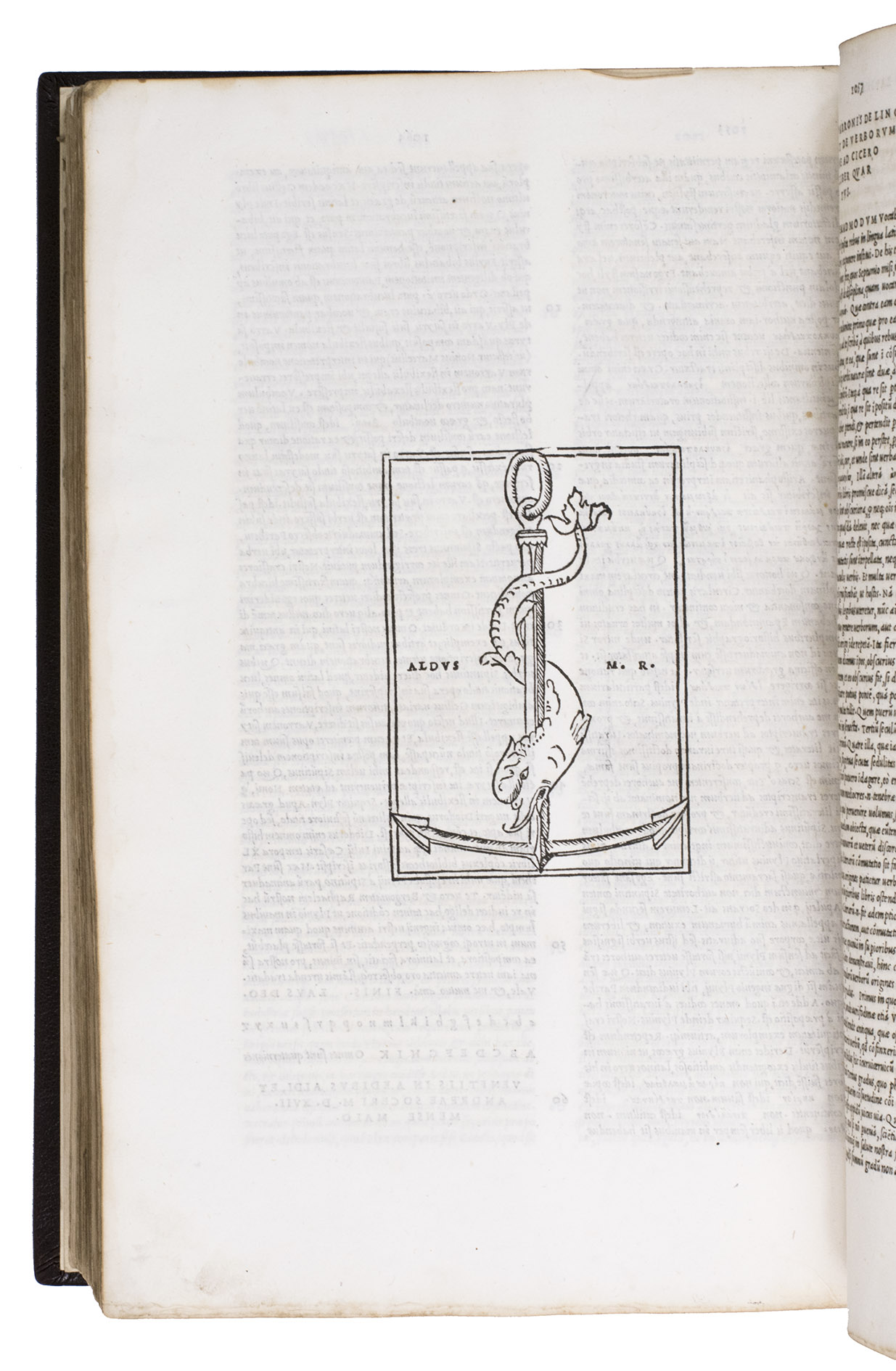
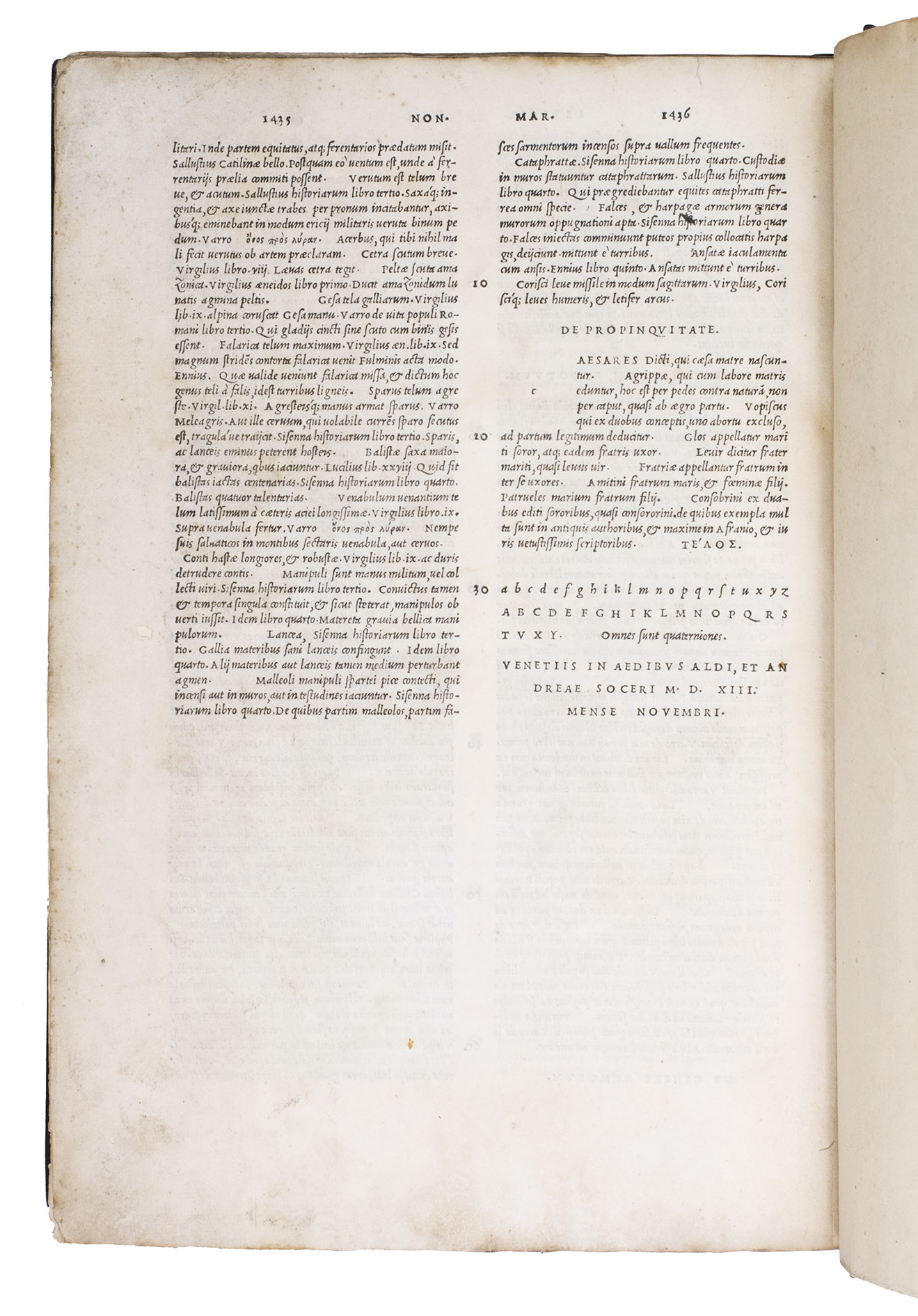
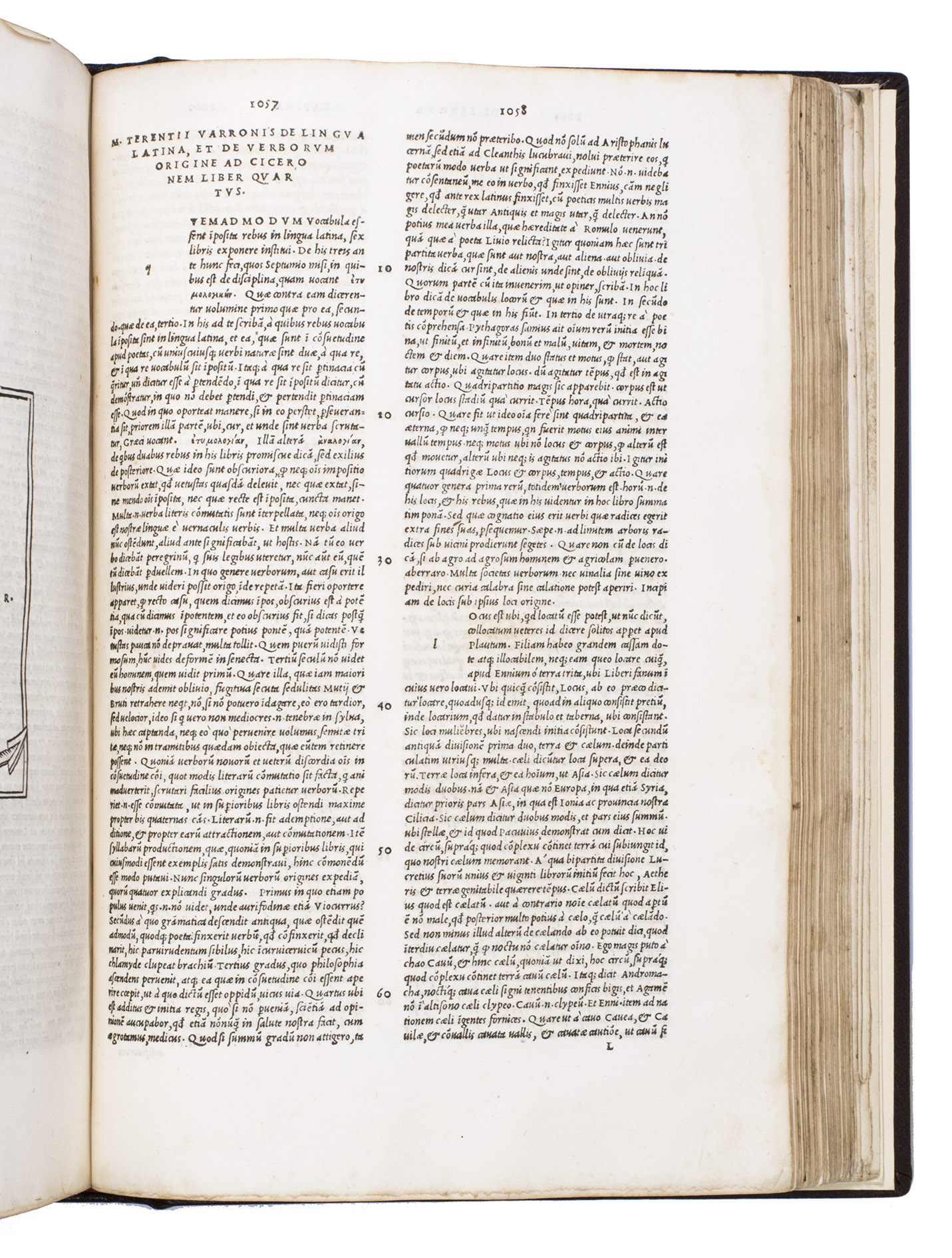
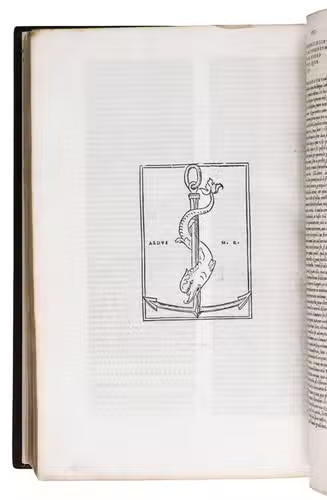
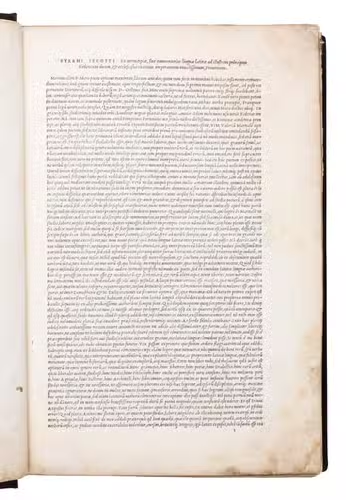
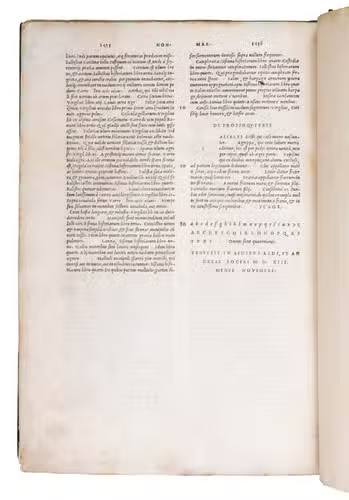
(Colophon on K8r:) Venice, in aedibus Aldo I Manuzio & Andrea I Torresano, May 1517; (colophon on Y7v:) November 1513. Folio. With a woodcut printer's device on the title page, repeated on the verso of the last leaf. Including:
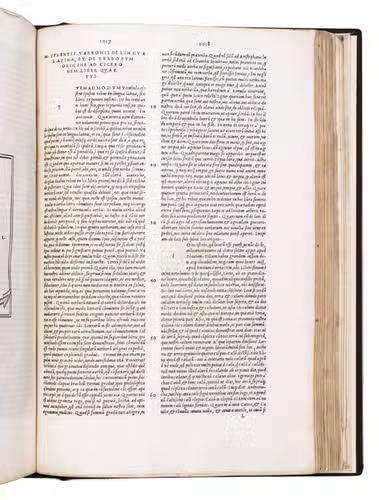
(2) VARRO, Marcellus Terentius. De lingua Latina.
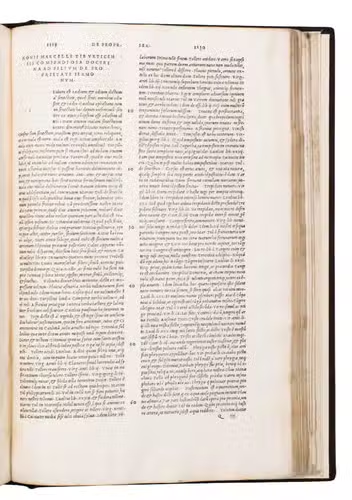
(3) FESTUS, Sextus Pompeius. De verborum significatione.
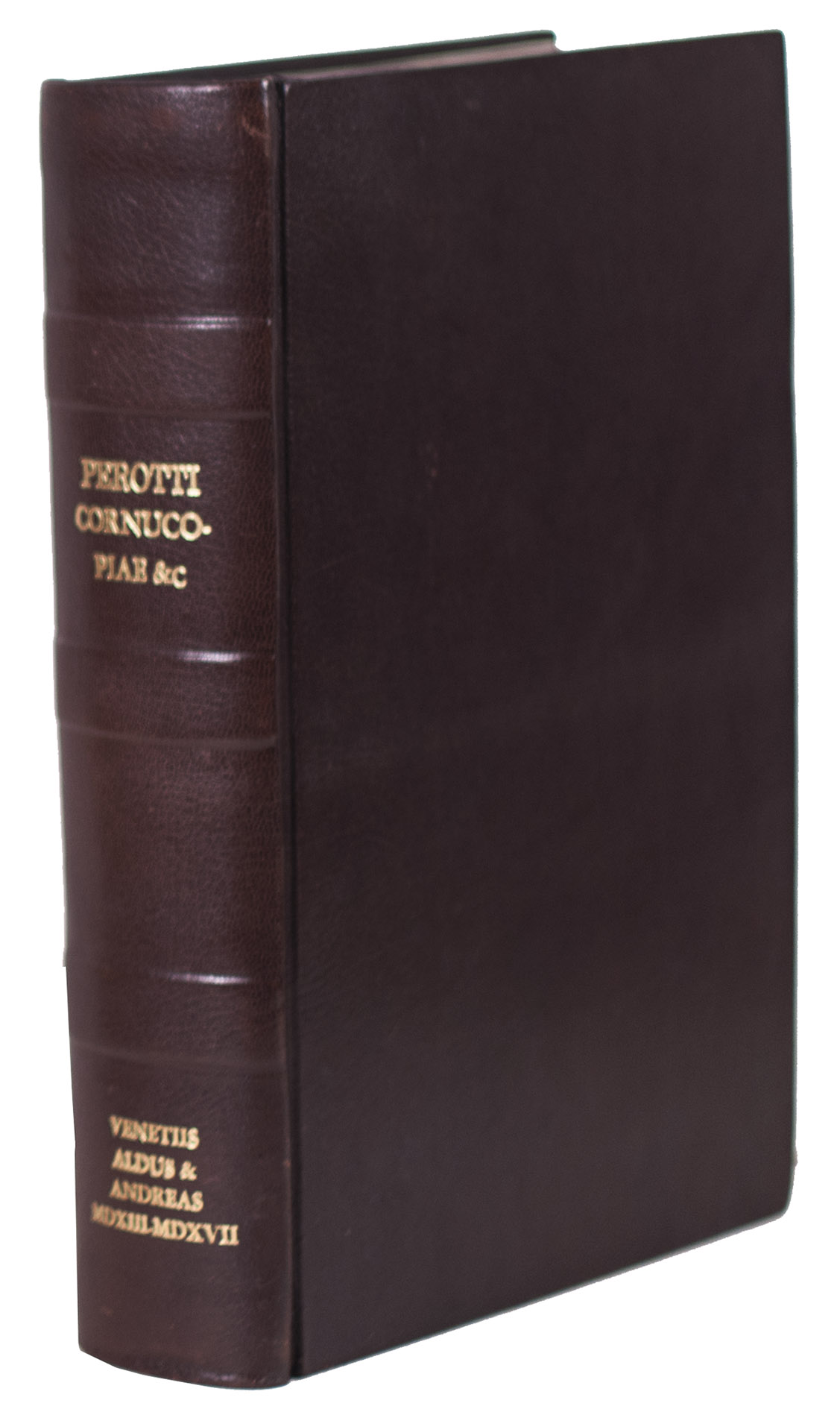
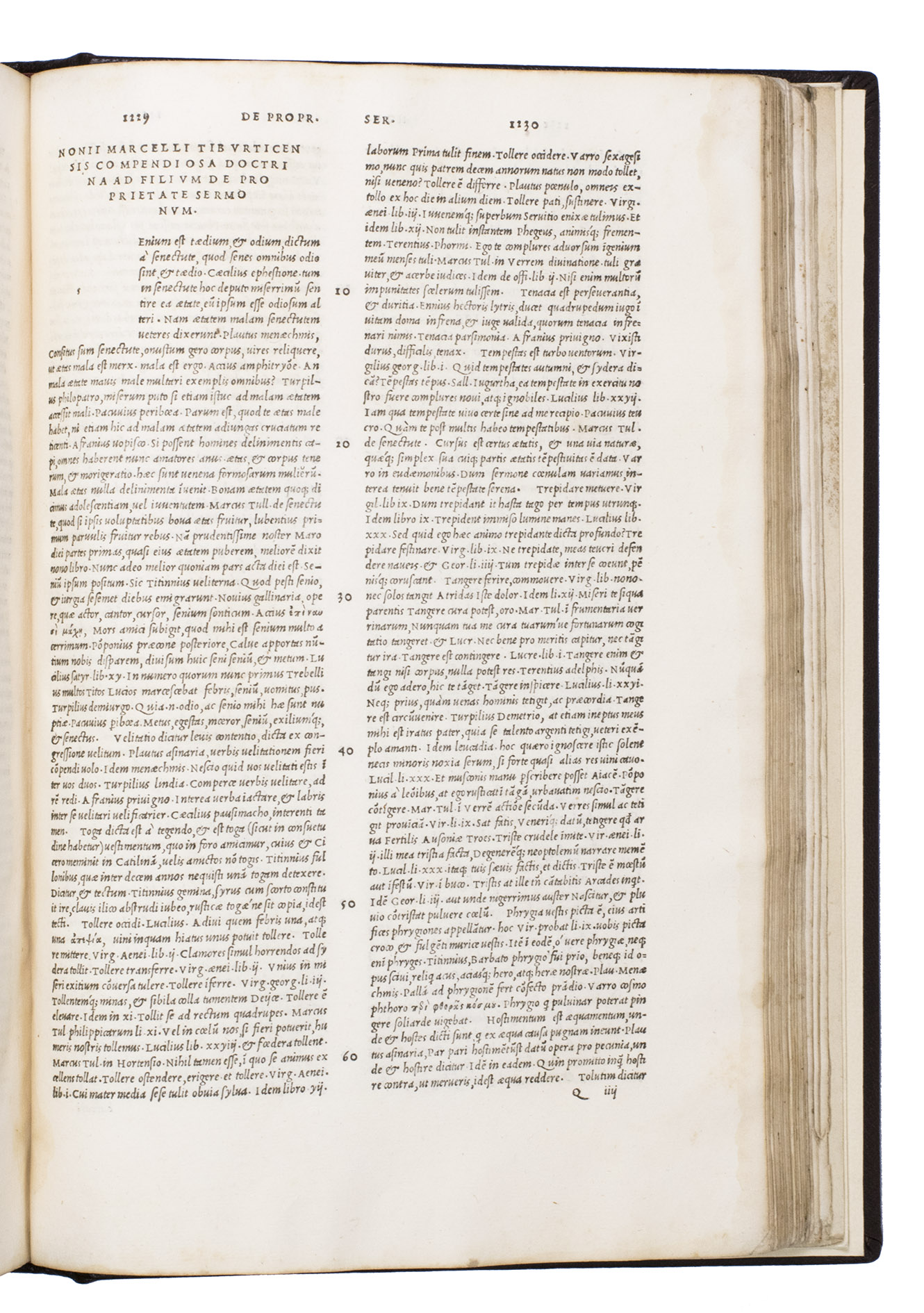
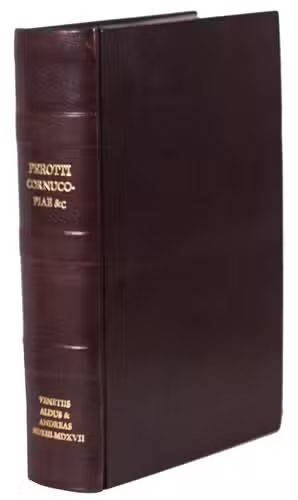
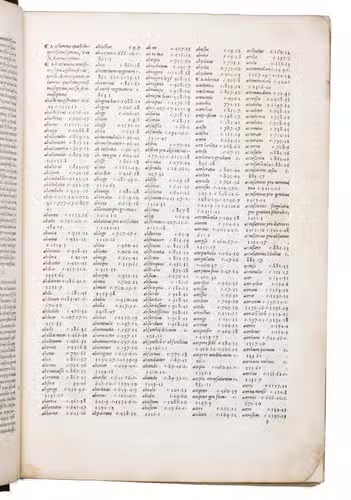
(4) MARCELLUS, Nonius. De compendiosa doctrina. Modern brown morocco. 79, [1 blank] ll., "1436" [= 1426] cols.
€ 5,000
Third Aldine edition of this collection of the main texts on the Latin language available to the early humanists: the most important Renaissance dictionary/encyclopaedia, written by Niccolo Perroti, together with the three most important and influential classical texts on the subject by Varro, Festus and Nonius Marcellus.
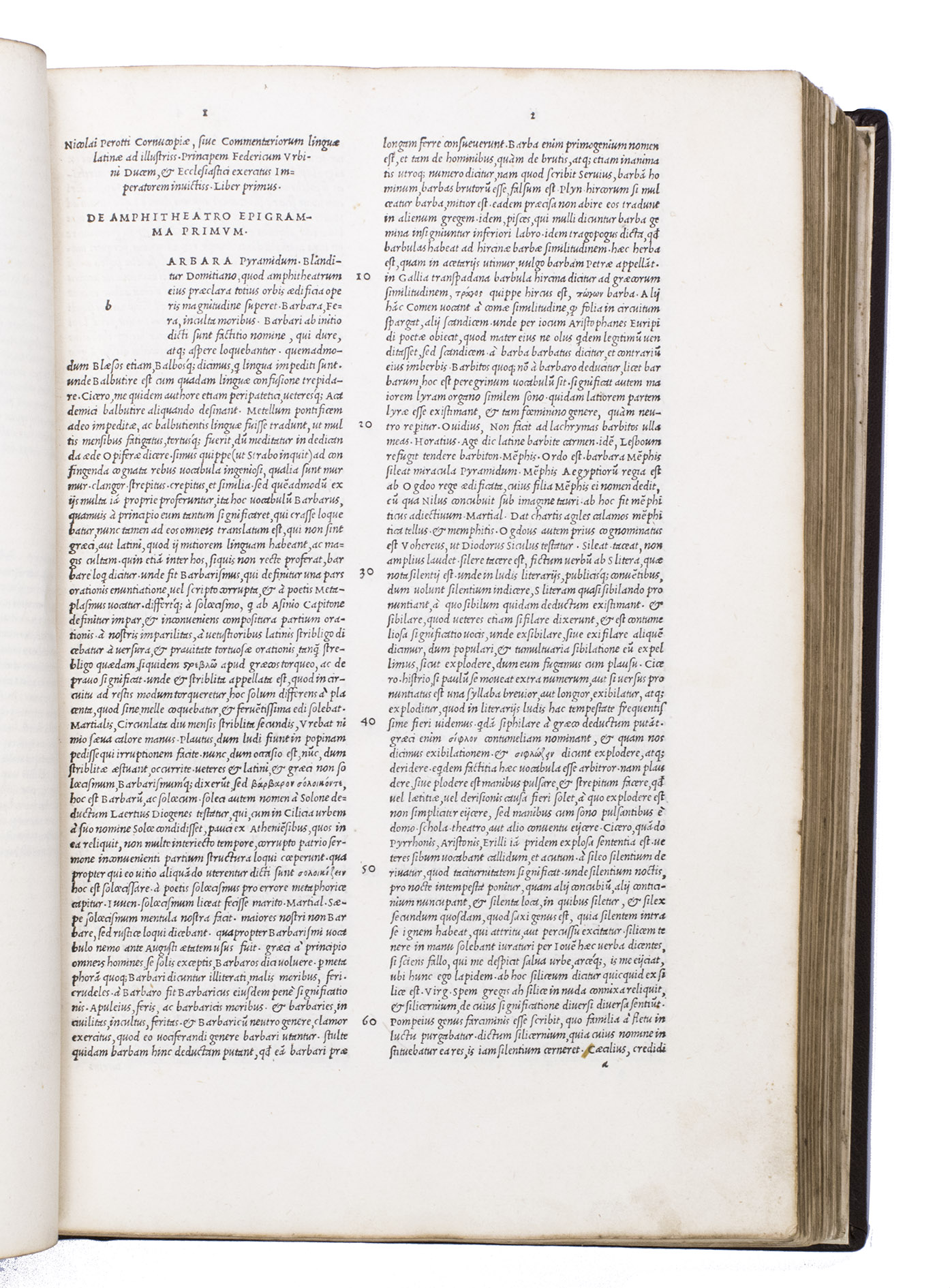
The greater part of this impressive Aldus edition is occupied by the Cornucopia of the Italian humanist Perotti. Written as a commentary on book I of Martial, it includes a discussion on almost every word of Martial's text and thus transcended its original ambition, becoming a standard work of reference on the Latin language. One commentator calls it "a massive encyclopaedia of the classical world. Every verse, indeed every word of Martial's text was a hook on which Perotti hung a densely woven tissue of linguistic, historical and cultural knowledge". The work was dedicated to the condottiere Federico da Montefeltro of Urbino (whose portrait was painted by Pierro della Francesco). The work was revised and expanded by Perotti's son Pyrrhus who made a number of additions of his own.
The first edition of the Cornucopia was published in Venice by Paganino de Paganin in 1489; the first Aldine edition in 1499. Our edition is a page-for-page reprint of the second Aldus edition of 1513.
Apart from his Cornucopia, Perotti wrote a Latin school grammar, Rudimenta Grammatices (printed by Pannartz and Sweynheim in 1473), one of the earliest and most popular Renaissance Latin grammars, which attempted to exclude many words and constructions of medieval, rather than classical, origin. Described by Erasmus as "accurate, yet not pedantic", it became a bestseller of its day, going through 117 editions. With Pomponio Leto, he produced a version of the poet Martial's Epigrammaton in the 1470s.
To the Cornucopia are added the three most important classical text on the grammar and etymology of the Latin language: (1) De lingua Latina by Marcellus Terentius Varro (116-27BC), a prolific classical author of whom only two works partly survive. In this Aldus edition the known books 4-6 of his most famous work De lingua Latina are given, together with the three books De analogia, which also belong to the De lingua Latina. (2) De verborum significatione of the Roman grammarian Sextus Pompeius Festus (2nd cent. AD), an epitome in 21 books of the encyclopaedic treatise of the same name by Valerius Flaccus. Festus gives the etymology as well as the meaning of many words, and his work throws considerable light on the Latin language, mythology and antiquities of ancient Rome. Of Festus's work, only a few fragments remain in only one single manuscript (in Naples). (3) De compendiosa doctrina by the Latin grammarian and lexicographer Nonius Marcellus (end 3rd, beginning 4th cent. AD), a "lexicon" in 20 sections or chapters. The first twelve deal with language and grammar, the remaining eight with special subjects (navigation, costume, food, arms). The work is a compilation from commentaries on the authors quoted (whom Nonius only knows at second hand) and from existing dictionaries and grammars.
The title page is somewhat soiled, the outer corners of the first three leaves have been reinforced, the last leaf has been mounted with preservation of the printer's device, some leaves are somewhat browned, a rust spot on col. 673. Otherwise in good condition. Adams P-721; Ahmanson-Murphy II, 132; The Aldine press 151; Bibliotheca Aldina 34; BM STC Italian p. 499; Edit 15 CNCE 36579; OPAC SBN RMLE017412; Renouard p. 81, no. 10 & p. 63, no. 6; USTC 847581.
Related Subjects: