[GENEAOLOGY - NOBILITY].
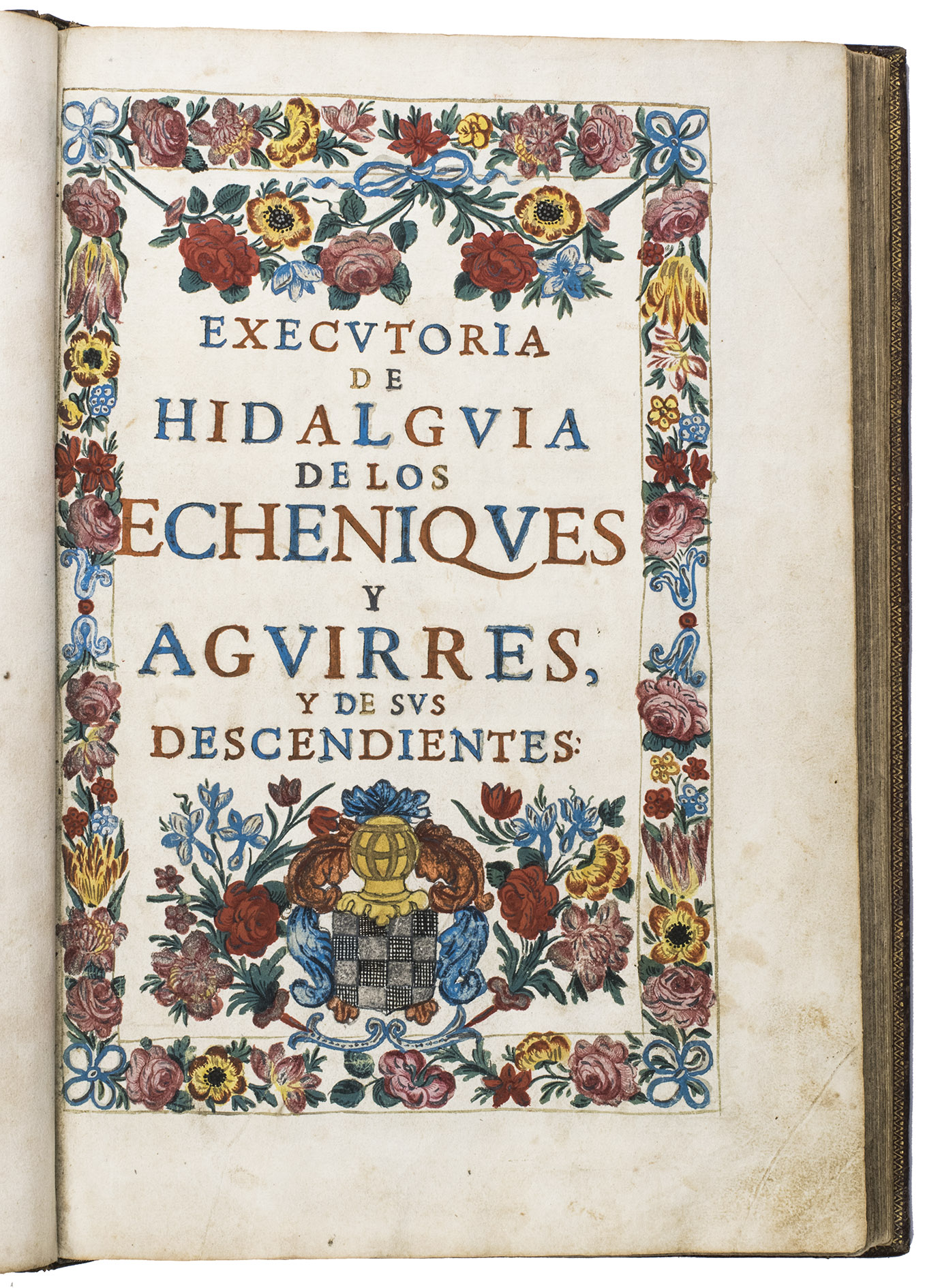
Executoria de hildaguia de los Echeniques y Aguirres, y de sus descendientes.
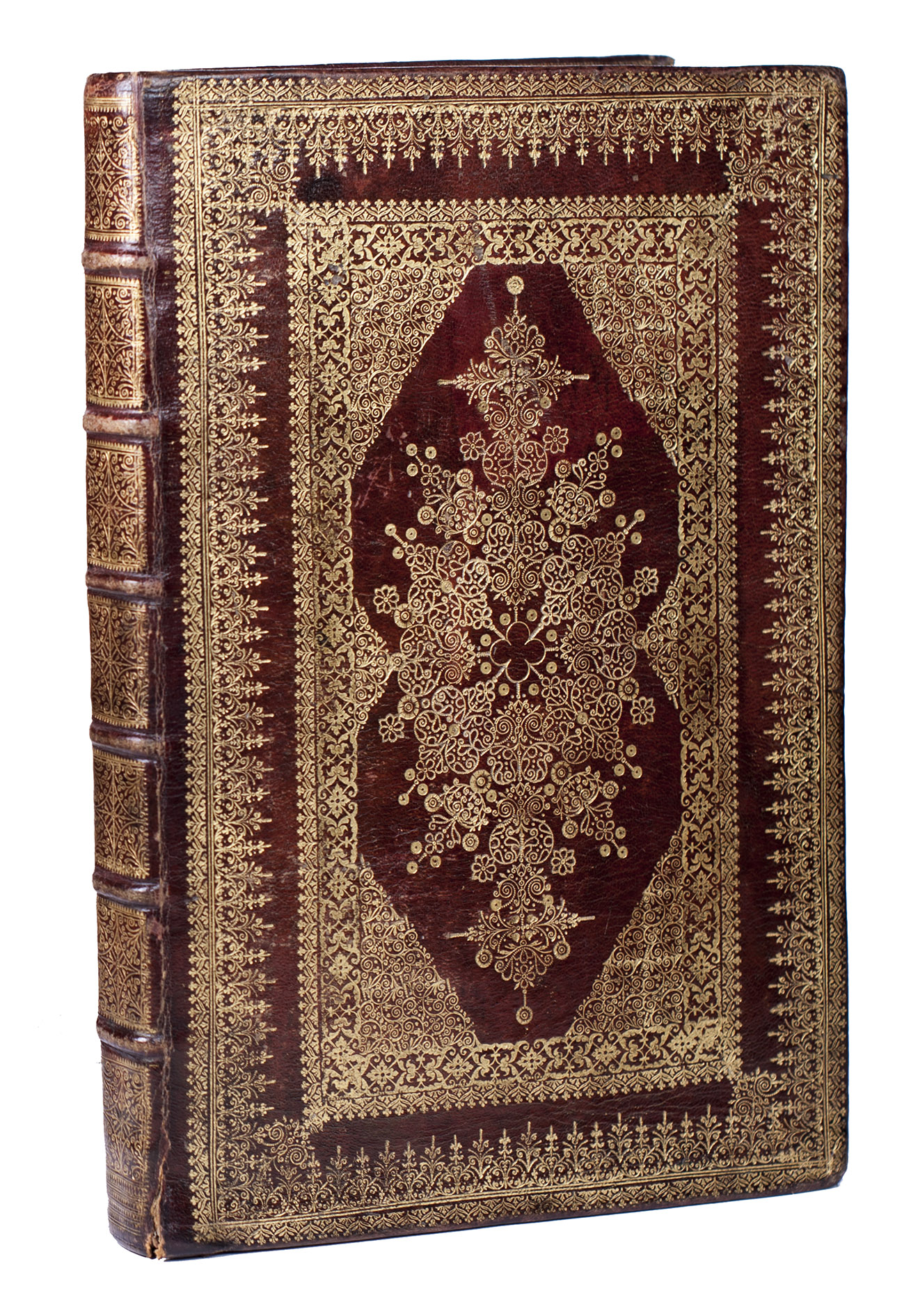
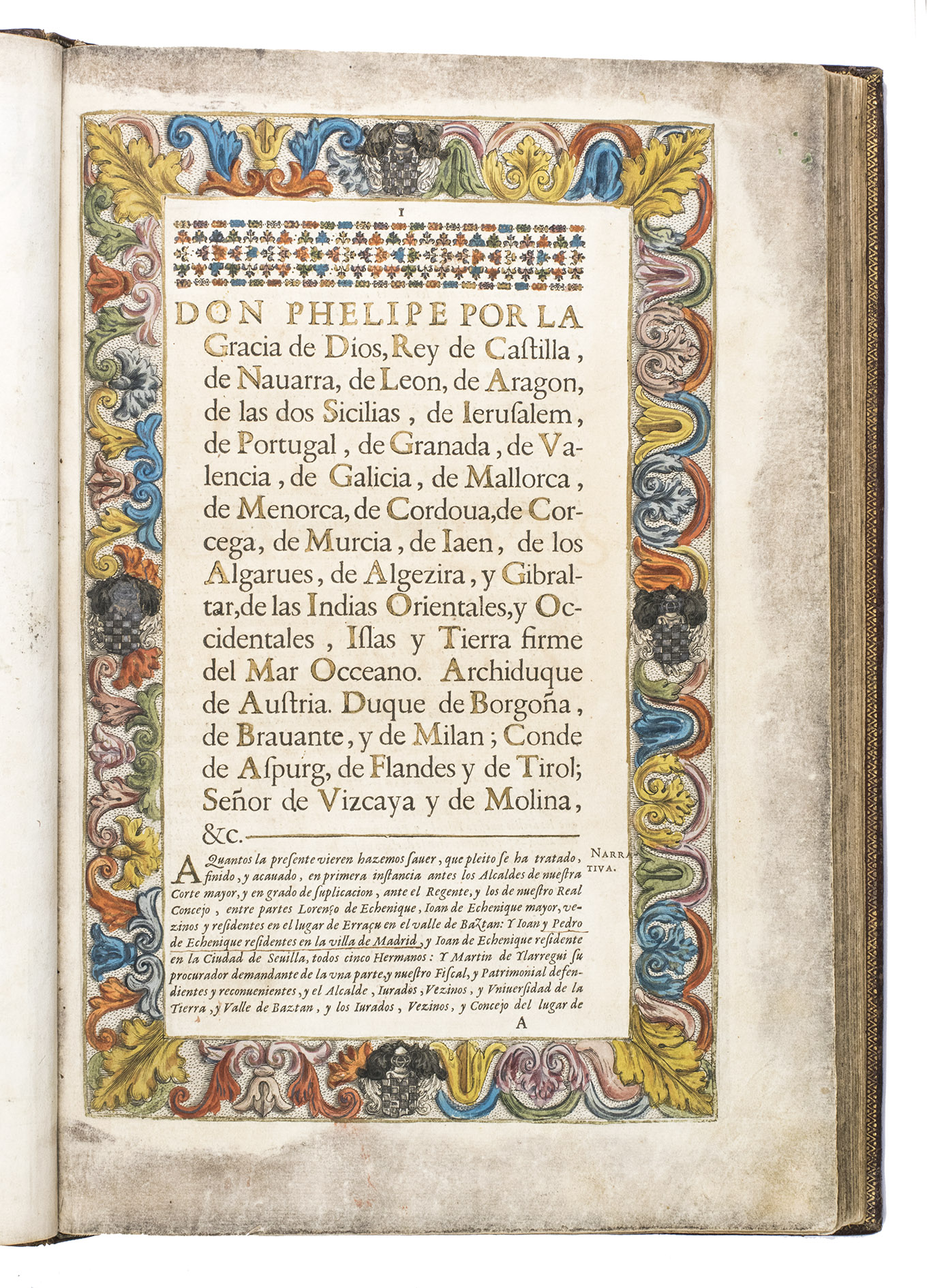
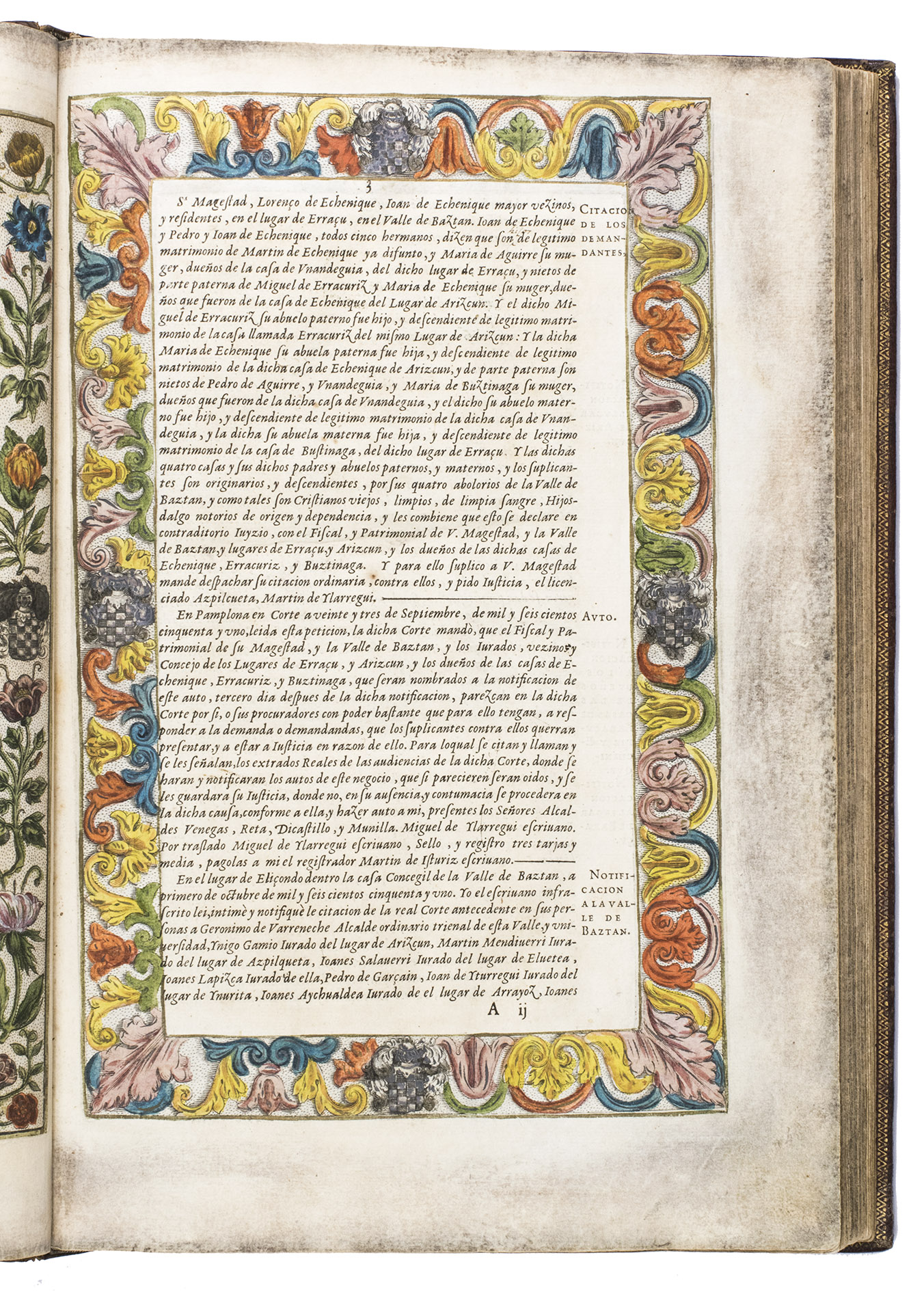
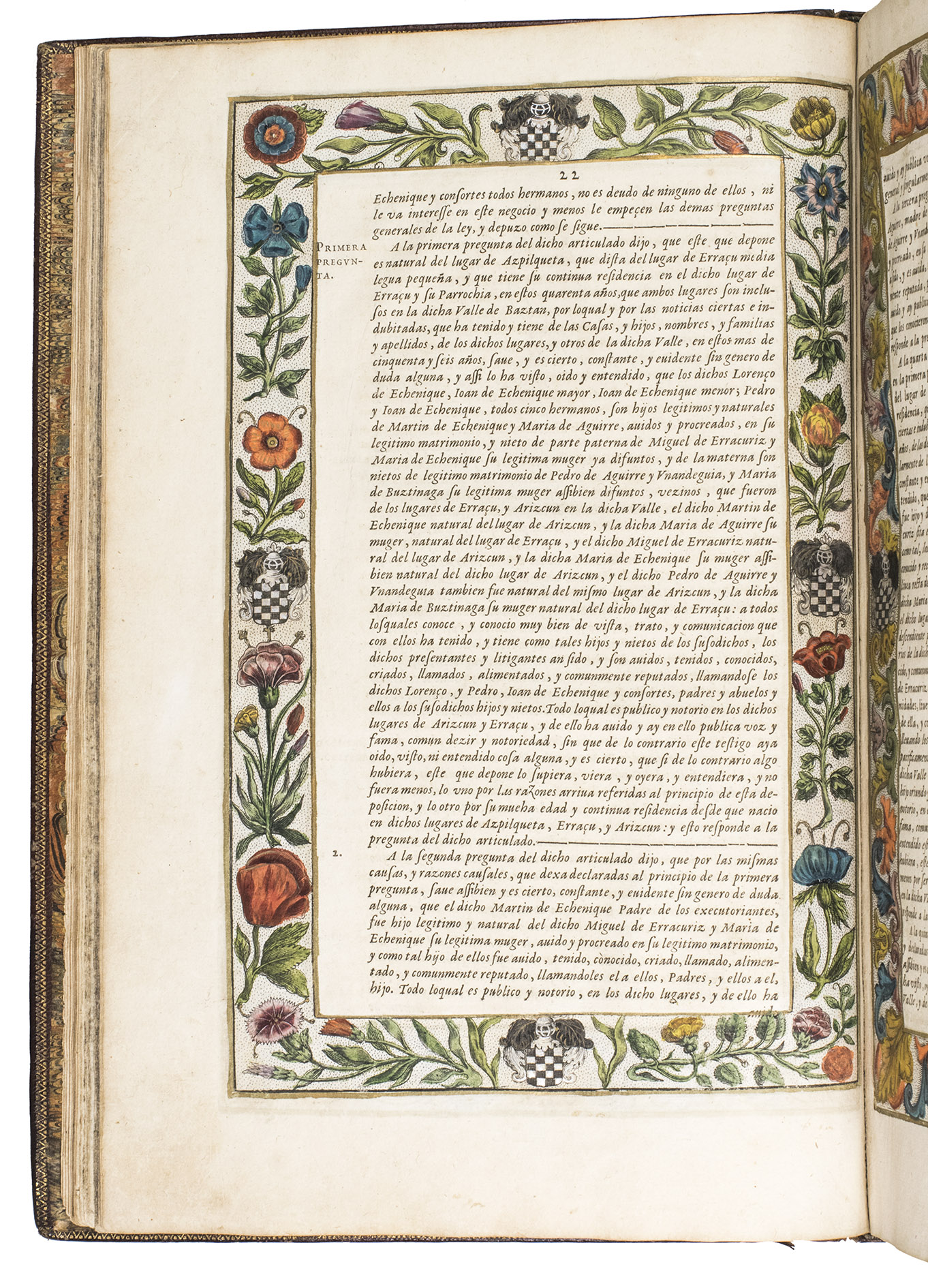
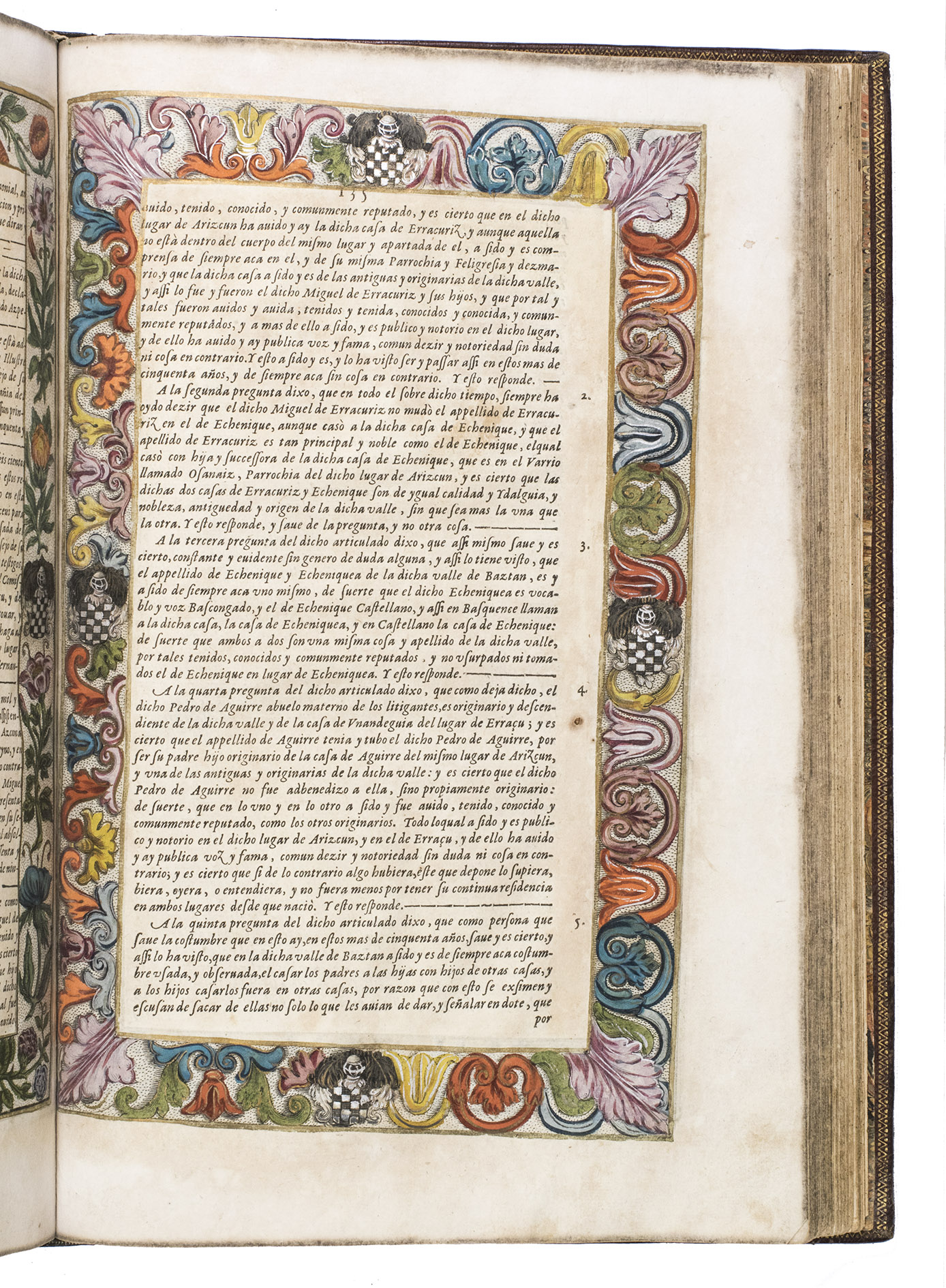
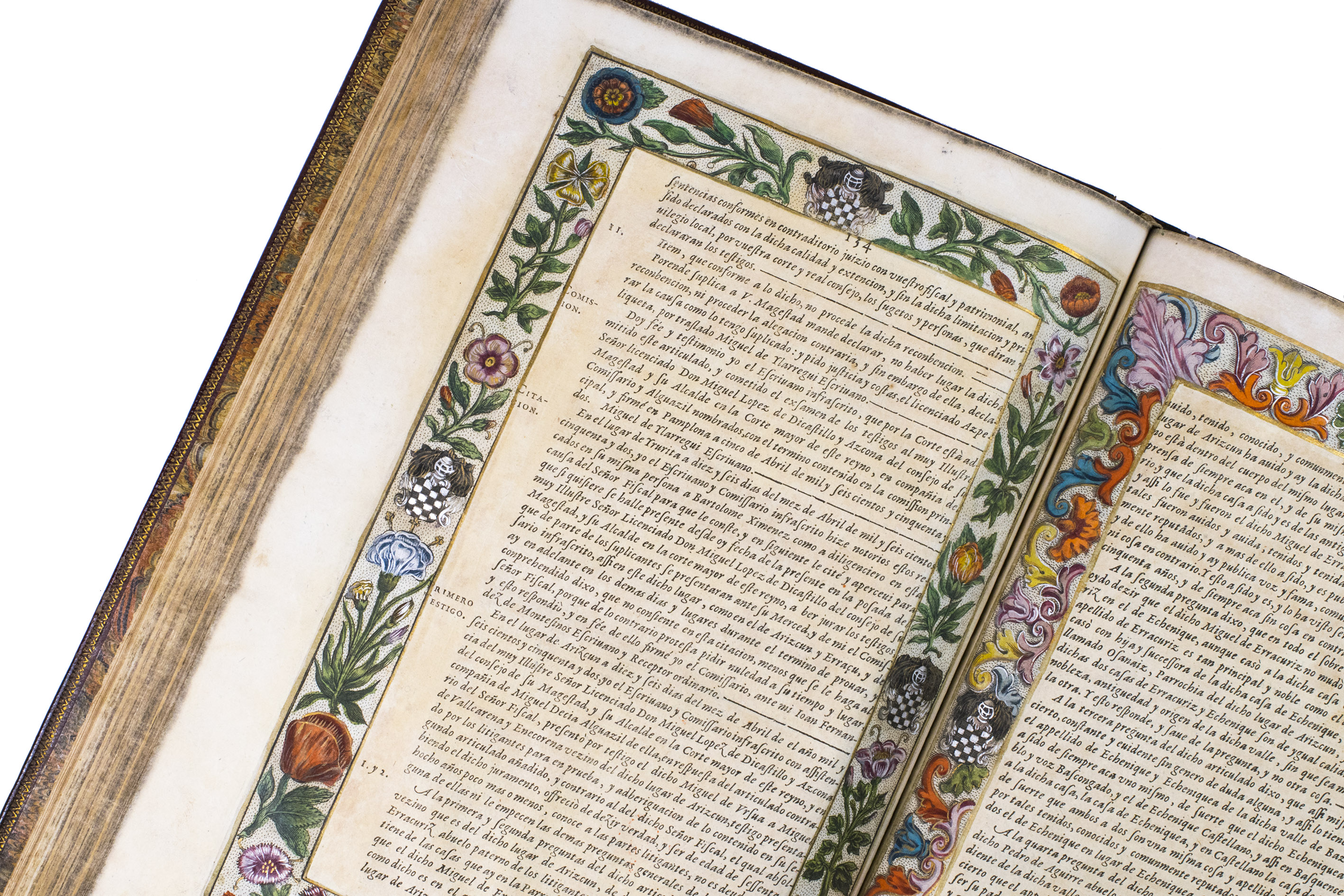
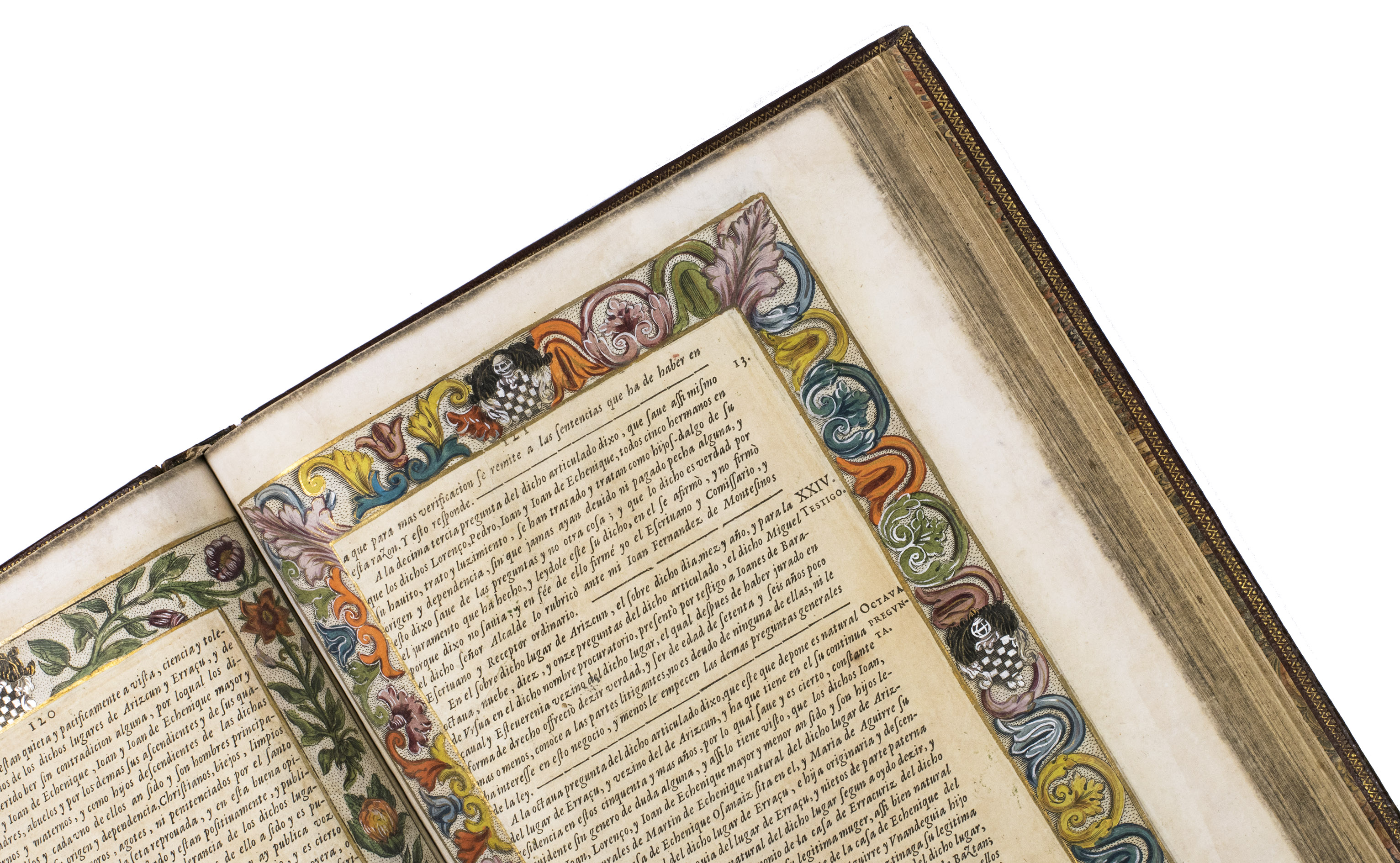
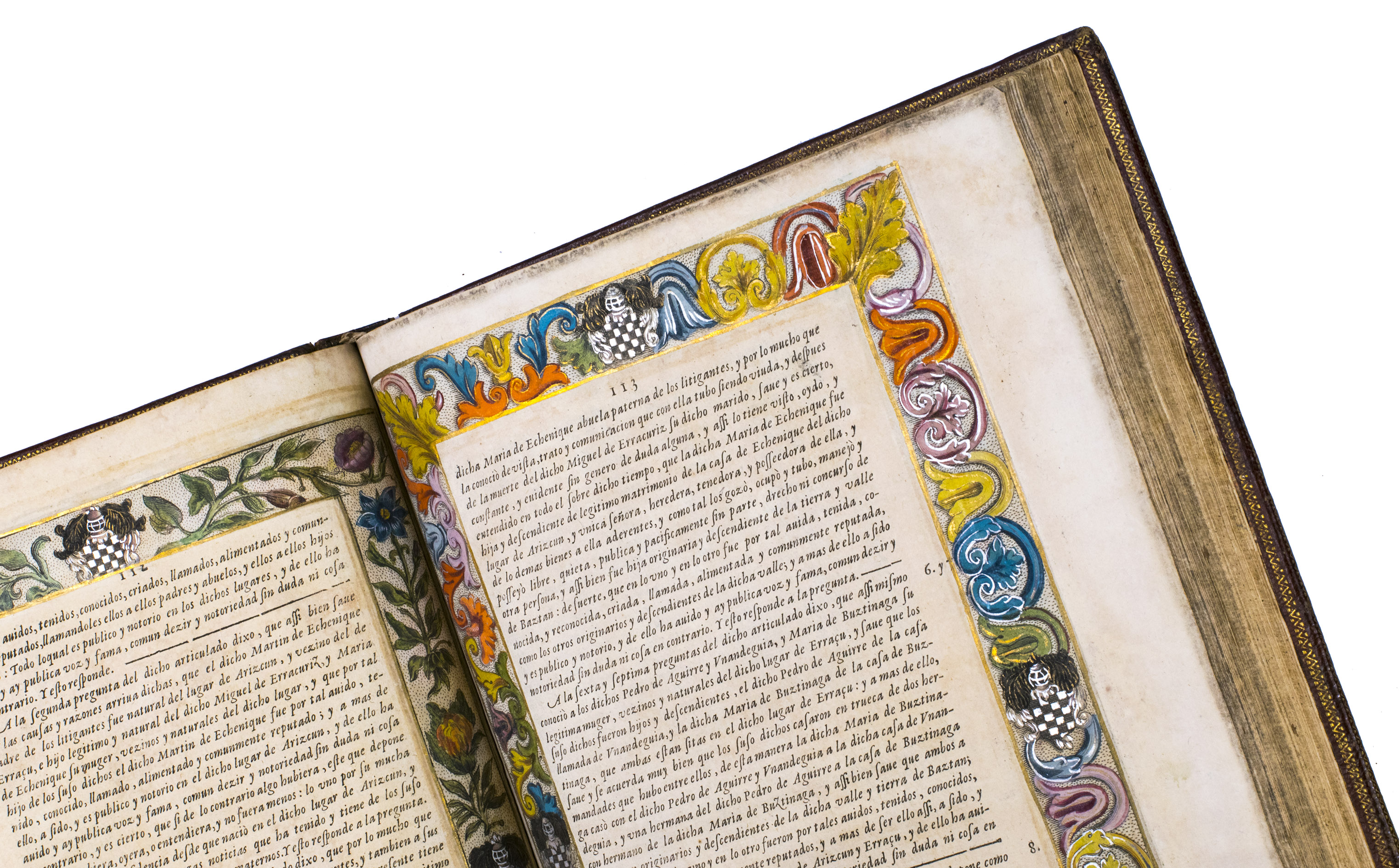
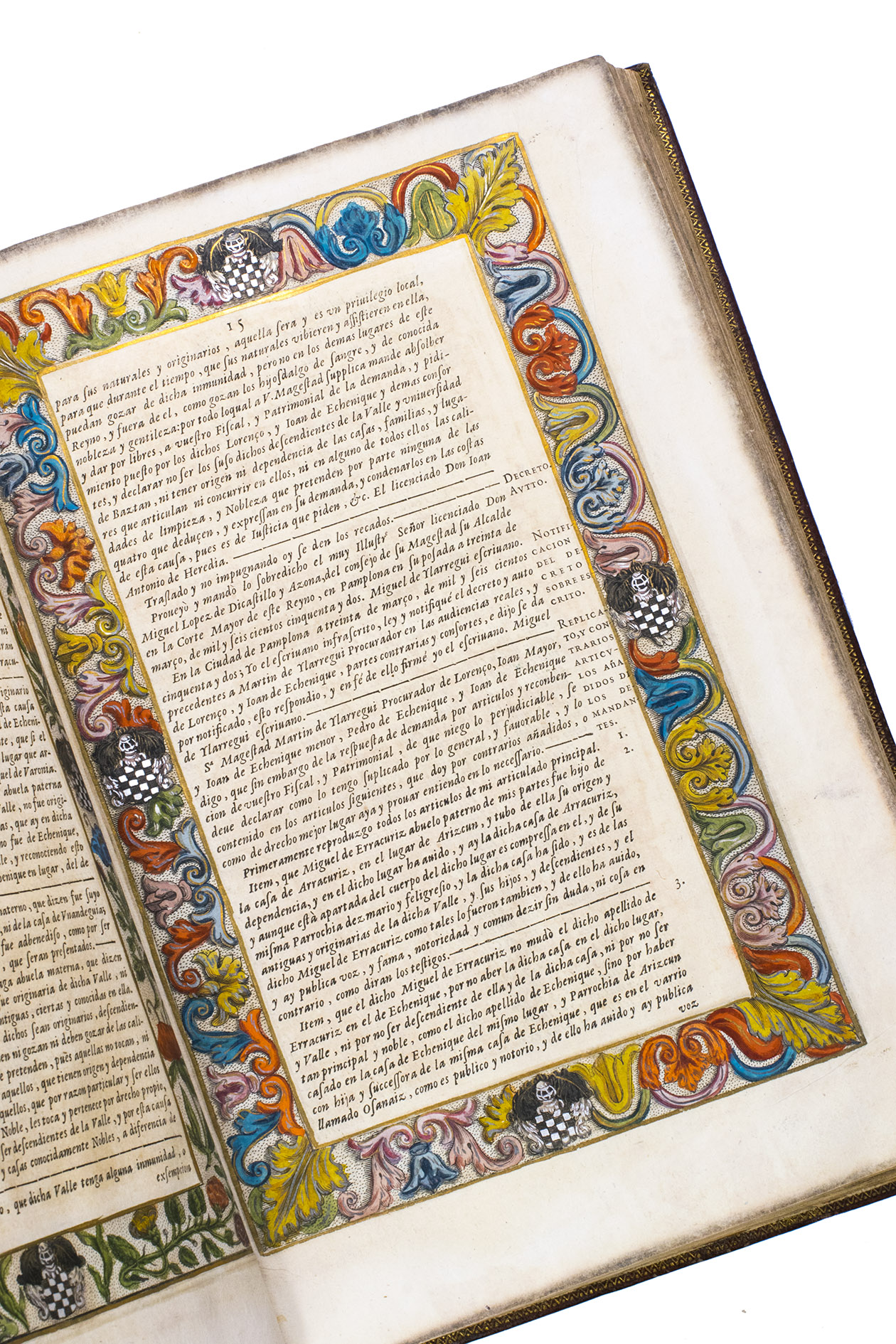
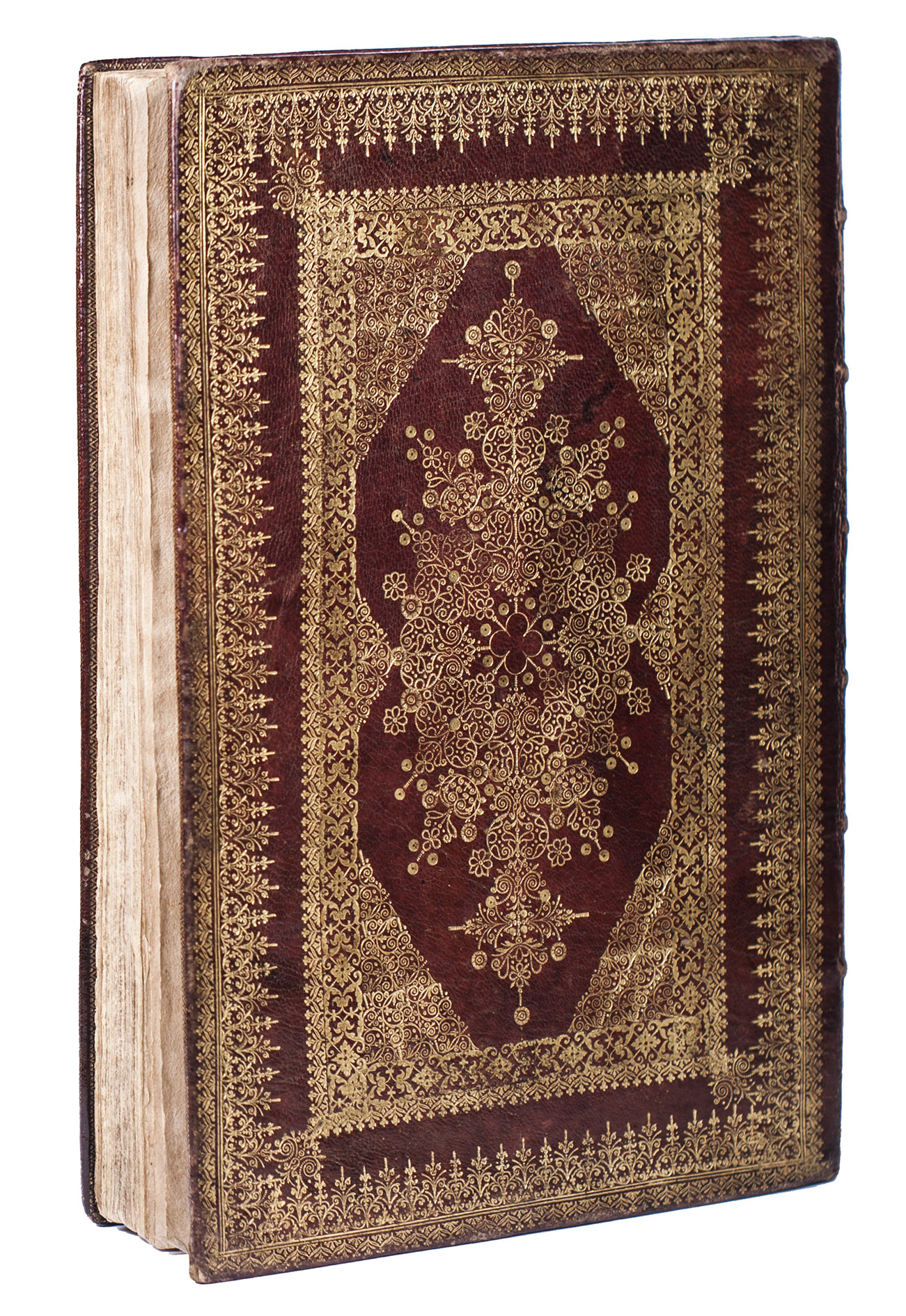
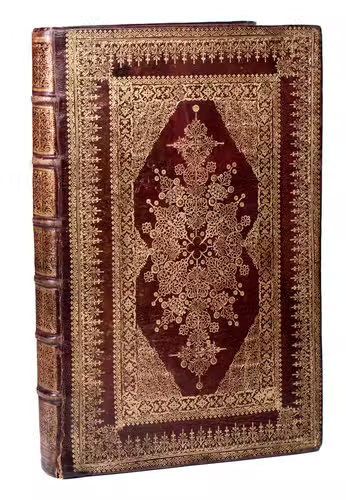
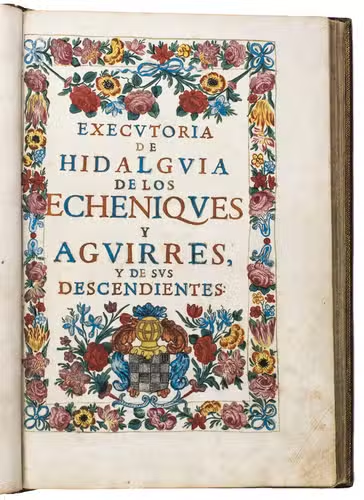
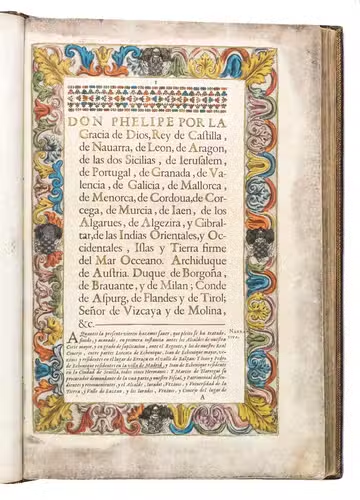
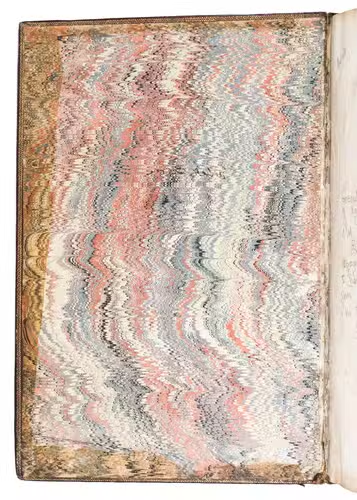
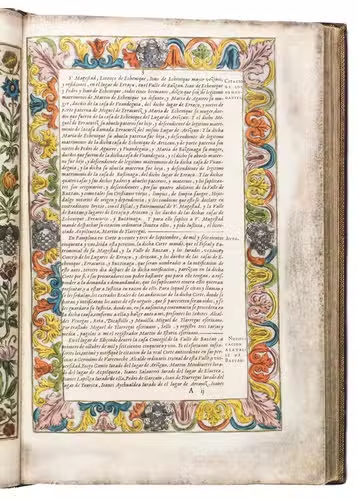
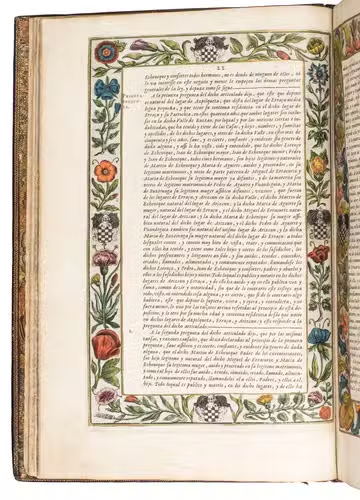
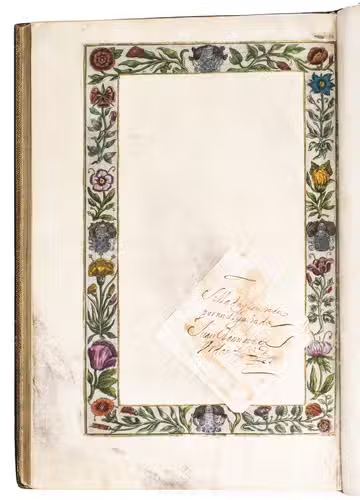
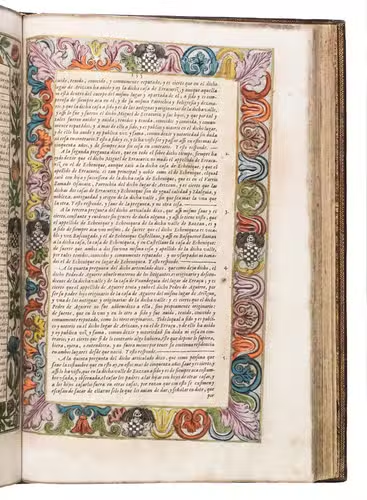
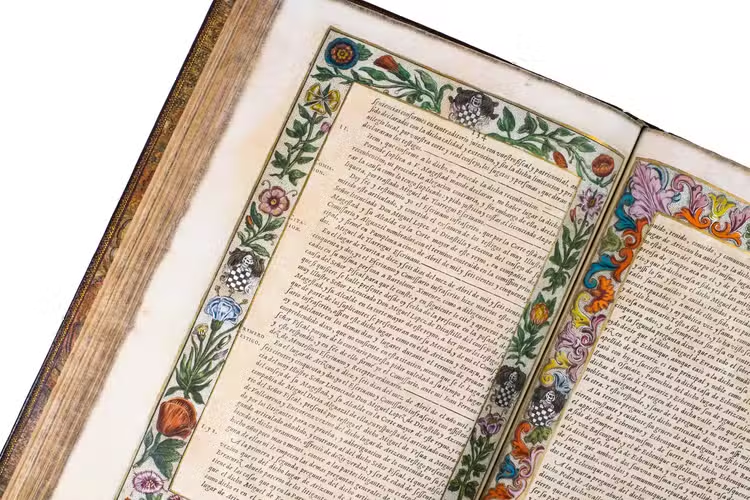
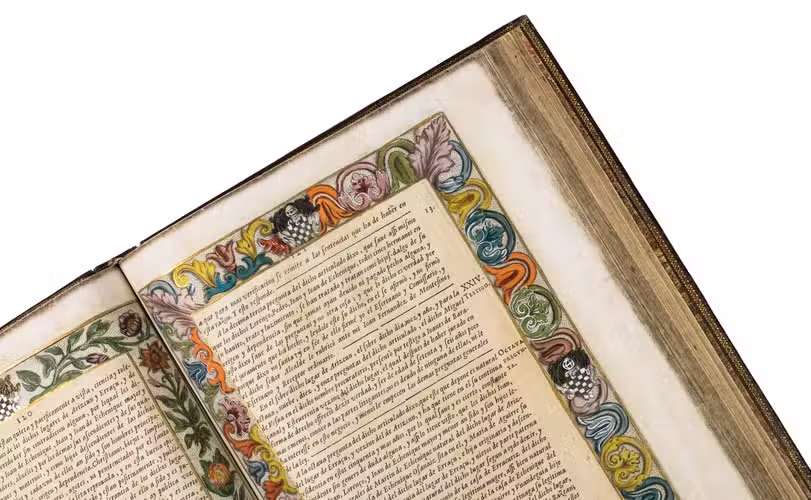
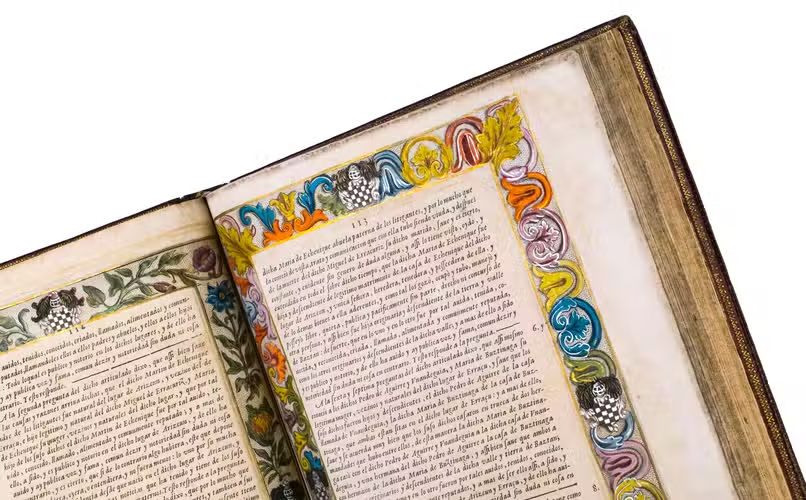
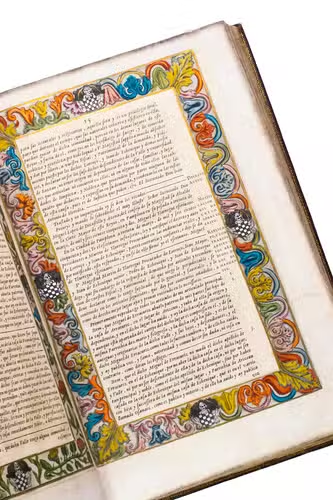
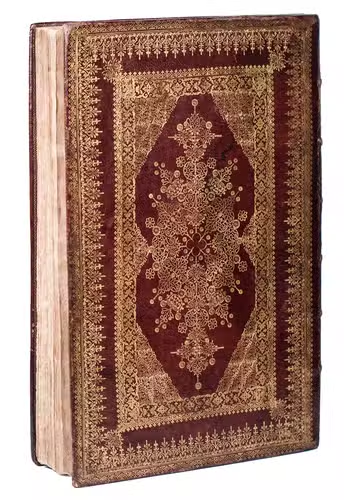
[Spain, 1657-1664?]. Folio. With an elaborately decorated letterpress title page, the letters of the title are highlighted in blue, red, gold, and silver, and are surrounded by a contemporary hand-drawn, hand-coloured, and highlighted in gold and silver floral frame (in the same style as the other floral borders in this work) including equally decorated arms of the Echeniques y Aguirres family. All text is set within woodcut borders incorporating the familys coat of arms, the borders show two different floral designs which are repeated throughout the work. All borders are vividly coloured by a contemporary hand and highlighted in gold and silver. Contemporary elaborately gold-tooled red morocco, sewn on six supports with the corresponding raised bands on the spine, the gold-tooling is built up from numerous impressions of small (pointillé) tools creating a large intricate centrepiece within two detailed frames, gold-tooled board edges and turn-ins, marbled pastedowns, and gilt edges. [24 blank], 232, [2], [24 blank] pp.
€ 15,000
Rare ejecutorias de hidalguía of the Echeniques y Aguirres family. The work is beautifully bound in contemporary richly gold-tooled morocco and it is handsomely decorated throughout with contemporary hand-coloured borders, which are highlighted in gold and silver. Among the most impressive legal artefacts produced in early modern Spain are the ejecutorias de hidalguía, royal documents issued when a family had successfully proven its noble status before the highest courts of the kingdom. These richly ornamented works are far more than dry legal records: they preserve genealogies, heraldic descriptions, testimonies of "limpieza de sangre" (purity of blood), and the voices of neighbours and officials who vouched for a familys lineage. They were the final seal that converted a favourable verdict into a binding, hereditary right. The present work is dated 24 July 1664 and comprising 233 pages. It opens with a hand-painted title page bearing the family arms, and every leaf is bordered with coloured decoration.
The Echenique y Aguirre family originated in Erratzu, a village in the Baztan Valley of Navarre. Martín de Echenique and María de Aguirre, both natives of the valley, were the parents of five sons, Lorenzo, Juan "the elder", Juan, Pedro, and another Juan, whose activities spread across the Iberian Peninsula. From their home region, the brothers established themselves in Madrid, Pamplona, Seville, and elsewhere, forming part of the thriving network of Basque and Navarrese merchants.
In 1659, the brothers petitioned for their heraldic rights to be formally confirmed. The Rey de Armas, Bernardo de Fonseca y Pinto, issued an official grant, later certified by herald Rodrigo Méndez Silva, combining elements from the Errazuriz, Echenique and Aguirre lineages. The resulting arms featured the iconic black-and-white chequered pattern of the Baztan Valley, enhanced with chevrons, gold fields and coloured bands. Although later heraldists noted that this composition was more elaborate than the traditional local arms, such embellishment was typical of mid-17th-century grants, where royal heralds often produced grander shields at the clients request. By royal order, the five brothers were authorised to use these arms freely on seals, rings, chapels, tombs and household objects, in this work, the arms are displayed on every leaf.
It records the full proceedings of the lengthy trial brought before the kingdoms senior judiciary. It opens with the royal heading of King Philip IV, followed by the legal narrative of the case heard first by the mayors of the High Court, then by the Regents and the Royal Council.
The opposing party was none other than the municipal authorities of the Tierra y Valle de Baztán, who challenged the brothers claim. The result, preserved in this volume, was a firm royal recognition of the Echenique y Aguirre lineage as noble in perpetuity.
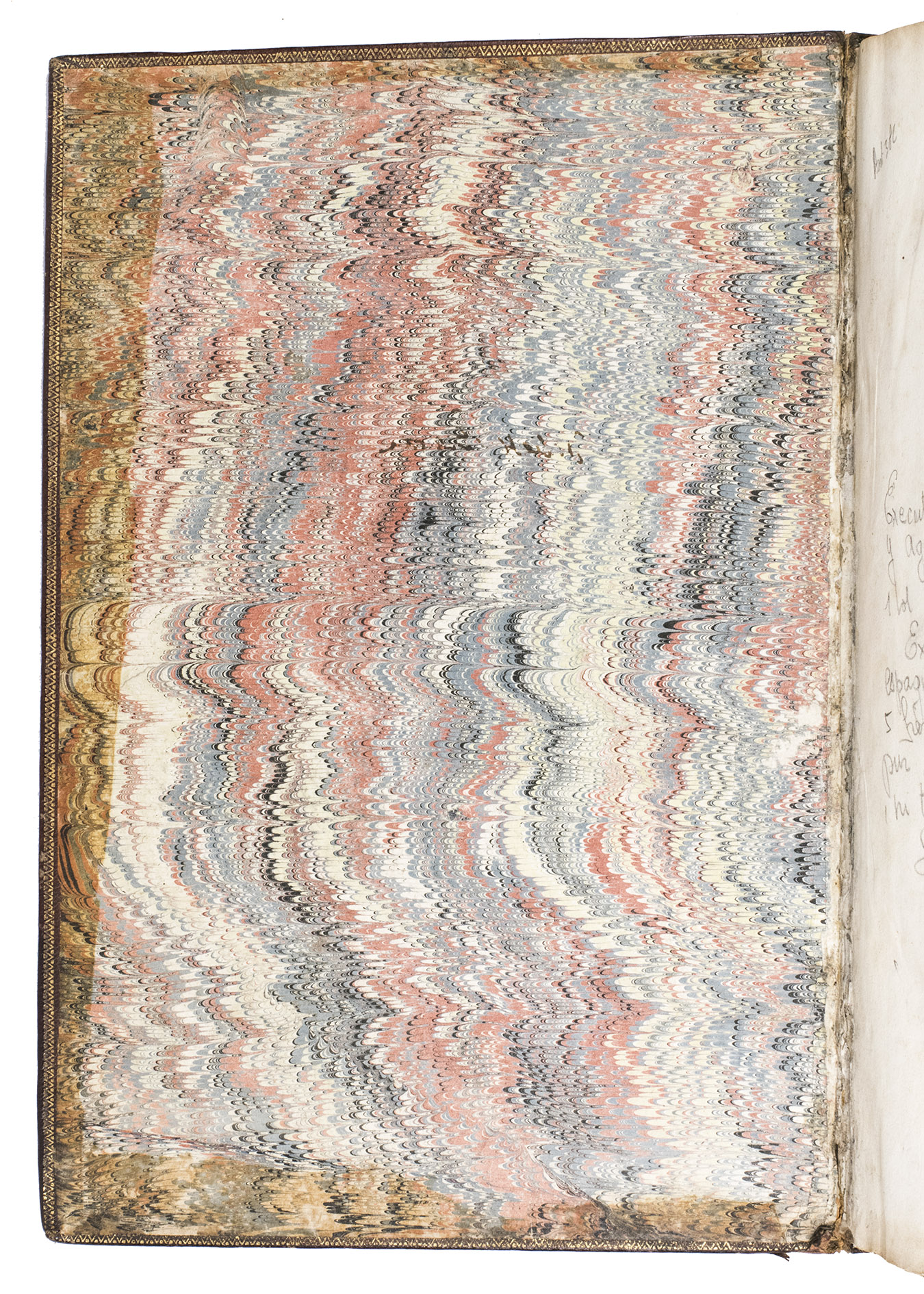
The present work is bound in sumptuous contemporary red morocco, its boards covered with intricate gold tooling arranged in the refined pointillé and "a petit fers" French-inspired style of the second half of the 17th-century. The tooling is reminiscent of the work of celebrated French and Dutch binders like le Gascon (only known by this nickname), Florimond Badier, and Albert Magnus.
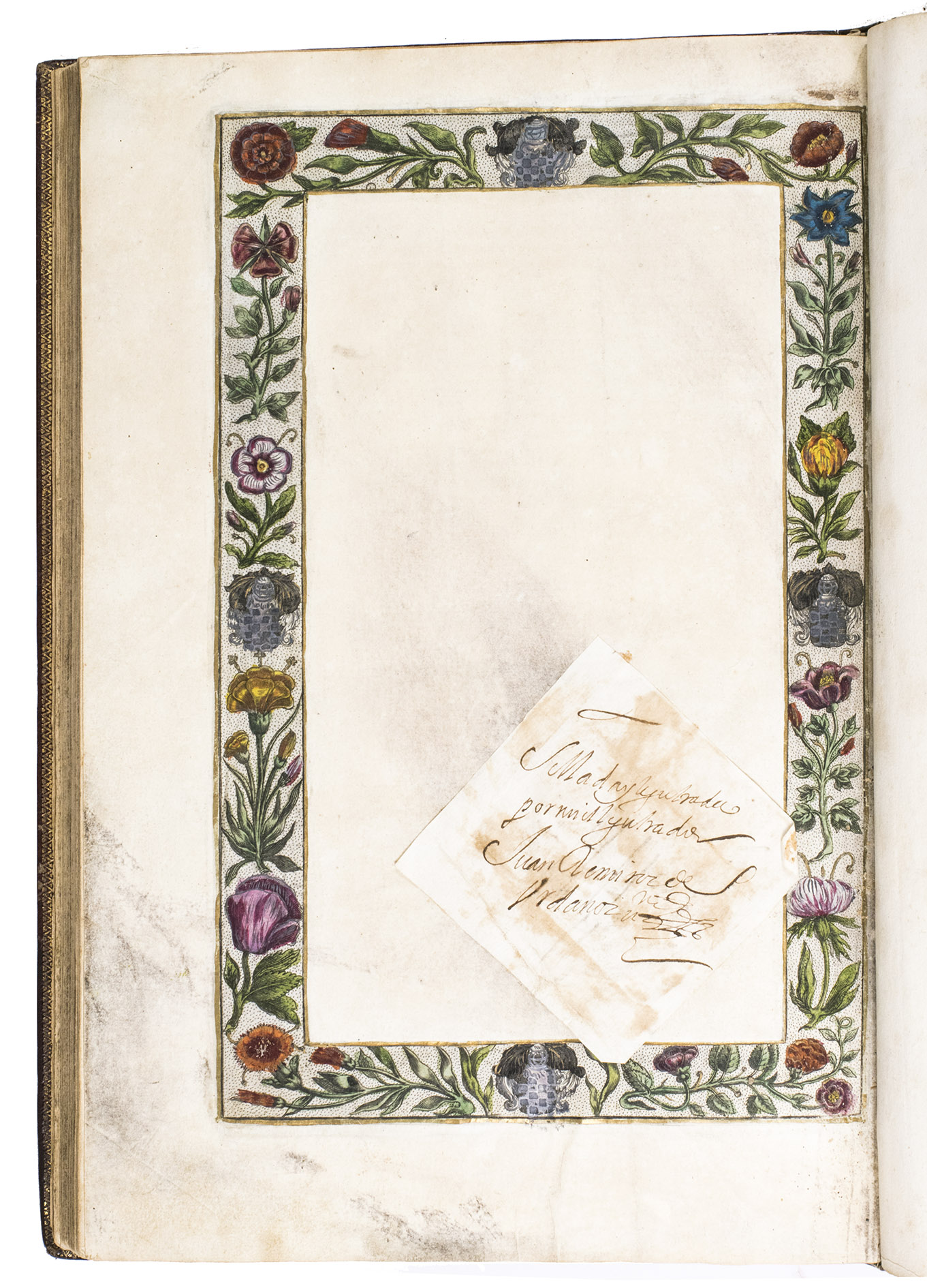
With a later pencil annotation on the first flyleaf providing a brief bibliographical or descriptive note about the content and significance of the work and stating the year 1657. Pages 232-233 bear the date 24 July 1664, along with the signatures of the royal authorities and members of the Echeniques y Aguirres family, page 233 includes a large royal blind stamp,its verso is covered by a separate piece of paper, with a manuscript note presumably by the official issuing the stamp, signed by a certain Juan. The front hinge is slightly damaged at the foot of the spine, some browning and staining throughout. Otherwise in good condition. Google Arts & Culture, Las ejecutorías de hidalguía; Il congreso de estudios vascos 324; Máximo Diago Hernando, "Los hombres de negocios navarros en el Madrid de mediados del siglo xvii: los Echenique del valle de Baztan", Principe de Viana 274, (May-August 2019), pp. 925-950.
Related Subjects: