[VLAMINGH, Willem de (subject); Mandrop TORST (attributed)].
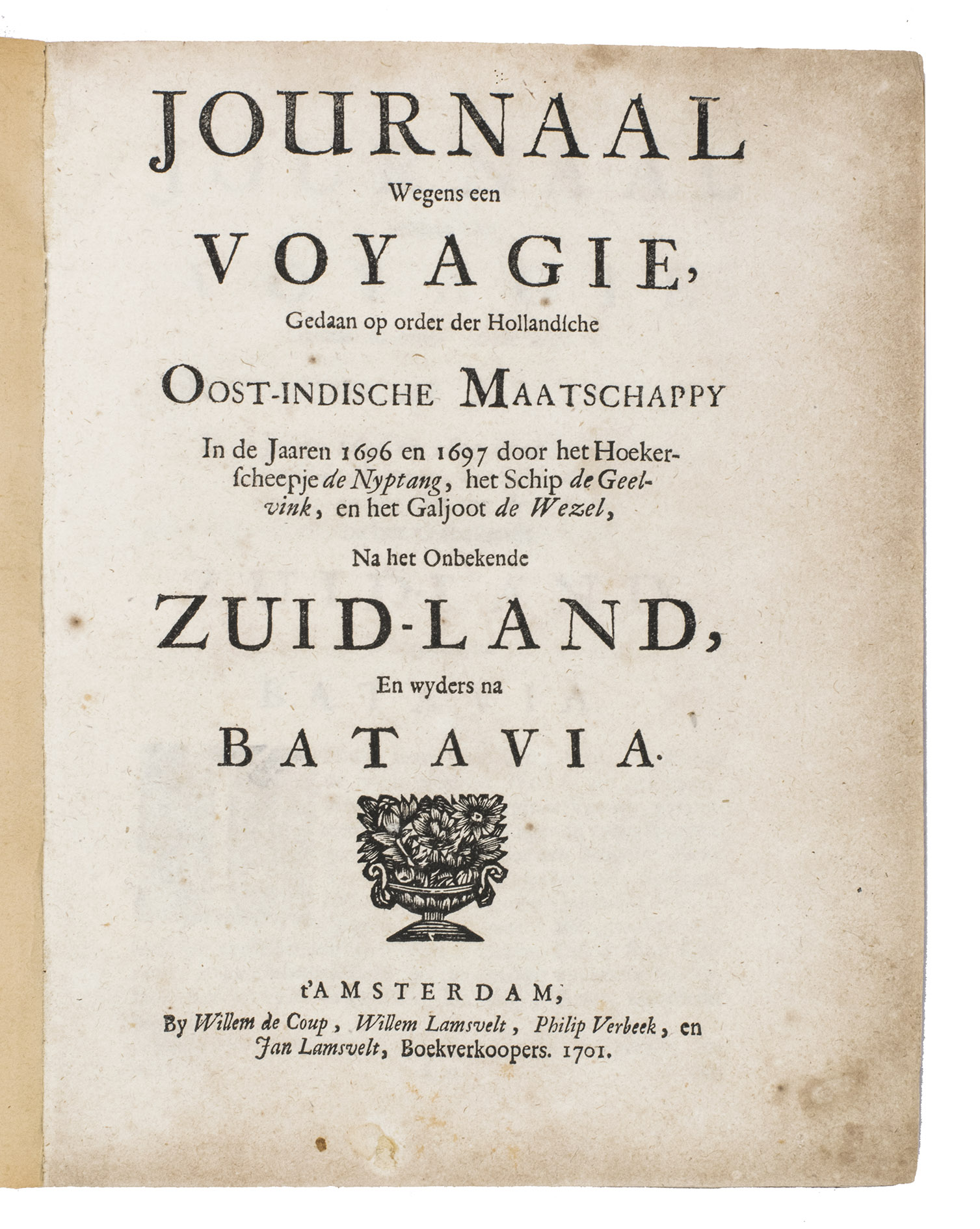
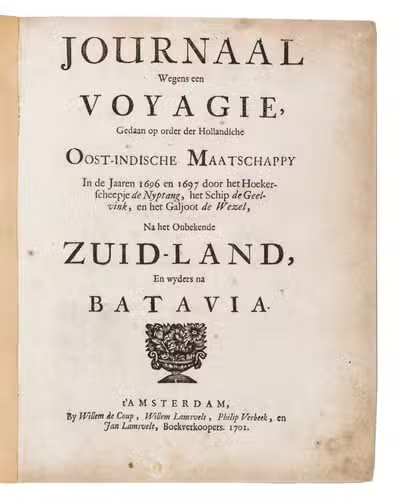
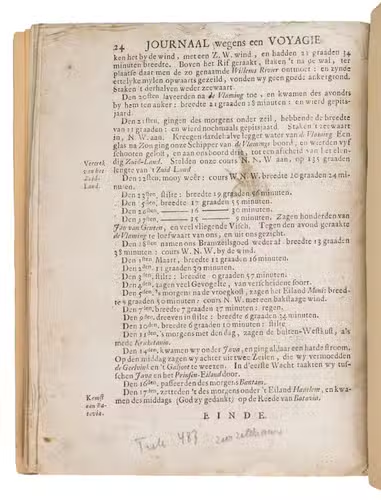
Journaal wegens een voyagie, gedaan op order der Hollandsche Oost-Indische Maatschappy in de jaaren 1696 en 1697 ...
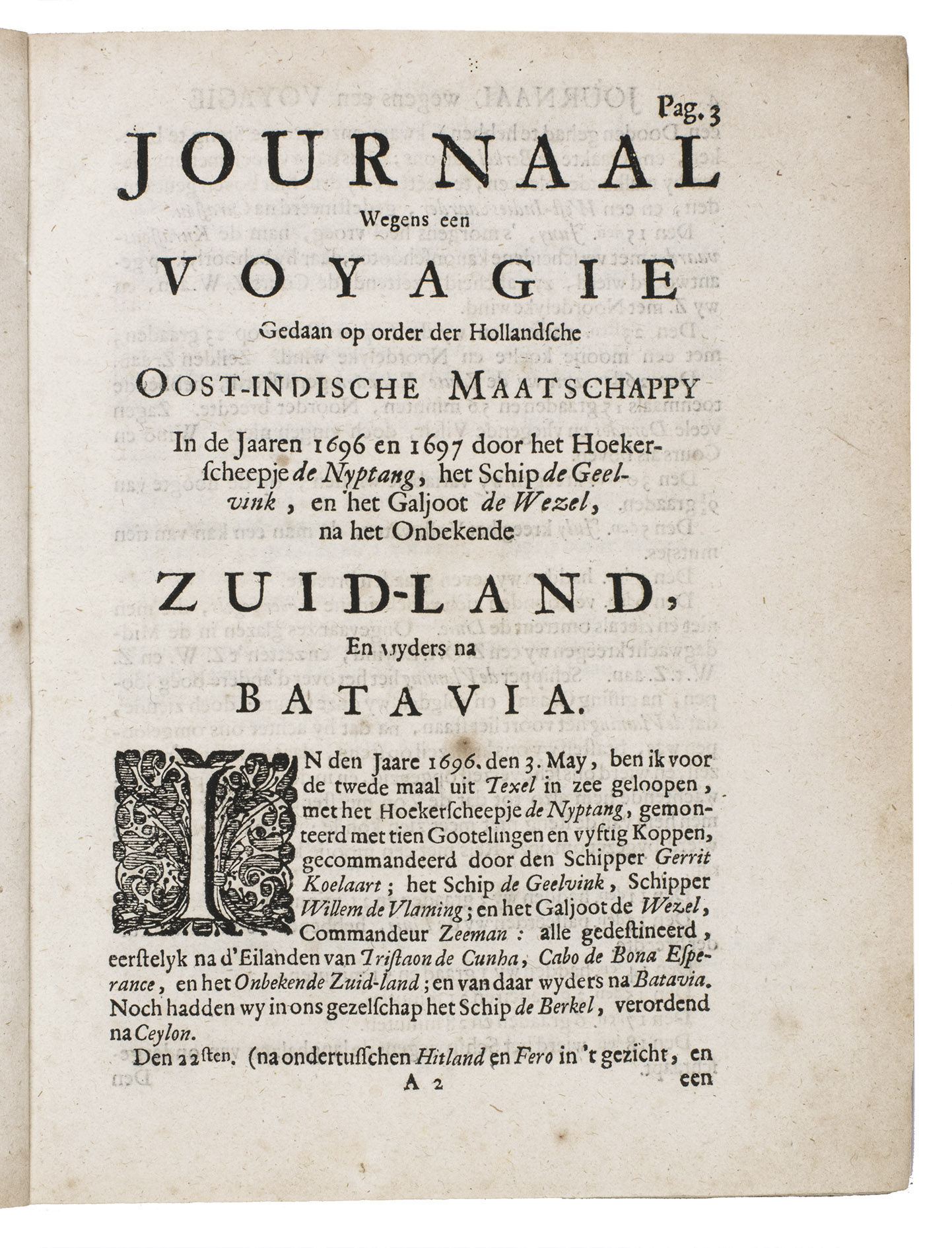
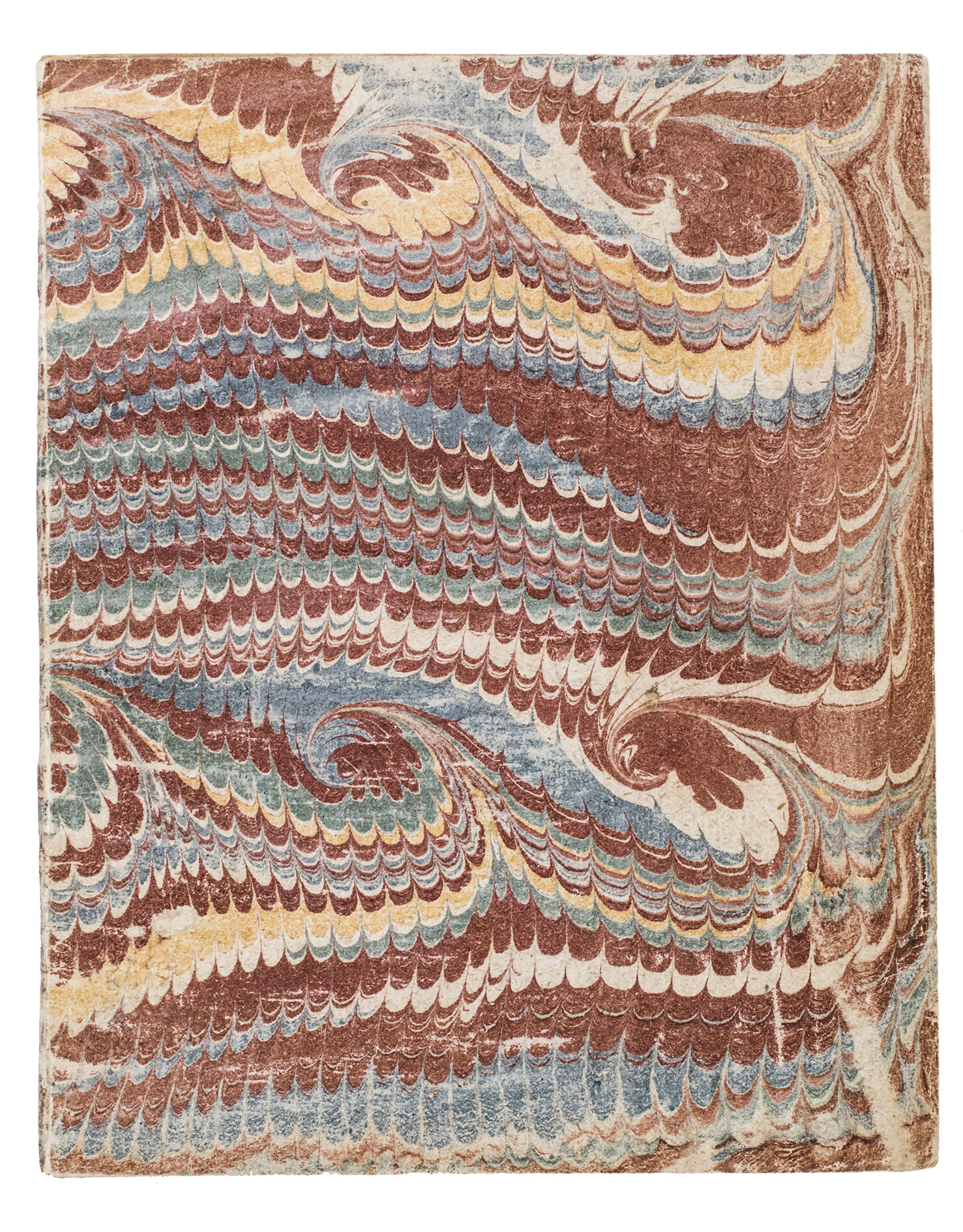
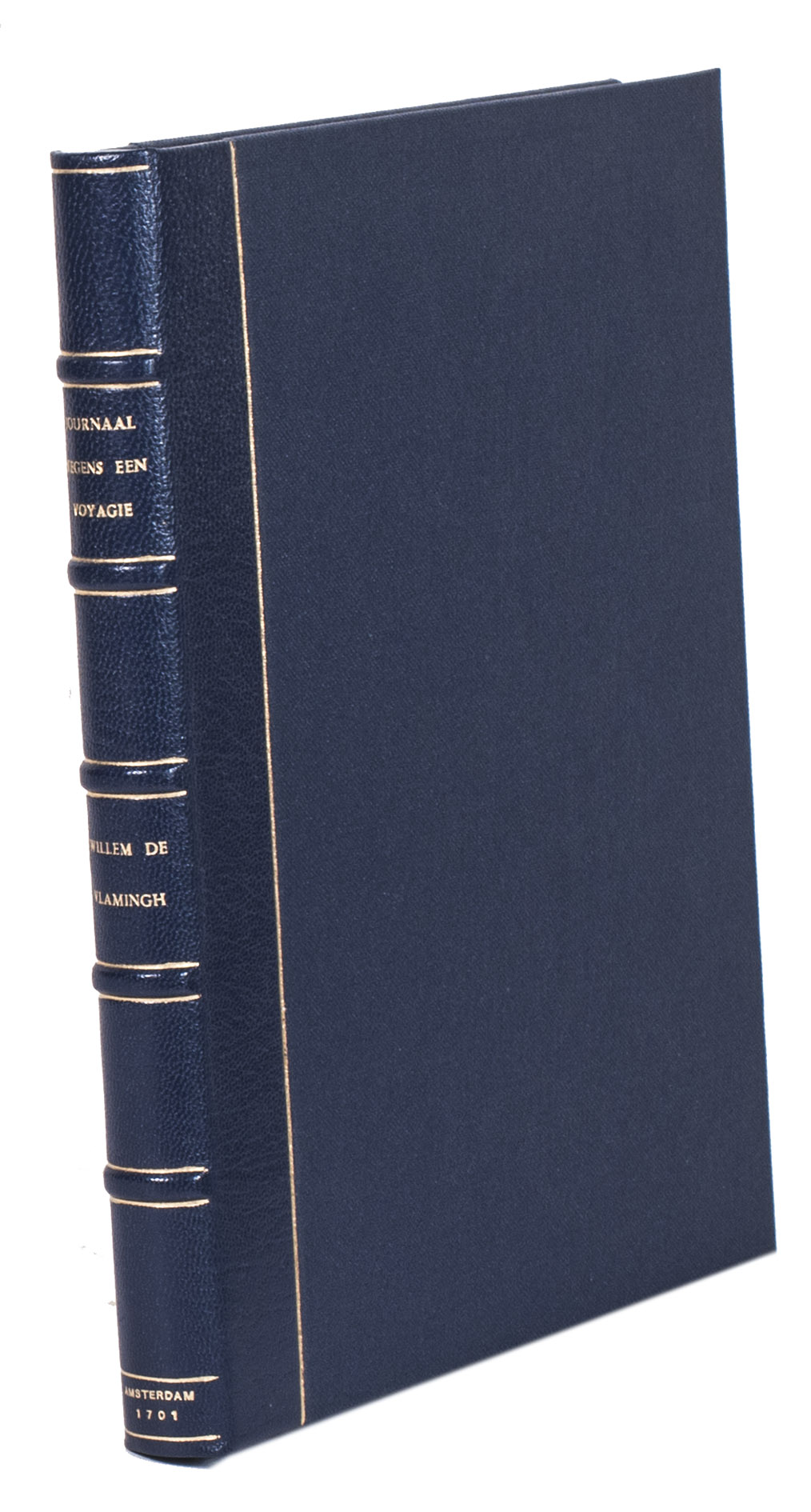
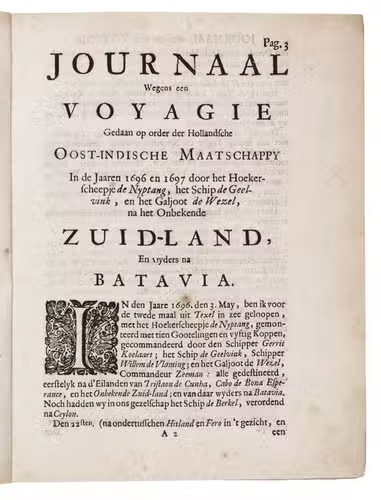
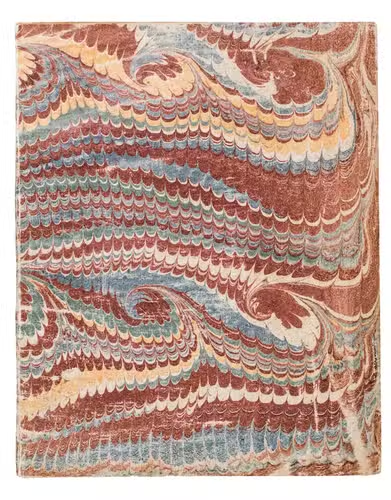
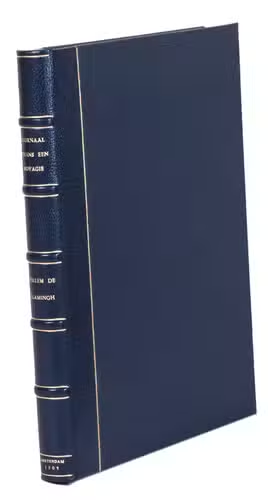
Amsterdam, Willem de Coup, Willem Lamsvelt, Philip Verbeek, and Jan Lamsvelt, 1701. Small 4to. With a small woodcut vignette on the title page and one woodcut decorated initial at the start of the text. 18th-century marbled wrappers, later endpapers, kept in a gold-tooled quarter blue morocco and blue cloth custom box, with the title lettered in gold on the spine. 24 pp.
€ 550,000
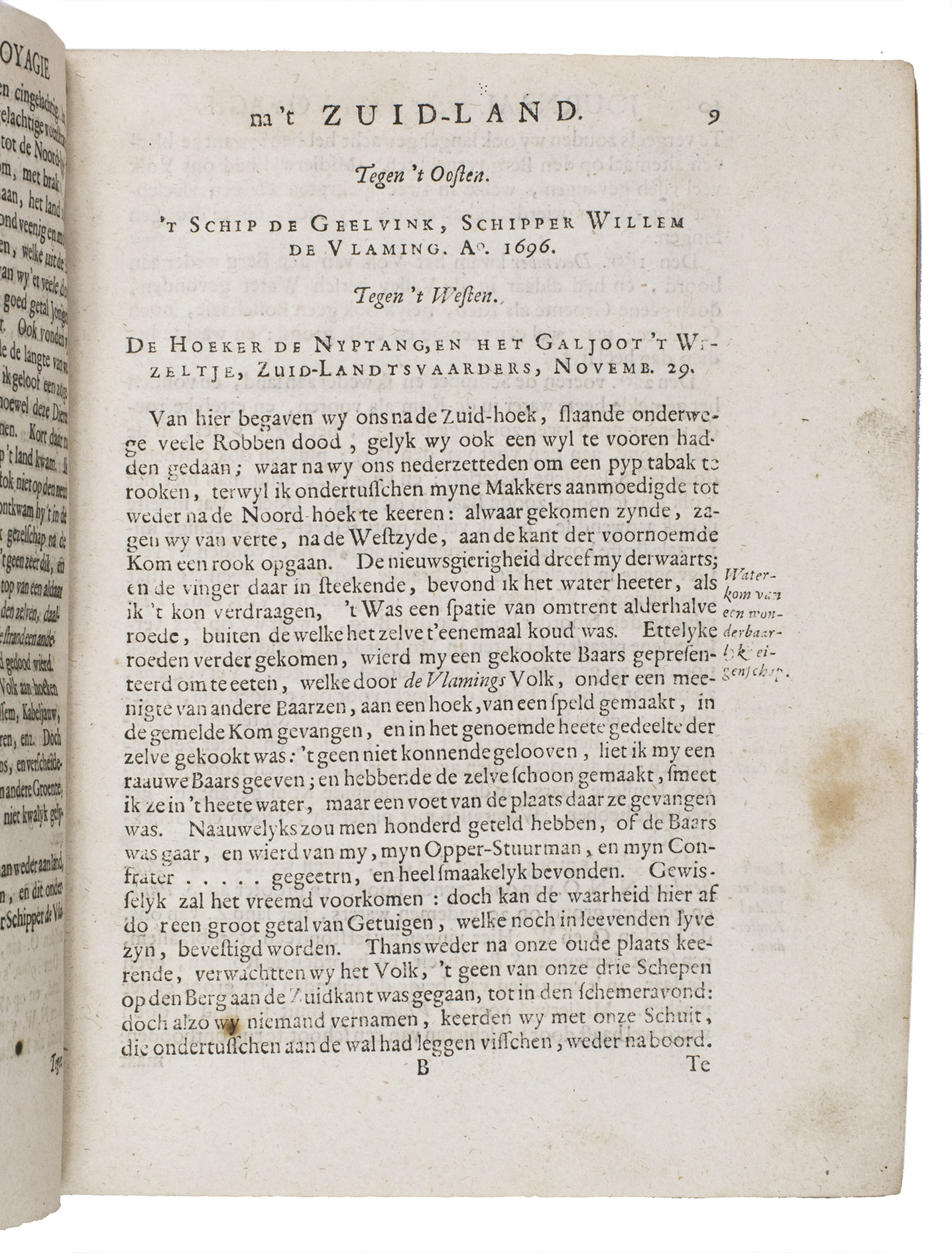
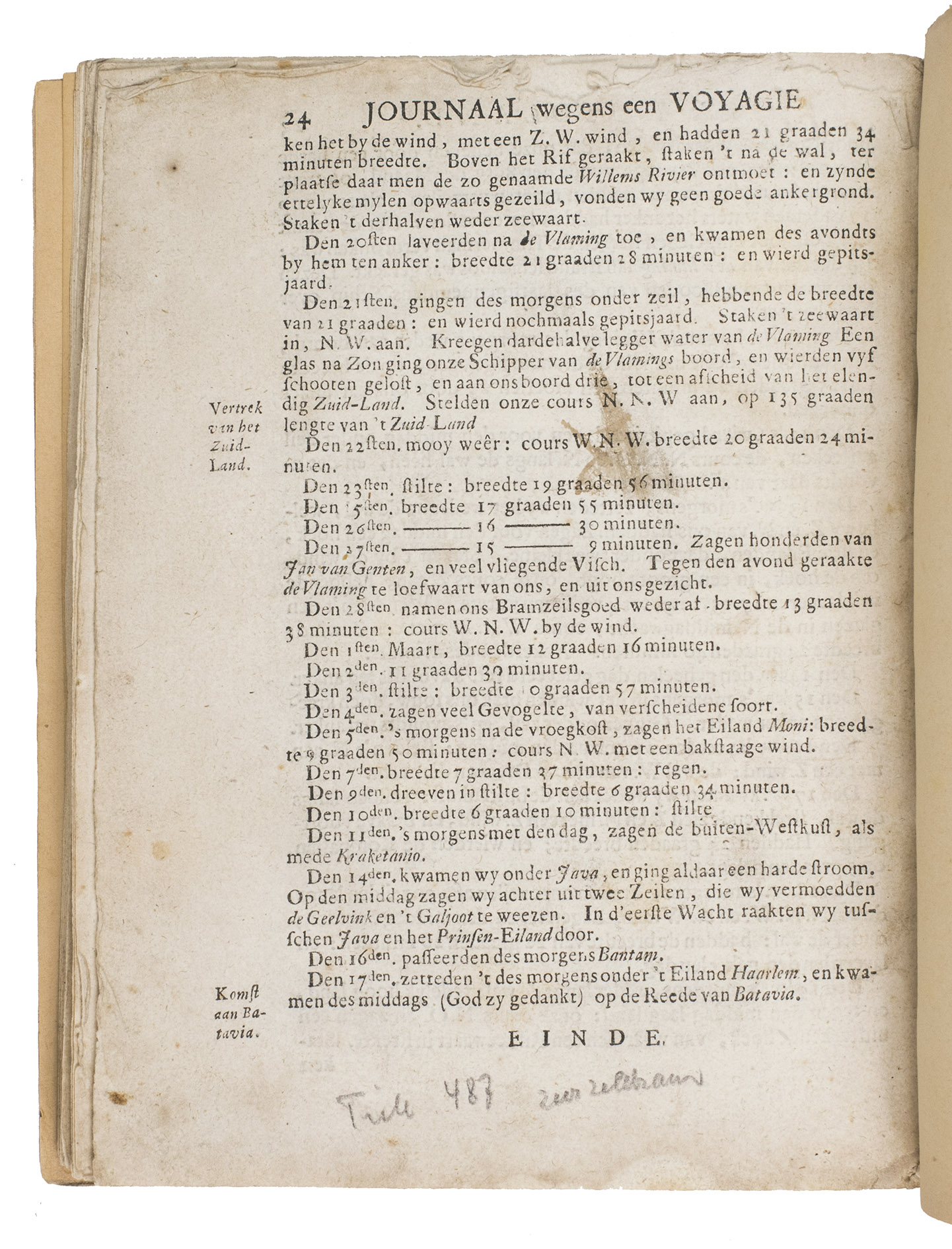
A first edition of extraordinary rarity: the only contemporary published account of Willem de Vlaminghs 1696-1697 expedition to the west coast of New Holland (the name for Australia from ca. 1644 until the mid-1850s) - marking the final major Dutch voyage of discovery in Australian waters.
After Dutch exploratory efforts waned following the death of Governor-General Anthonie van Diemen in 1645, interest in the commercial and scientific potential of New Holland persisted. Influential VOC director Nicolaes Witsen successfully lobbied for this renewed voyage - remarkably, the first Dutch mission to intentionally explore the western coast of Australia.
Led by experienced VOC commander Willem de Vlamingh, the expedition of nearly 200 men aboard three ships (the Geelvinck, Nijptangh, and Wezeltje) departed from Texel, arriving at Rottnest Island in December 1696. Over the following six weeks, the expedition extensively explored and charted nearly 1500 kilometres of previously unexamined coastline, including the Swan River, Jurien Bay, Gantheaume Bay, and Dirk Hartog Island. Despite frequent evidence of Aboriginal habitation, no direct contact was made.
At Dirk Hartog Island, Vlamingh famously replaced Hartogs 1616 pewter plate with one of his own, commemorating both voyages. His plate was later taken to France by Freycinet and eventually returned to Western Australia in 1940.
Despite its remarkable hydrographical achievements, the expedition was dismissed by VOC officials as a failure - deemed to offer "no people, no riches, no promise." Disheartened, Vlamingh disappeared from the historical record shortly after returning to Batavia.
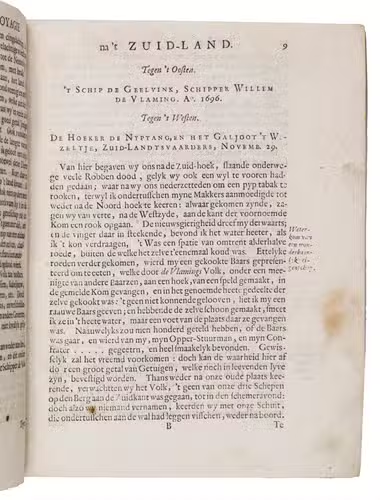
The only known contemporary account of the voyage is this slender 1701 publication. Based on extensive research by Gunter Schilder, the author has been identified as Mandrop Torst, upper-surgeon aboard the Nijptangh. Unlike Vlaminghs formal log, Torsts narrative is rich with scientific observation, personal insight, and descriptive detail - he participated in many landings and enthusiastically recorded natural specimens and inland discoveries.
The texts survival is remarkable: the book was not widely distributed and is now one of the great rarities of Australiana. Often found bound with fictional voyage accounts by Vairasse dAllais and Foigny, it sometimes appears under the collective title Beschryving van t onbekende Zuyd-land. P.A. Leupe referenced it as early as 1856 but admitted he had never seen a copy.
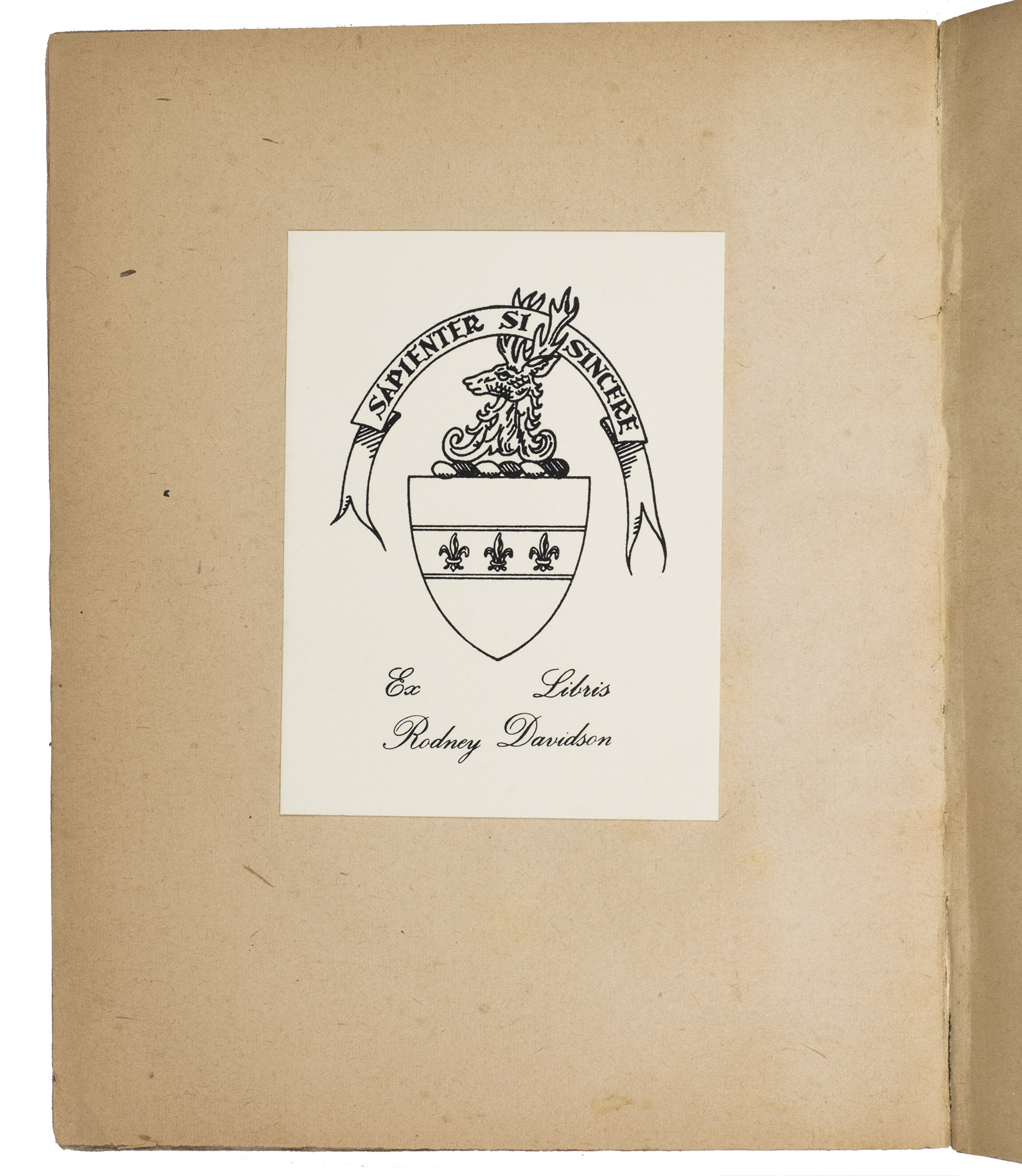
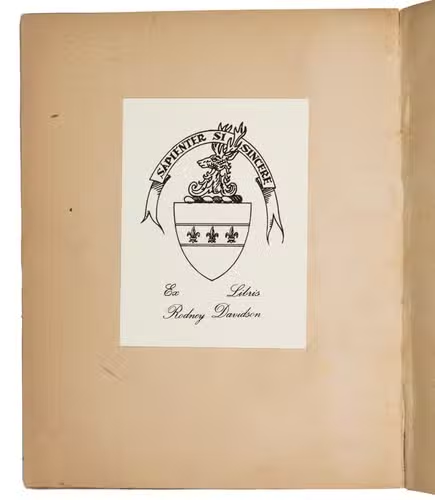
With the large ex libris book plate of Rodney Davidson on the verso of the first flyleaf. The marbled wrappers are slightly rubbed, with two small worm holes in the upper outer corner of the front wrapper. The edges of the title page are slightly browned, some minor foxing and staining throughout, the edges of the last two leaves are slightly frayed. Otherwise in good condition. A foundational and virtually unobtainable work in the history of Australian exploration. Australian Book Auctions, The Davidson Collection, 24; Landwehr VOC 373; Tiele, Land- en Volkenkunde, 487; STCN 170299481 (5 copies); WorldCat 562698113, 65697771, 1154666728 (14 copies, incl. 3 also in the STCN).
Related Subjects: