[TREASURY OF FINANCE - RIO GRANDE DO SUL].
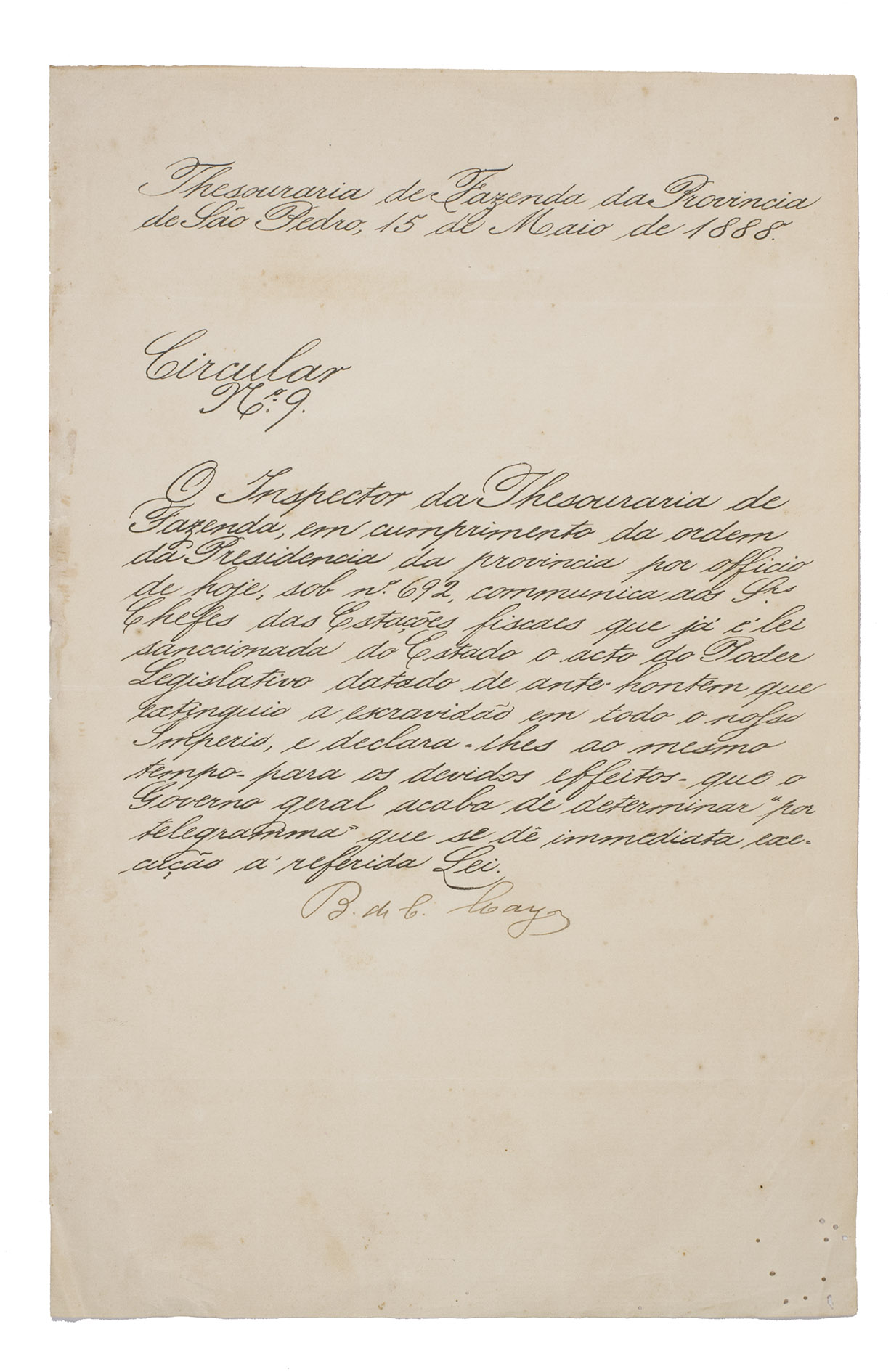
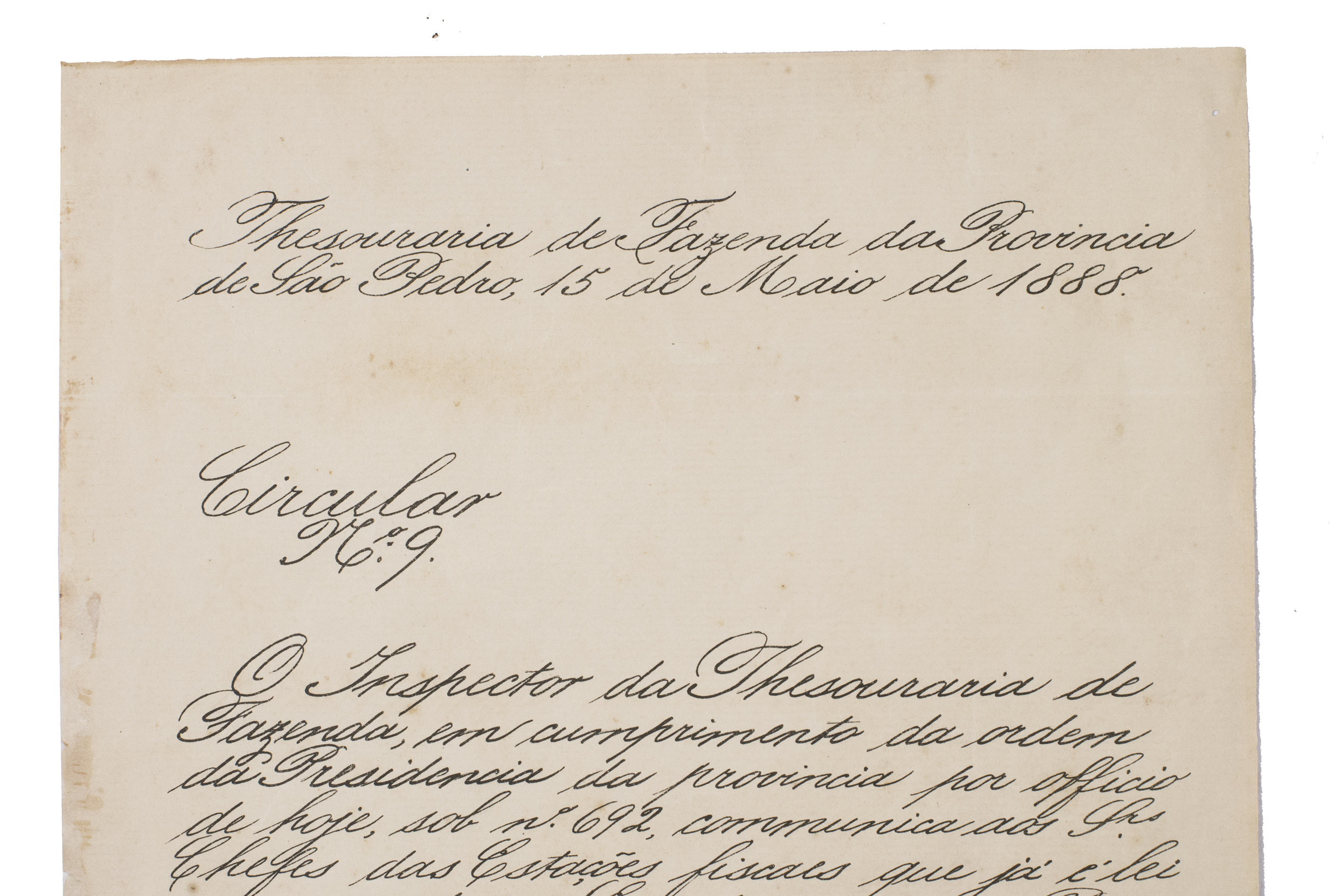
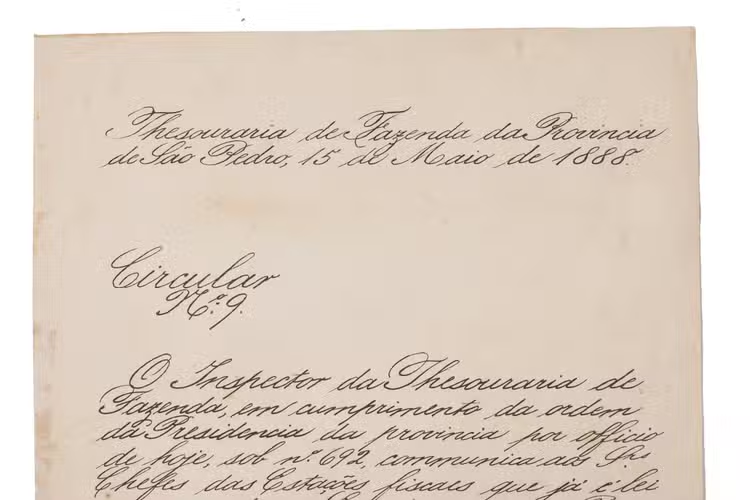
[Official circular by the Treasury of Finance of the Brazilian province Saõ Pedro (now Rio Grande do Sul)]. [drop title:] Thesouraria de Fazenda da Provincia de Saõ Pedro, 15 de Maio de 1888. Circular No: 9.
[Brazil], May 15 1888. 32.9 x 21.2 cm. [1], [1 blank] pp.
€ 2,950
Rare official record, dated 15 May 1888, by the Treasury of Finance of the southern Brazilian province now known as Rio Grande do Sul. It stands as a remarkable administrative witness to one of the most decisive moments in Atlantic history: the abolition of slavery in Brazil.
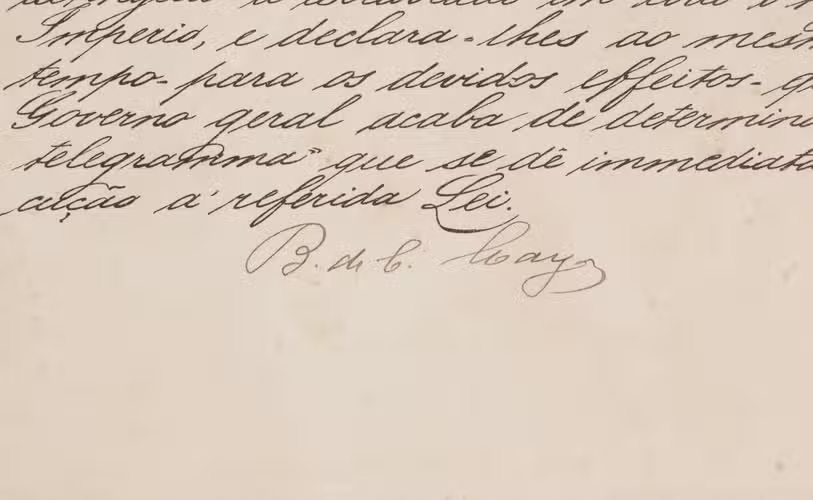
Written a mere two days after the signing of the Lei Áurea (Golden Law) on 13 May 1888, the document was circulated to local administrative boards known as the Mesas das Estradas Reais. Its purpose was both declarative and imperative: to formally announce that slavery had been abolished throughout the Brazilian Empire, and to instruct provincial authorities that the law was to be enforced immediately and without exception.
The present work records that the President of the Province had sanctioned the law following its approval by the Imperial Legislative Assembly, and further notes that the National Treasury in Rio de Janeiro had already transmitted a telegraphic order demanding instant compliance. The language reflects the urgency of the moment and the unprecedented coordination between imperial and provincial institutions, underscoring the governments determination to ensure that abolition was not merely symbolic, but swiftly implemented across the countrys vast territory.
By the late 19th century, slavery in Brazil had been steadily eroded by incremental legislation. The Law of the Free Womb (1871) and the Sexagenarian Law (1885) had already weakened the institution, yet full abolition was repeatedly delayed by political resistance. It was only under the second regency of Princess Isabel (1891-1921), daughter of Emperor Pedro II, that the final step was taken. Appointing a new cabinet willing to act decisively, she oversaw the passage of the Golden Law in just 7 days. Comprising only two brief articles, the law abolished slavery outright and revoked all contrary provisions.
Public celebrations followed, with work suspended and crowds gathering in jubilation. Yet, beneath this atmosphere lay profound tensions. Brazil was the last country in the Western Hemisphere to abolish slavery, and emancipation came without compensation, land, or social support for the formerly enslaved. The imperial regime itself would collapse less than 18 months later.
Against this backdrop, the present work acquires exceptional historical significance. It offers first-hand insight into the bureaucratic mechanisms through which emancipation was communicated and enforced at the provincial level, capturing the exact moment when centuries of legalised slavery gave way to freedom by decree.
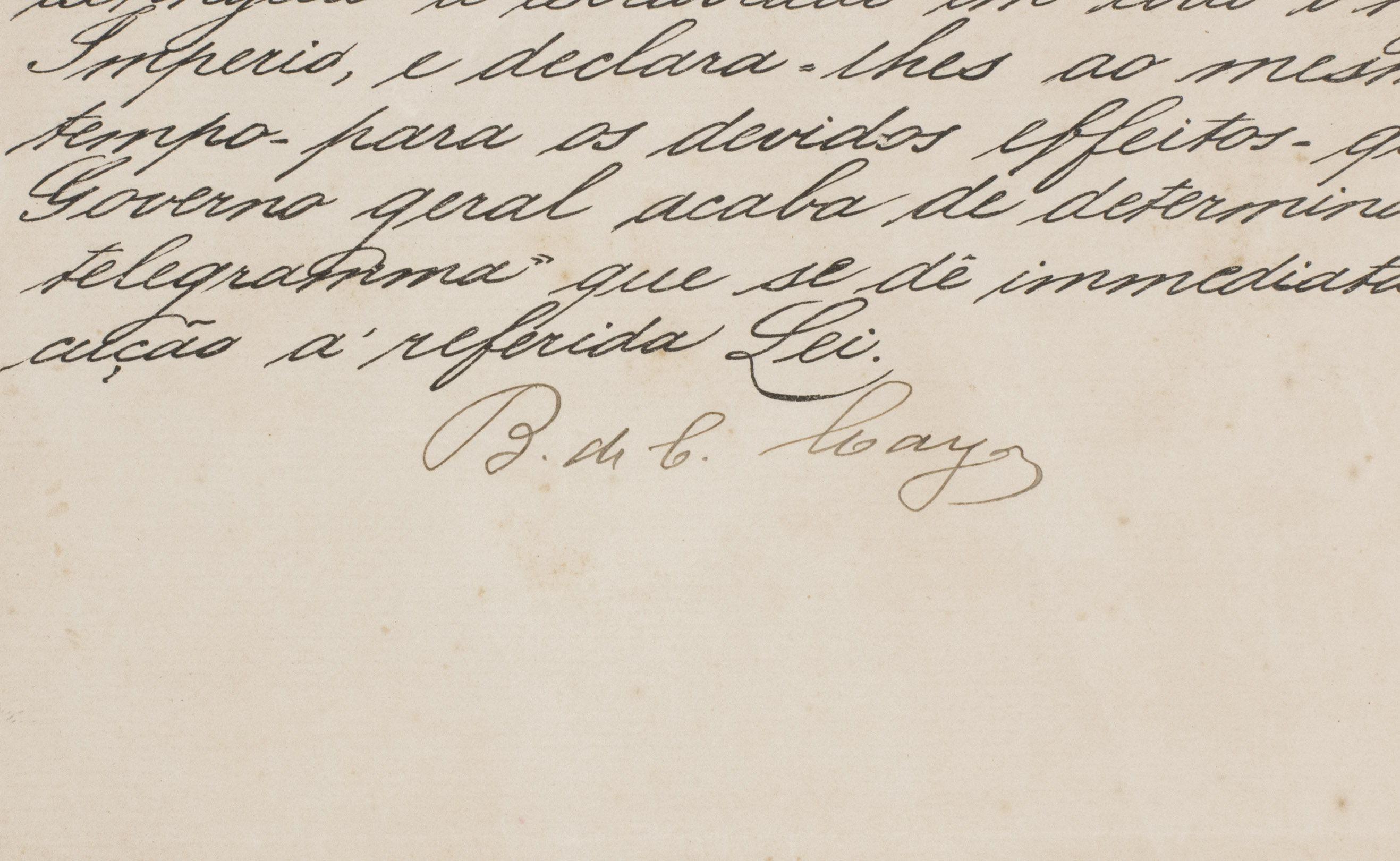
With a signature at the end of the text. Some worming in the outer bottom margin (not affecting text), some damp staining in the margin. Otherwise in very good condition. Cf. Lei nş 3.353 (Lei Áurea), 13 May 1888, manuscript, Arquivo Nacional, Rio de Janeiro; Scott, Drescher, De Castro, et al. "The abolition of slavery and the aftermath of Emancipation in Brazil", (1998).
Related Subjects: