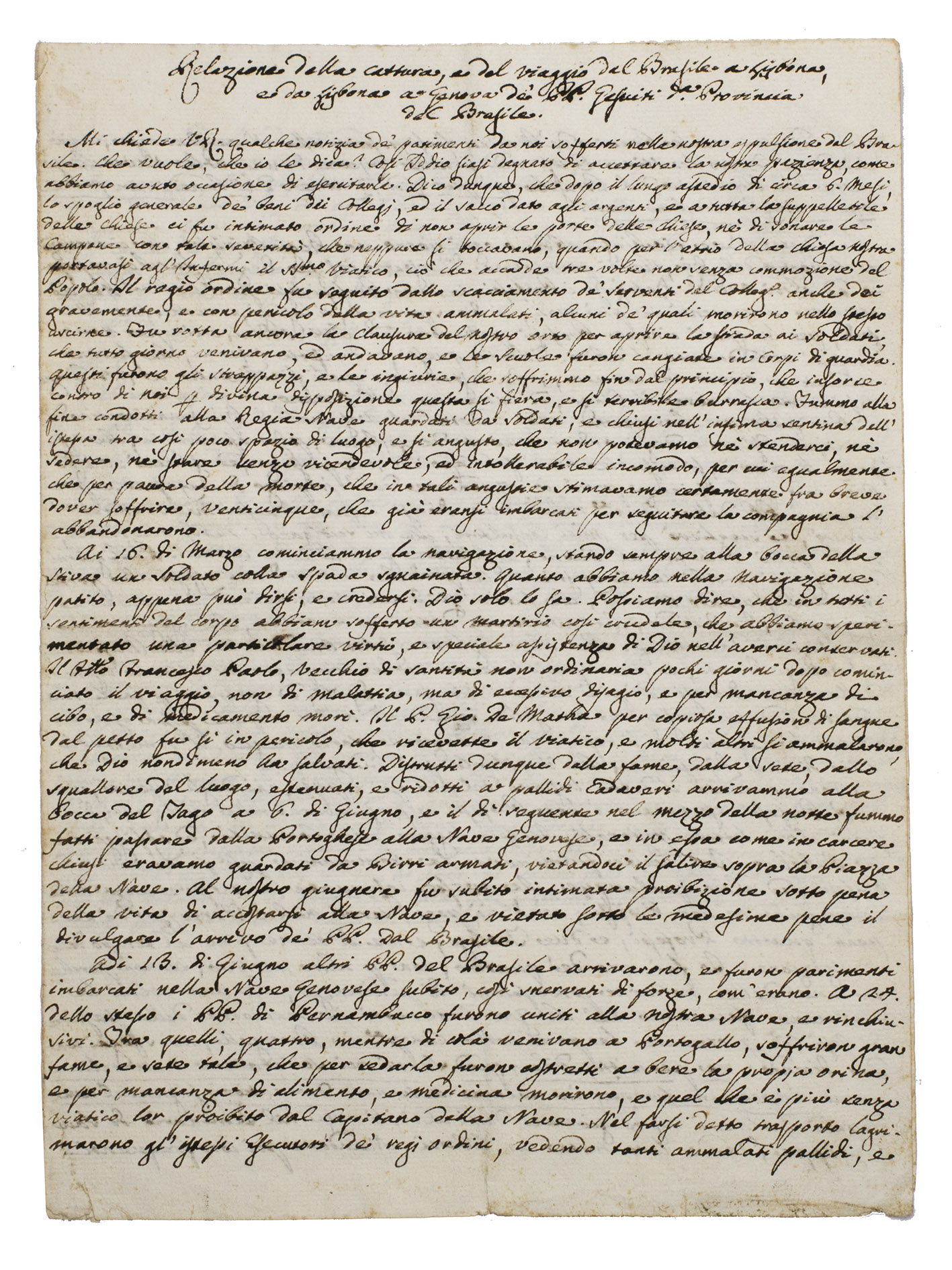
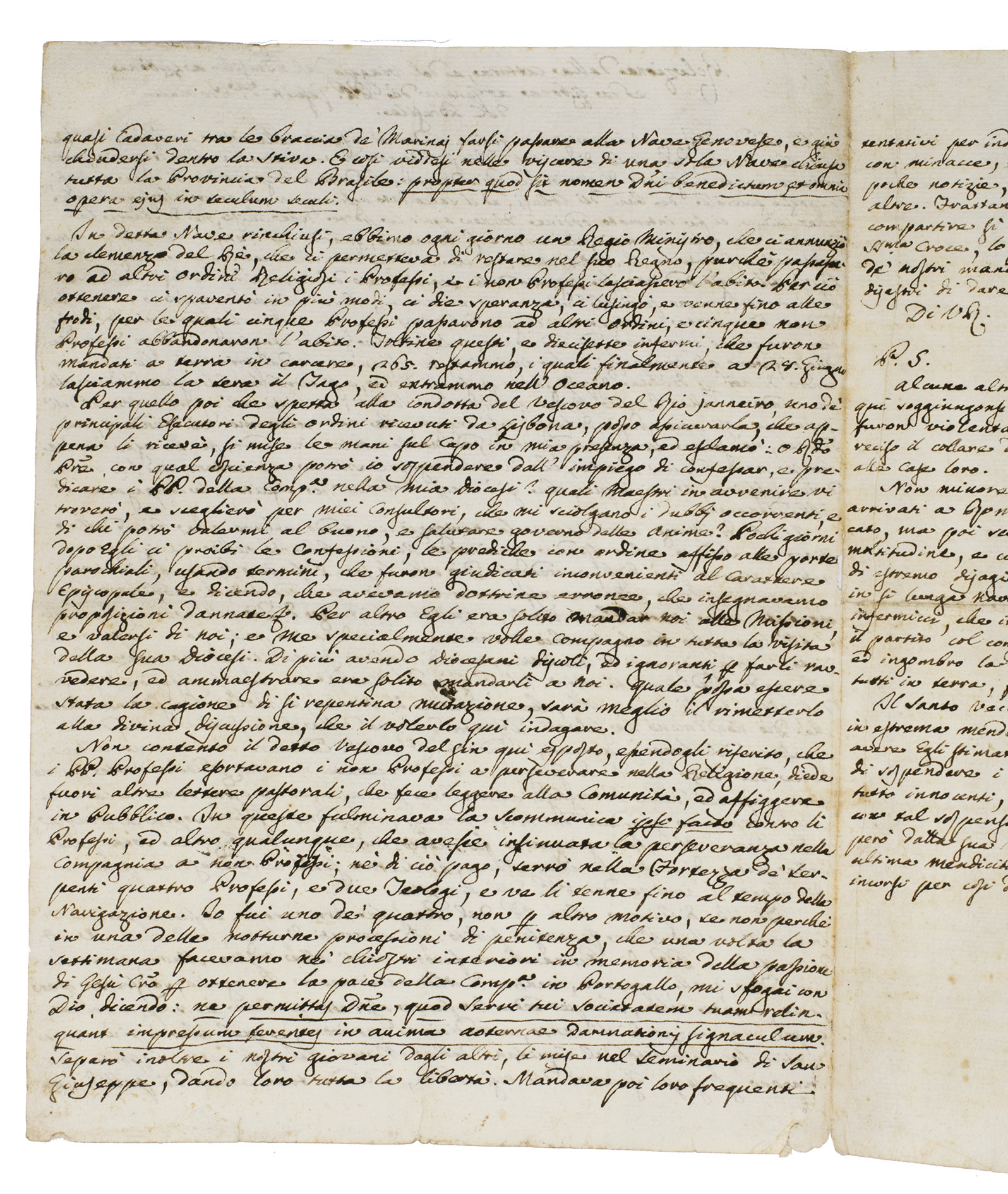
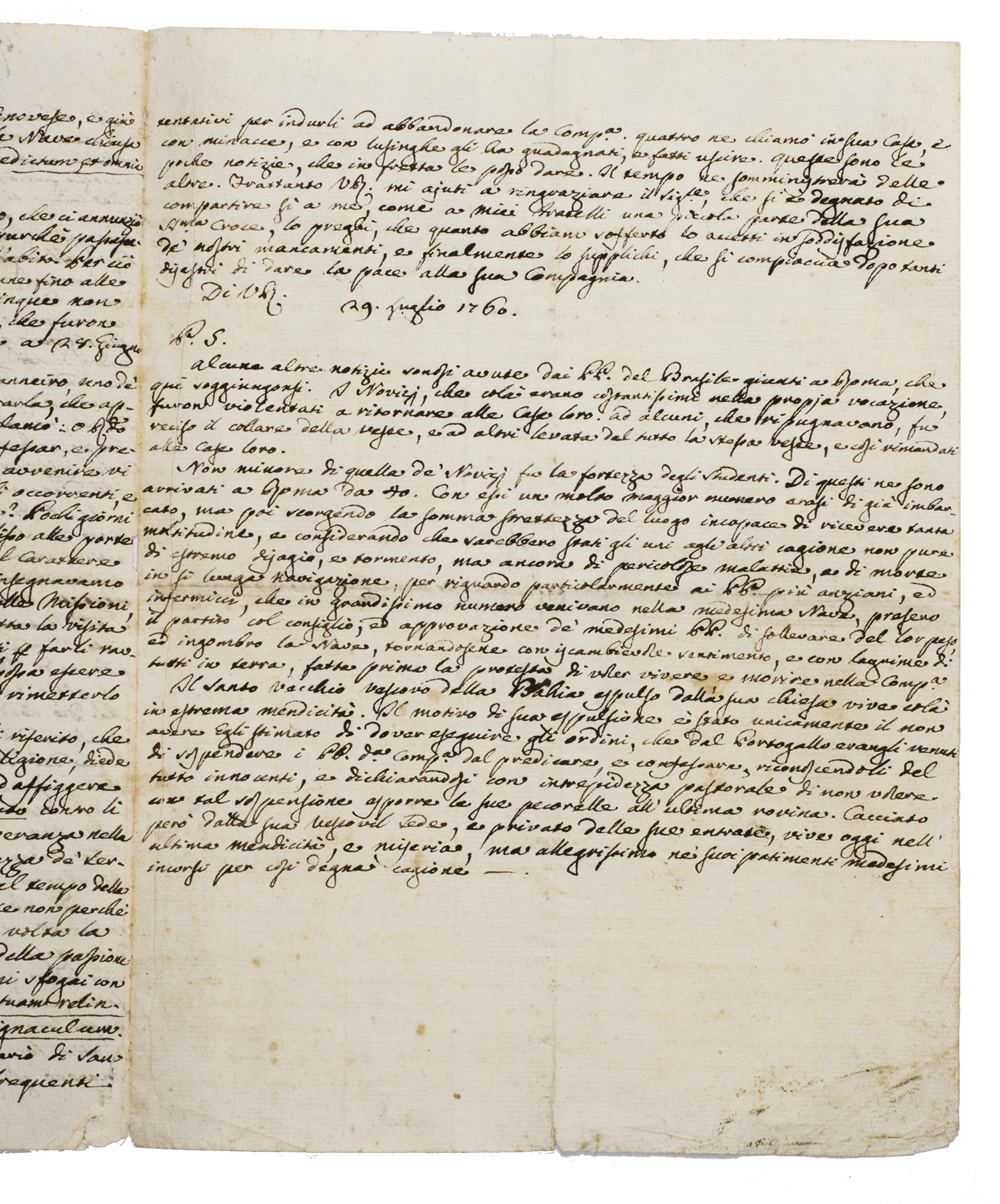
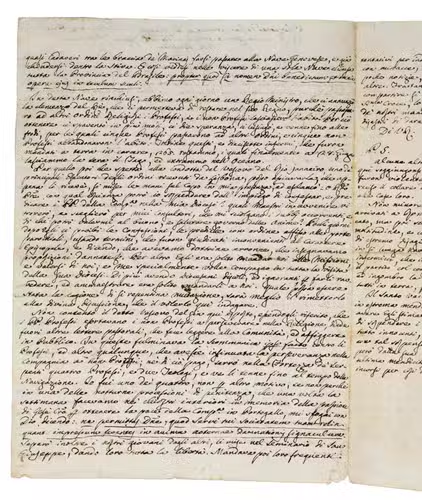
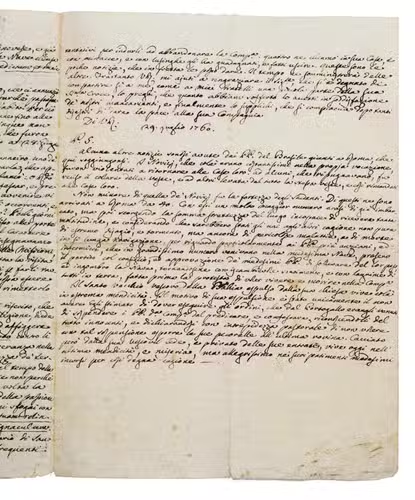
[MANUSCRIPT - JESUITS - BRAZIL - PORTUGAL].
Relazione della cattura, e del viaggio del Brasile a Lisbona, e da Lisbona a Genova de PP. Gesuiti da Provincia del Brasile.
[En route from Brazil to Lisbon, ca. 1760]. 4to. Manuscript in Italian written in a neat cursive in brown/black ink on laid paper. [3], [1 blank] pp.
€ 2,950
Rare account by the Jesuit Fathers of the Province of Brazil, describing their forced expulsion from Brazil in 1760, the hardships they endured during their capture, and the perilous journey from Brazil to Genoa, via Lisbon.
The present work begins with the long and painful siege that lasted about six months. Following this, the Jesuit colleges were thoroughly plundered, property seized, precious silver taken, and church furnishings stripped away. They were ordered not to open the church doors or ring the bells, although on three occasions the Blessed Sacrament was brought to the sick, an act which deeply moved the local people.
The Jesuits endured many sufferings during their captivity. They were confined under harsh conditions, guarded constantly by soldiers. Their living quarters were cramped and filthy, so small that they could neither sit nor lie down comfortably. Many suffered from hunger, thirst, and illness, and several lost their lives during this ordeal.
On 16 March, the journey by sea began. The voyage was nothing short of a cruel martyrdom: extreme hunger and sickness afflicted the Jesuit Fathers. One elderly and saintly Father, Francesco Paolo, died shortly after the journey began, not from disease but from severe distress caused by lack of food and medicine. Another, Father Giovanni de Matha, suffered a dangerous haemorrhage and narrowly survived, while many others fell ill.
They arrived at the mouth of the Tagus River in Portugal on 6 June, after which they were transferred under guard to a Genoese ship, effectively imprisoned once again. They were forbidden from going ashore or even signalling their arrival. More Jesuit Fathers from Brazil joined them later in June, many weakened and sick from the hardships endured.
Tragically, some who had been sent ahead to Portugal suffered such extreme famine and thirst that they resorted to drinking their own urine, and several died without the comfort of the last rites, which were denied by the ships captain. The captains and executioners of the royal orders showed little compassion even as they witnessed the Jesuits' pale and dying condition.
Throughout this entire ordeal, a royal minister constantly monitored the Jesuits, offering false hopes that they might remain in the kingdom if they renounced their order and left the Jesuit habit behind. Some succumbed to these pressures, but most remained steadfast.
The Jesuits also faced opposition from the Bishop of Rio de Janeiro, who initially used them for missions but later prohibited their confessions and sermons, accusing them falsely of heretical teachings. He even excommunicated those who encouraged perseverance in the Jesuit order.
Despite all these hardships, the siege, imprisonment, brutal sea voyage, hunger, disease, and ecclesiastical persecution, the Jesuits maintained their faith and dignity, praying for peace and the restoration of their Society.
The account closes on 29 July 1760, expressing a solemn hope that, after so many disasters, peace will return to the Jesuit order.
With some minor foxing, some folding lines, the creases sligthly flattened, the bottom edge of the leaves is slightly frayed. Otherwise in very good condition. See for more context: Fang, "Sacred Ambition, Secular Power: Jesuit Missions and the Rebalancing Authority of the Portuguese Empire, 1540-1759", Religions 16.9, 1211 (2025), pp 1-12.
Related Subjects: