JEROME (HIERONYMUS), Saint.
Explanationum in Esaiam prophetam libri IX-XVI
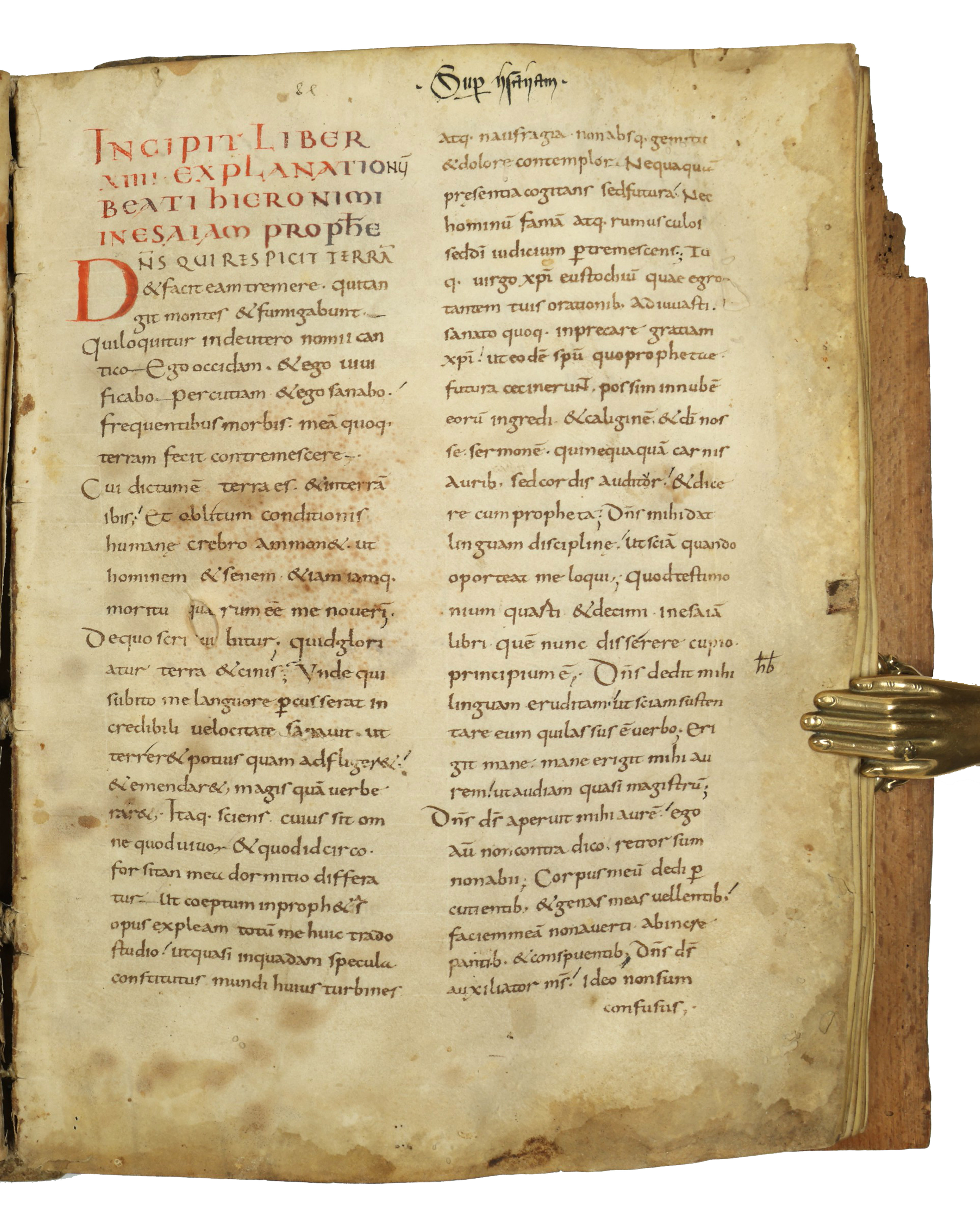
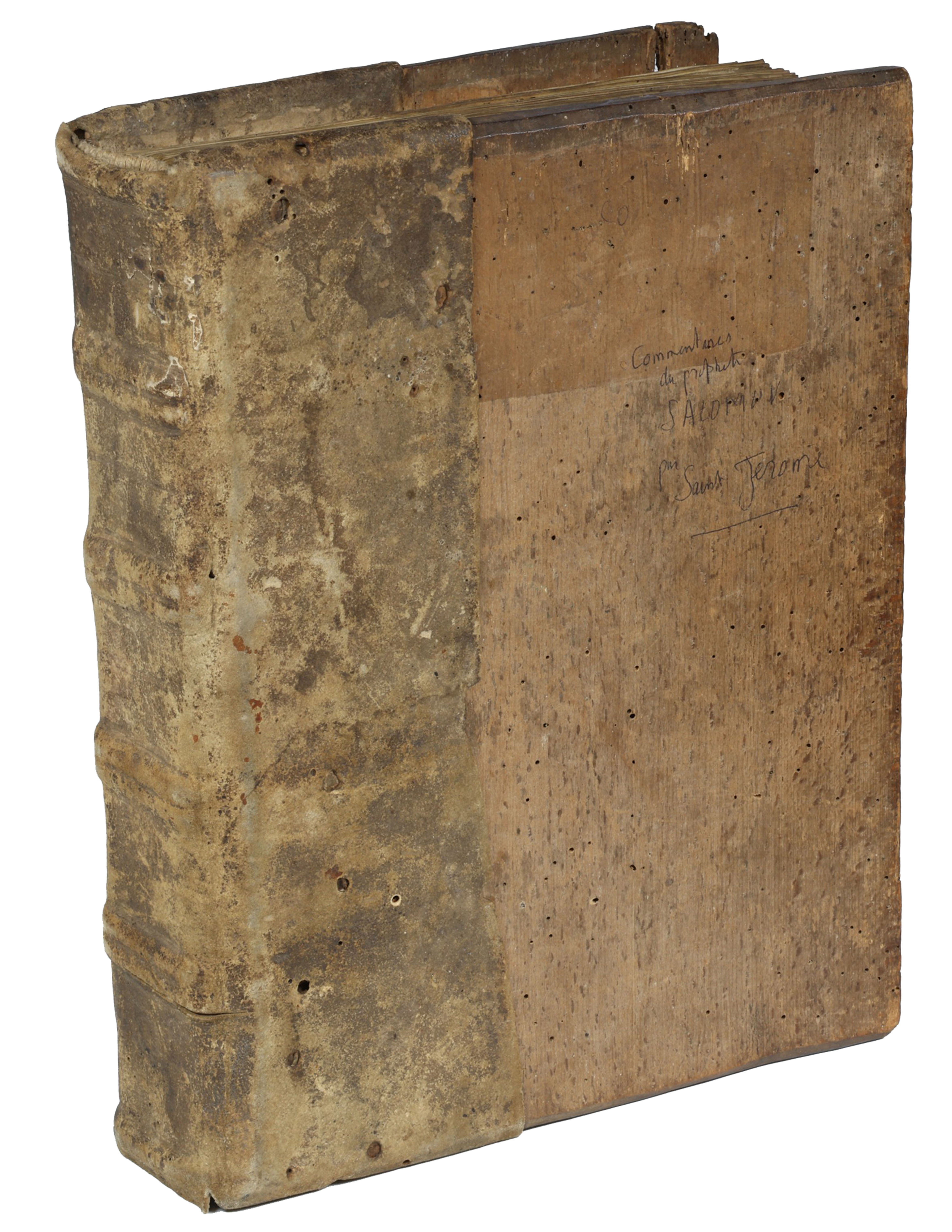
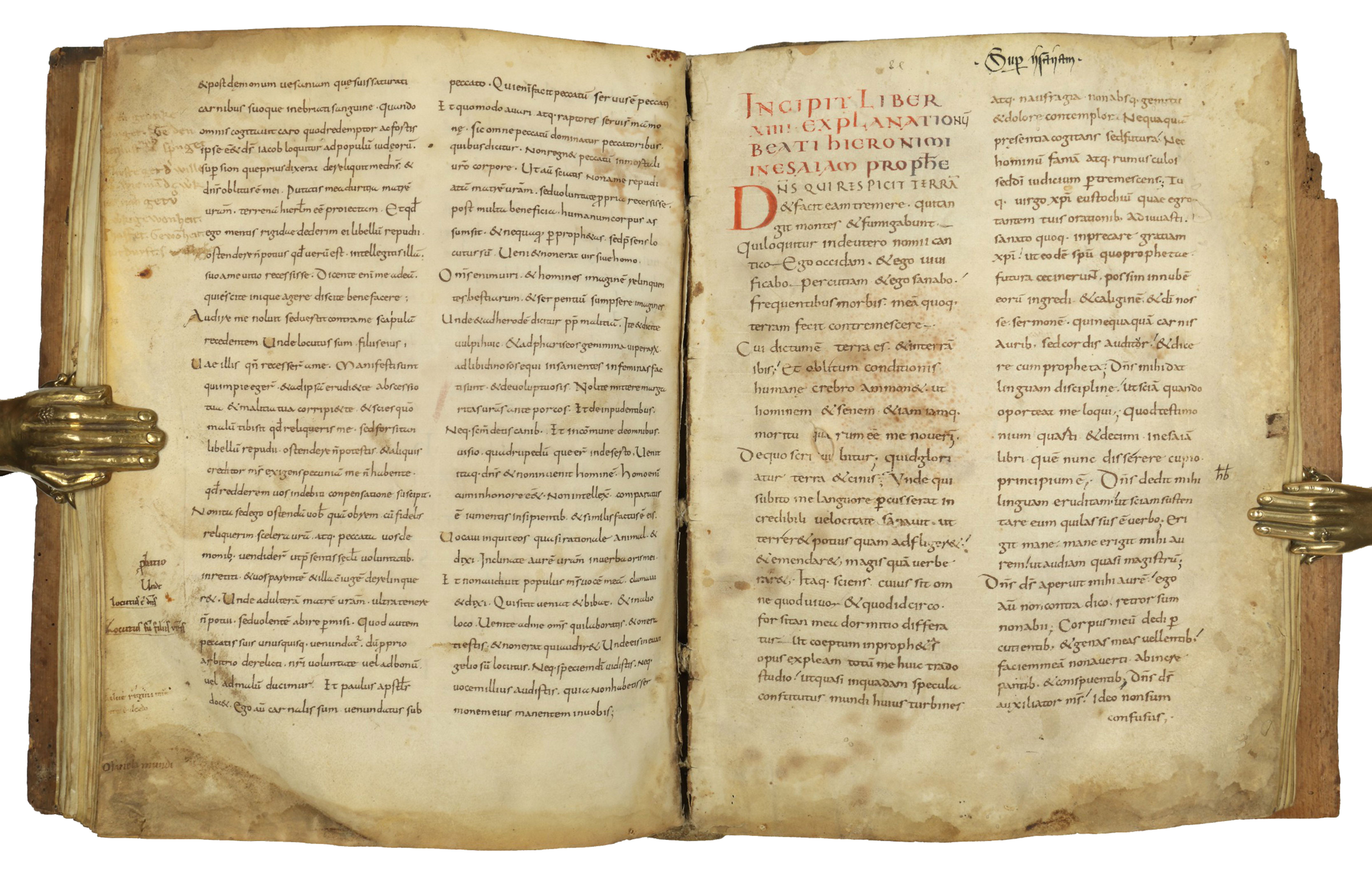
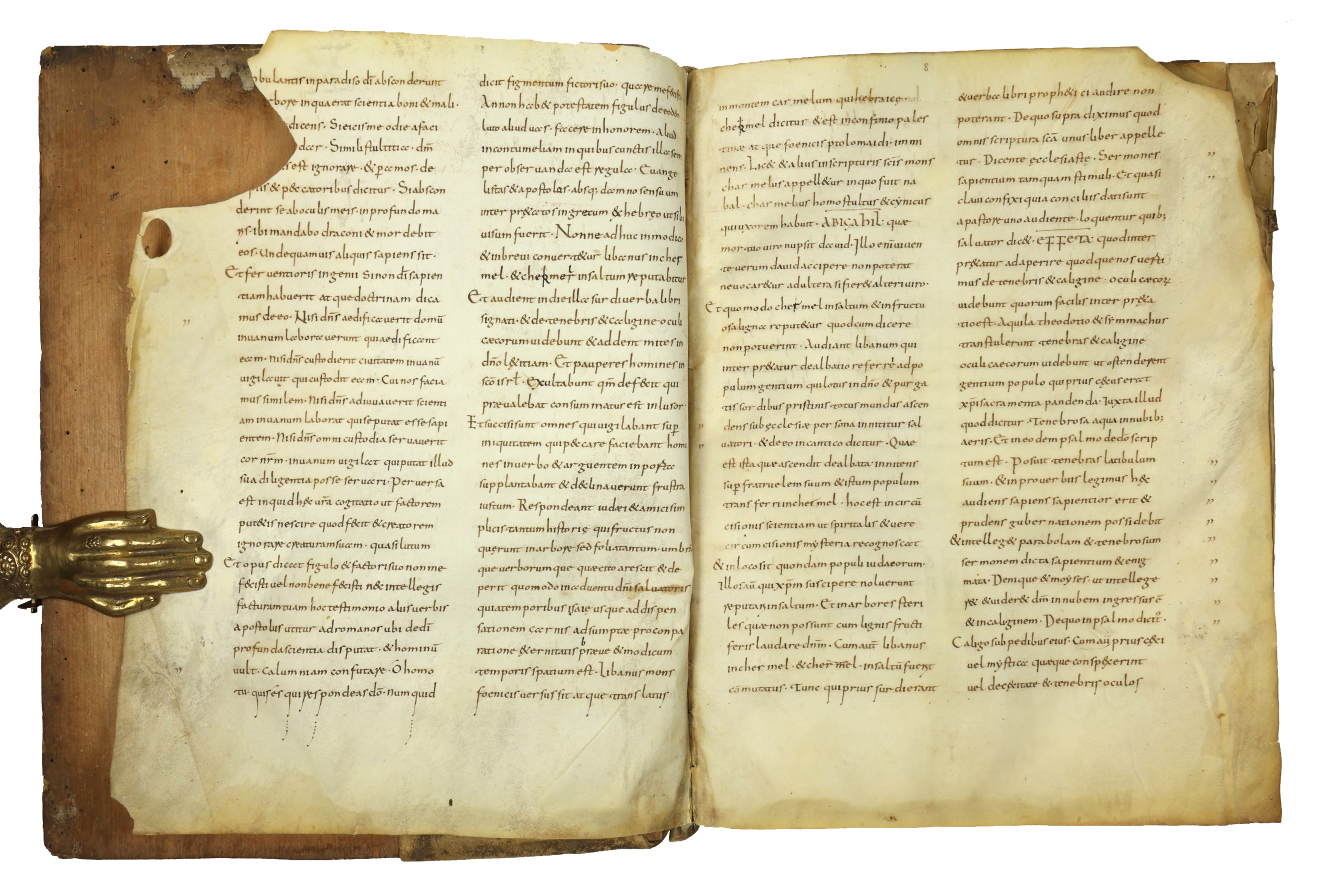
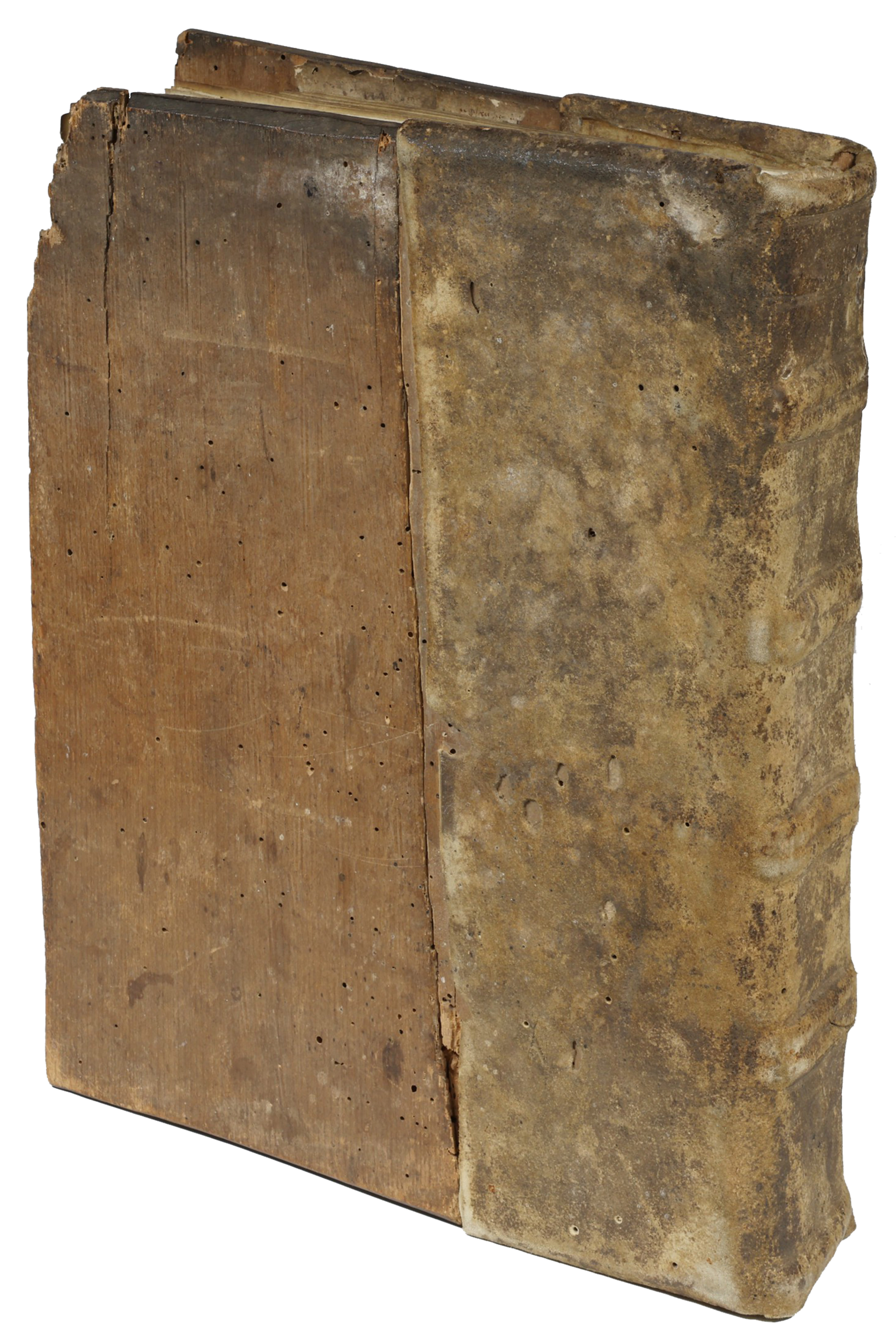
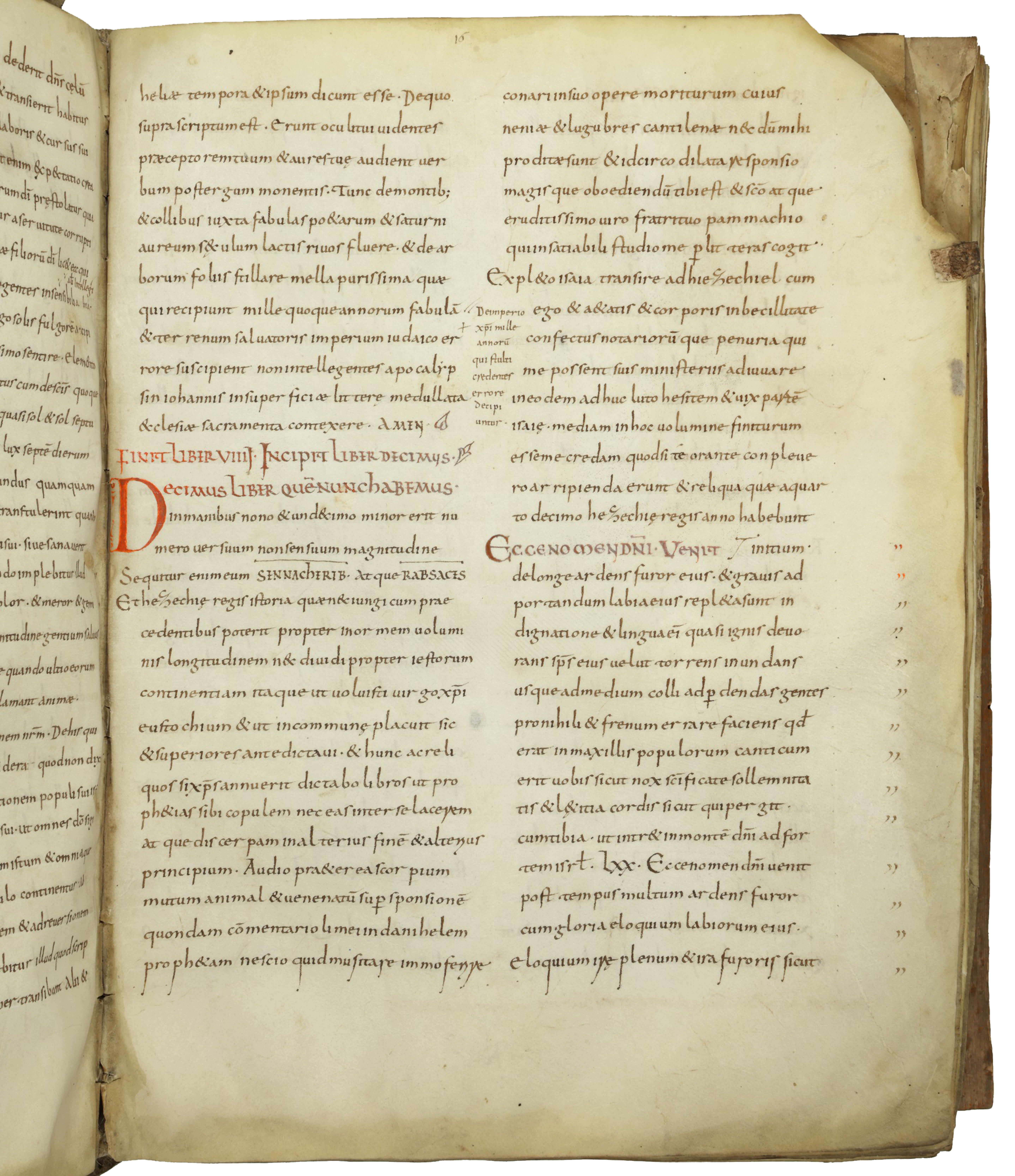
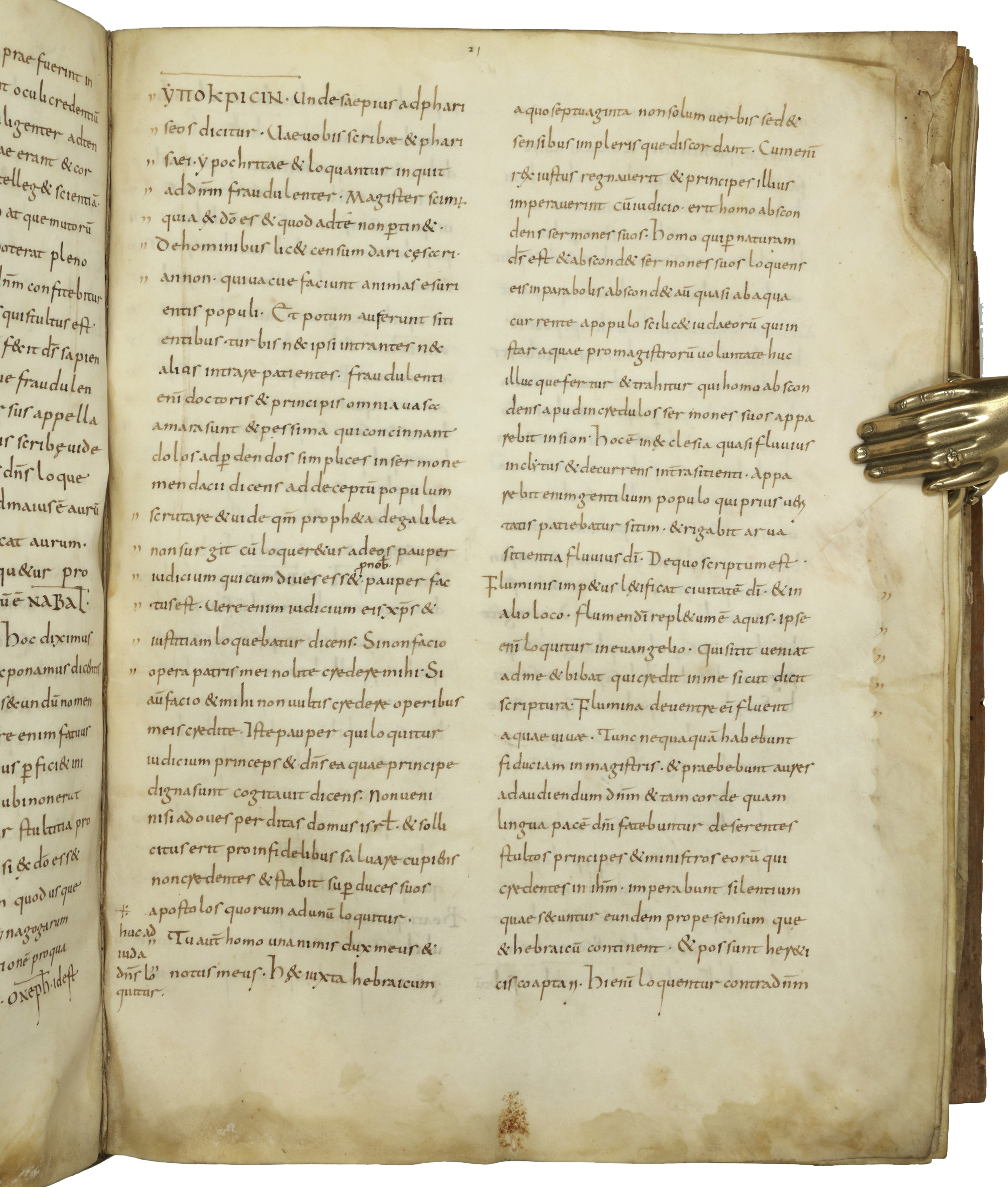
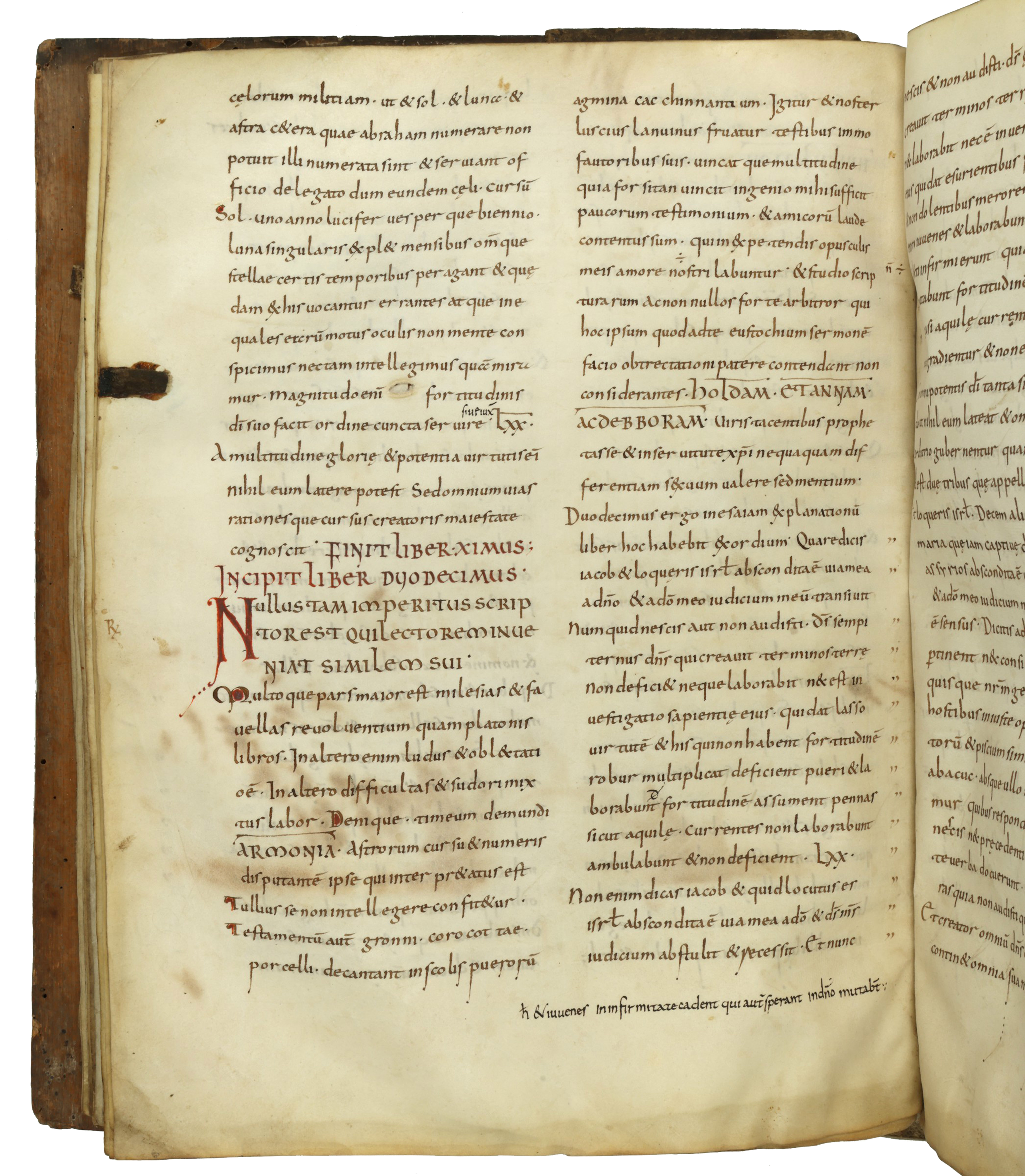
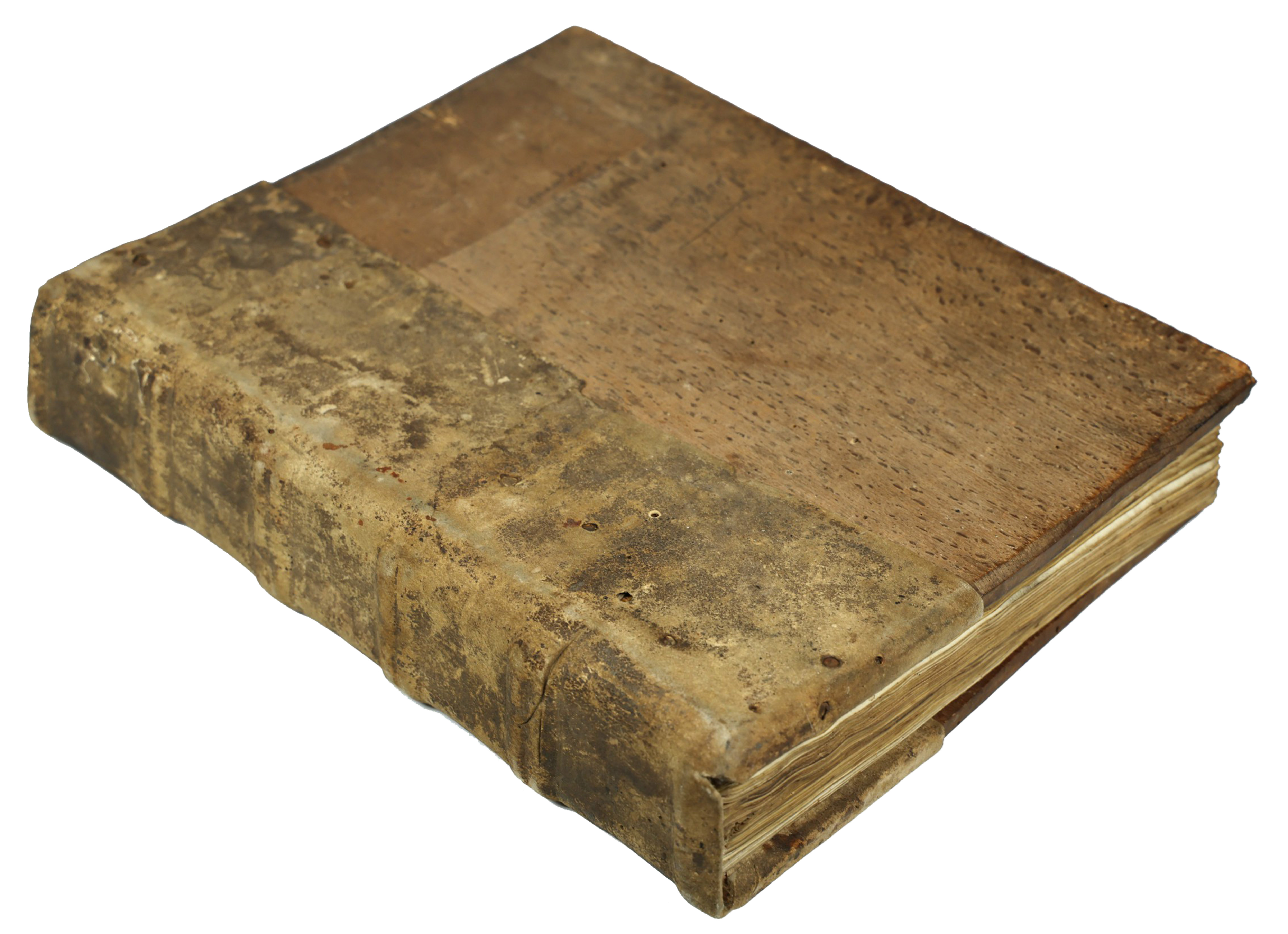
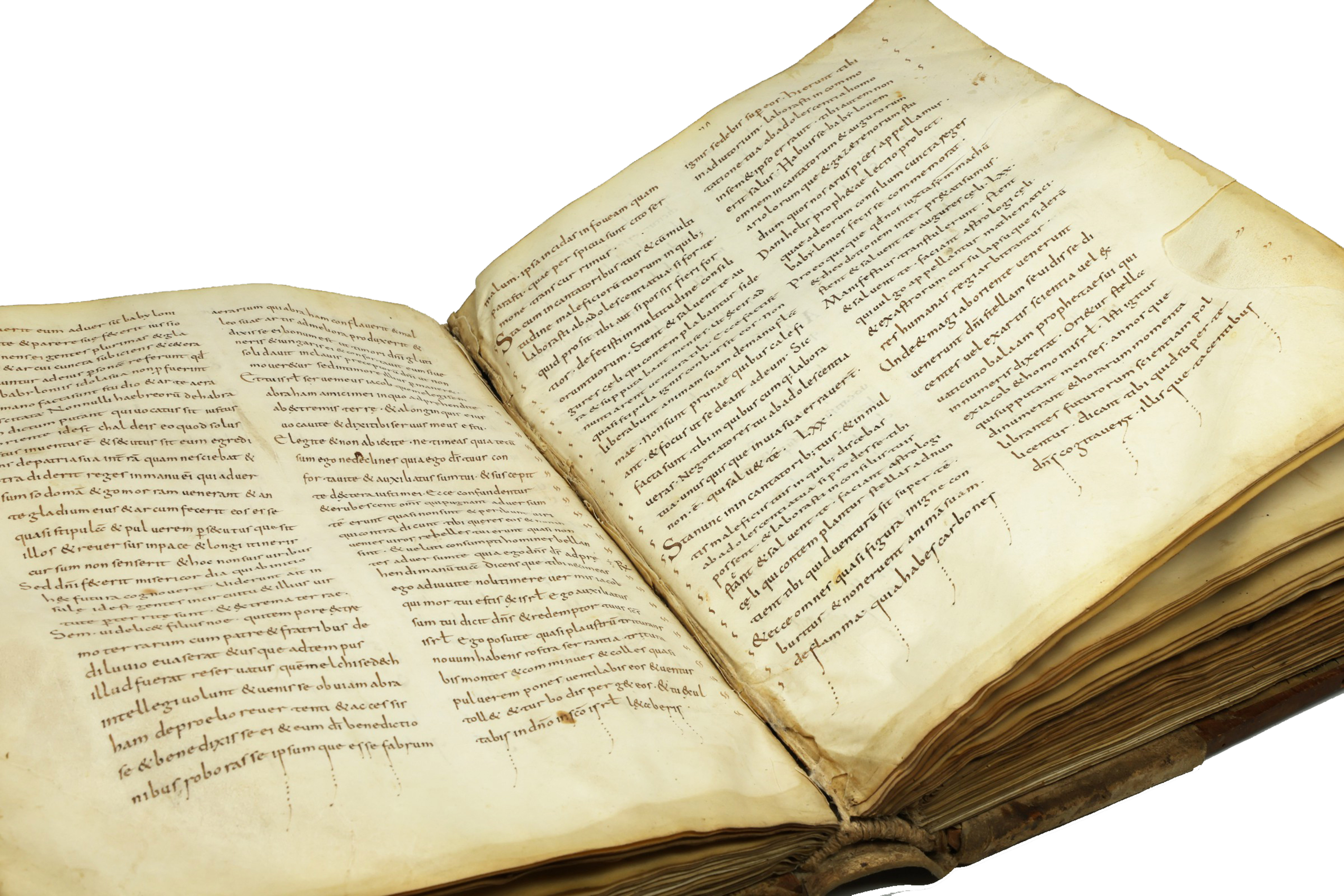
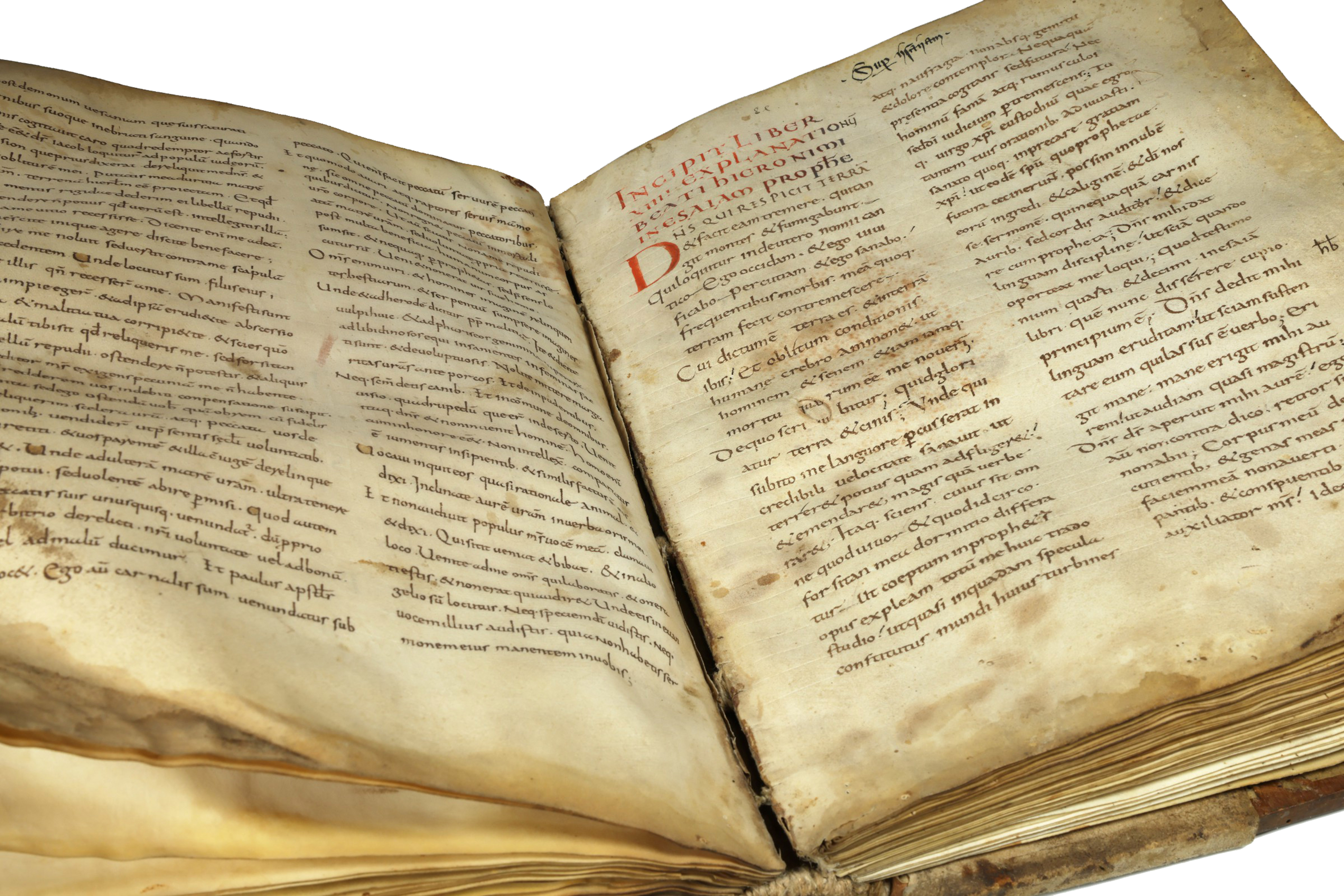
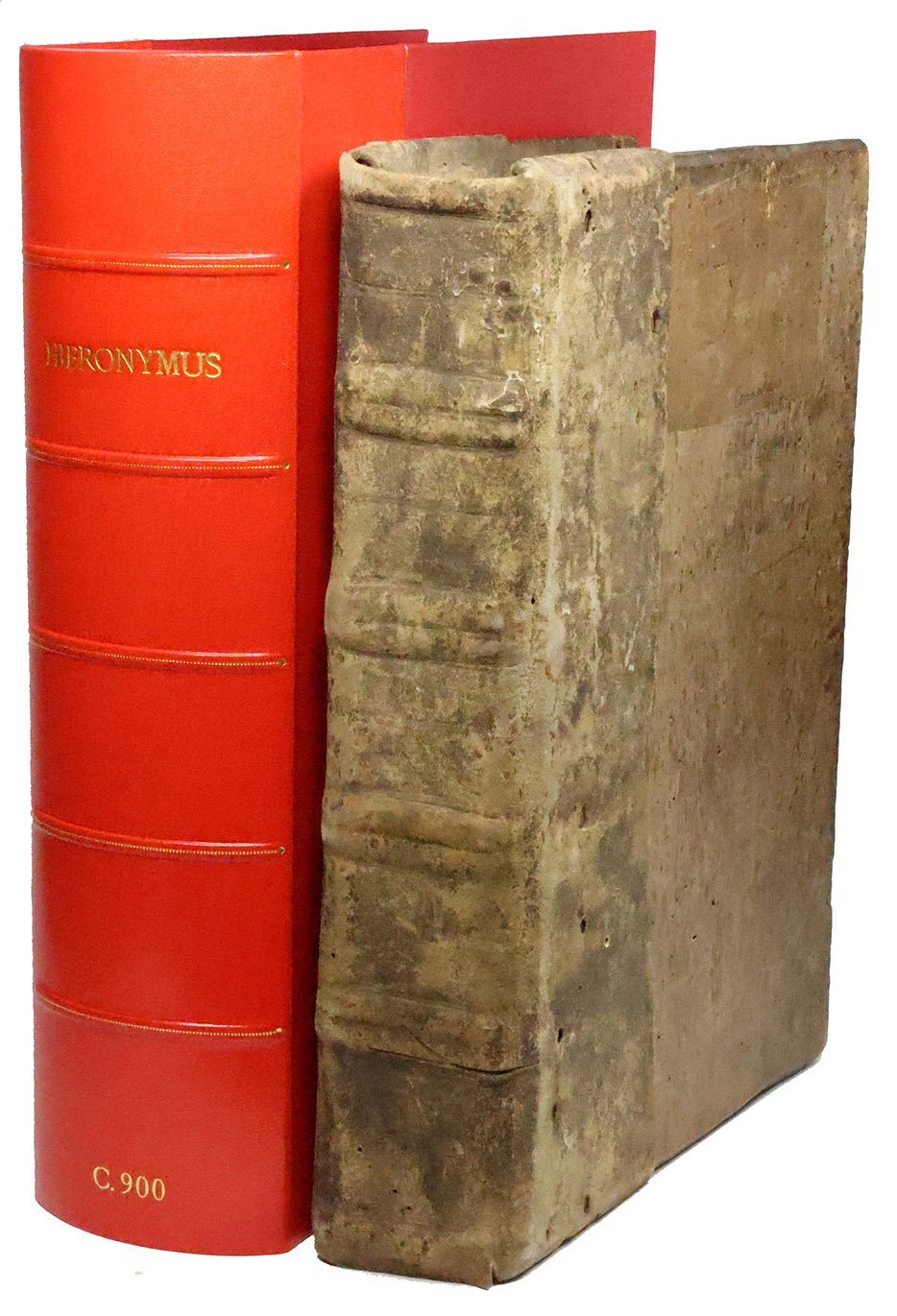
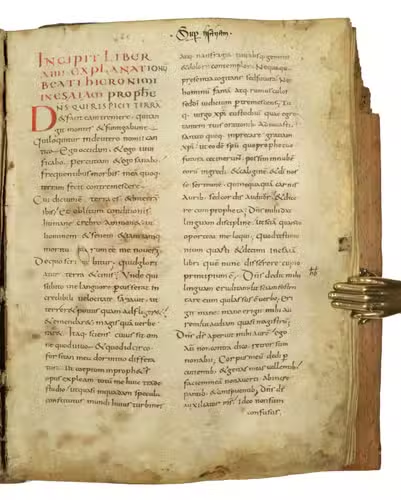
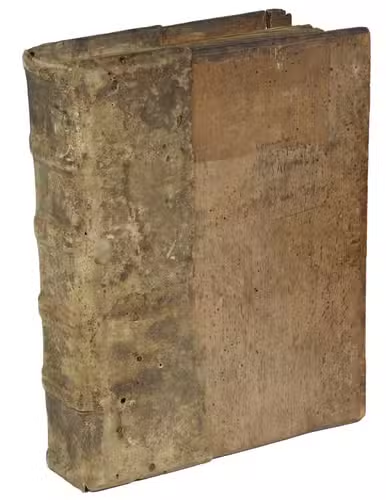
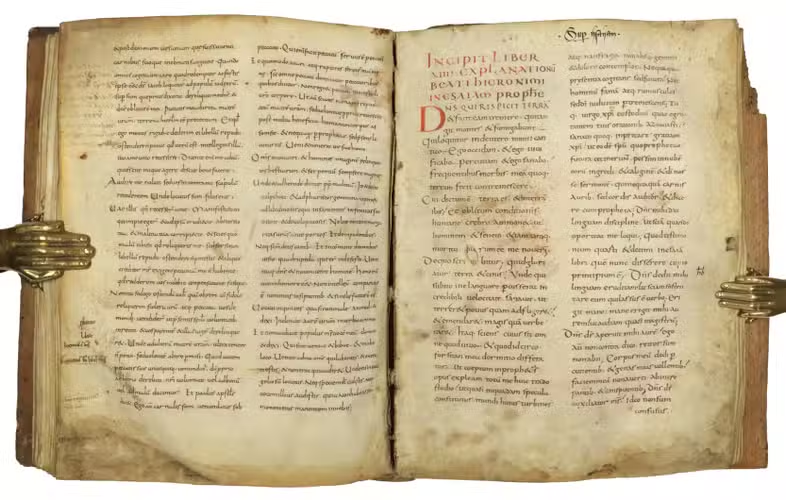
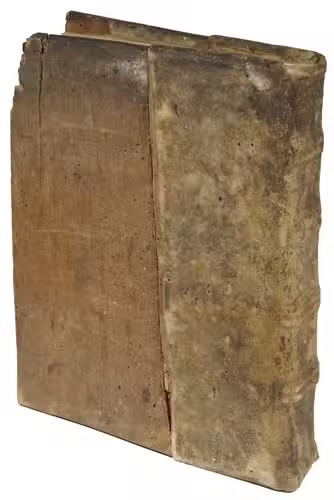
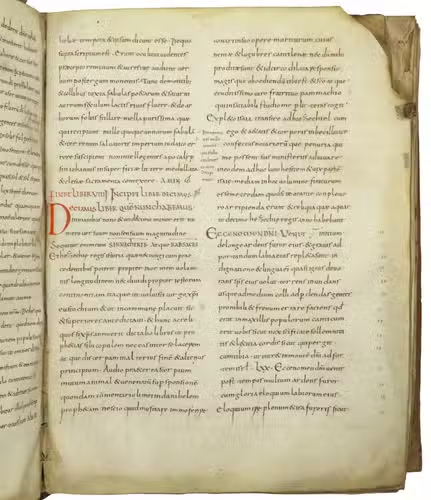
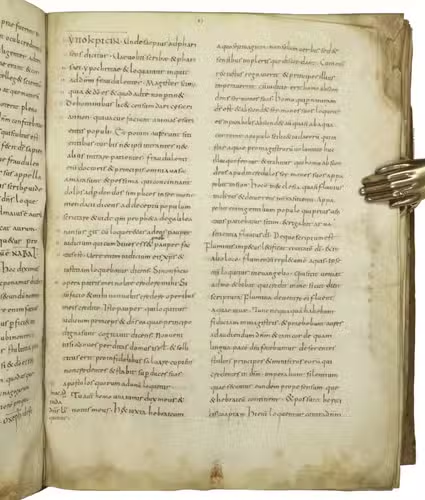
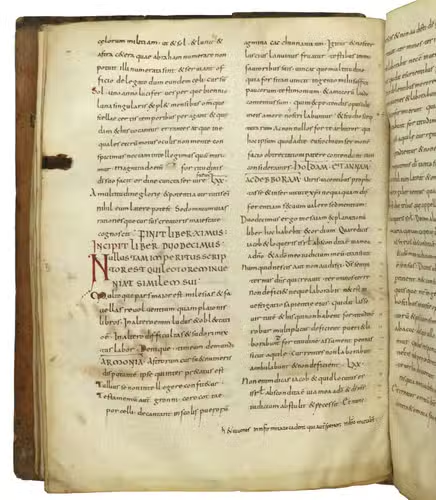
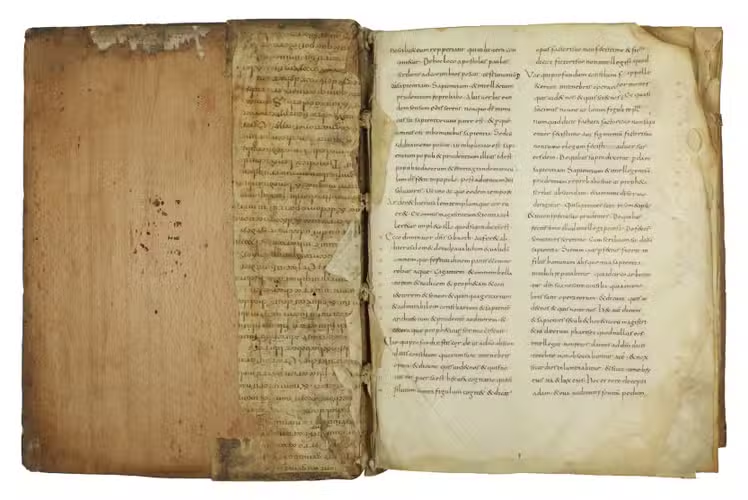
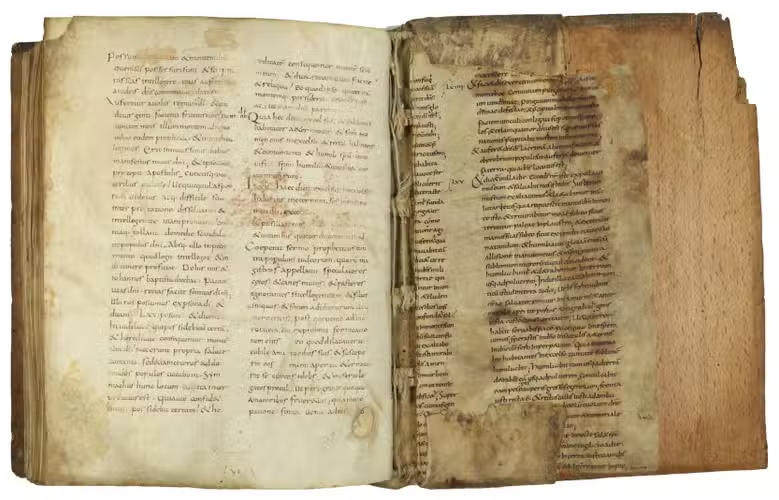
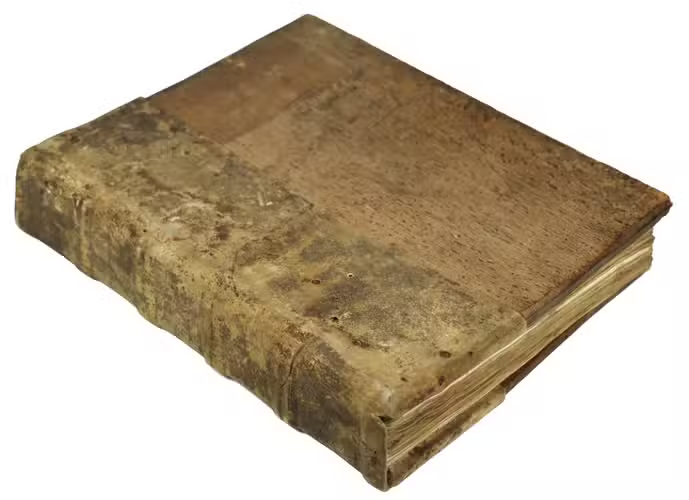
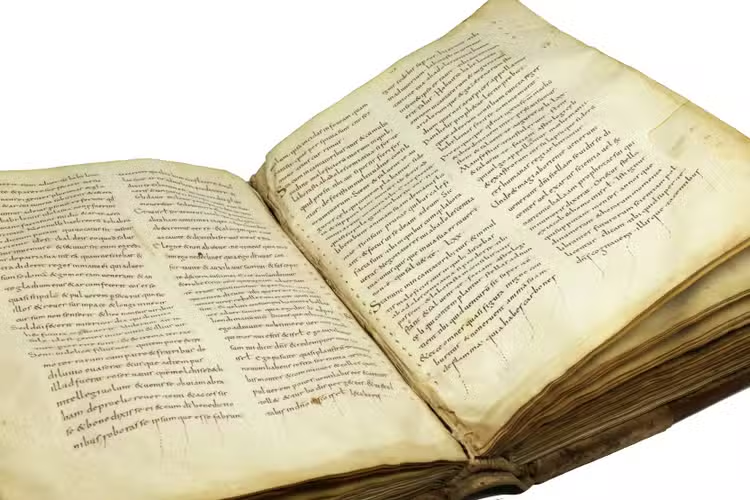
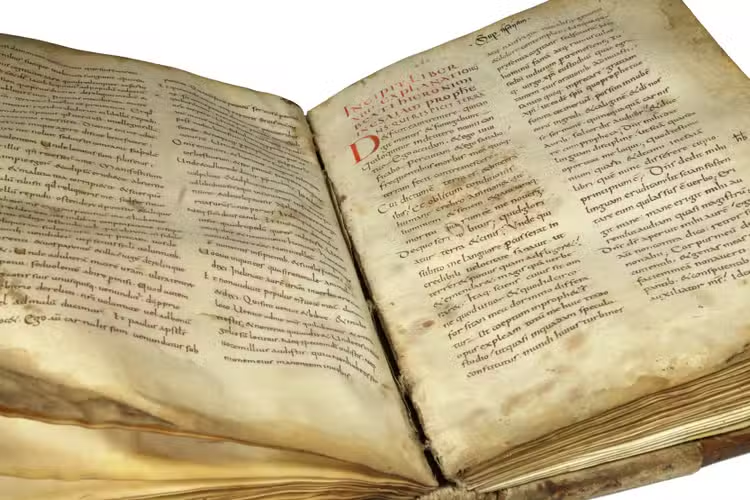
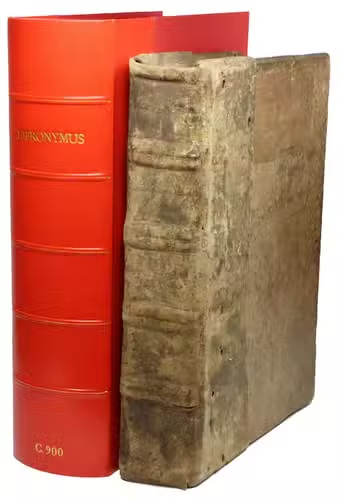
[Southwestern Germany, 825-850 CE]. Folio (34.2 x 26.3 cm). Latin manuscript on vellum, written in an admirably elegant, clear Caroline minuscule in brown, black, and red ink, with large initials. Leaf dimensions 32.7 x 25.1 cm., written in 2 columes (9.4 x 25.5 cm.) of 30 lines each, ruled in drypoint. 15th-century half-calf and wooden boards, manuscript-waste pastedowns, with text written in a Caroline minuscule. Stored in a custom-made half morocco case. [101 (of 139)] ll.
€ 850,000
A previously unknown Carolingian manuscript of St Jerome's Commentary on Isaiah, securely dated to the second quarter of the ninth century. Prof. Dr. Tino Licht (Heidelberg) has confirmed a date before 850, while Dr. Philipp Lenz (Stiftsbibliothek St. Gallen) attributes the manuscript to a major scriptorium in southwestern Germany, possibly Lorsch, Reichenau, or Weissenburg. Preserved in its medieval binding, with pastedowns from early ninth-century Bibles and abundant traces of medieval use, it survives as an unusually authentic witness to the Carolingian Renaissance. Codices such as this one are practically non-existent outside institutional settings: only one single other definitely pre-850 Carolingian codex has appeared on the market since 1950.
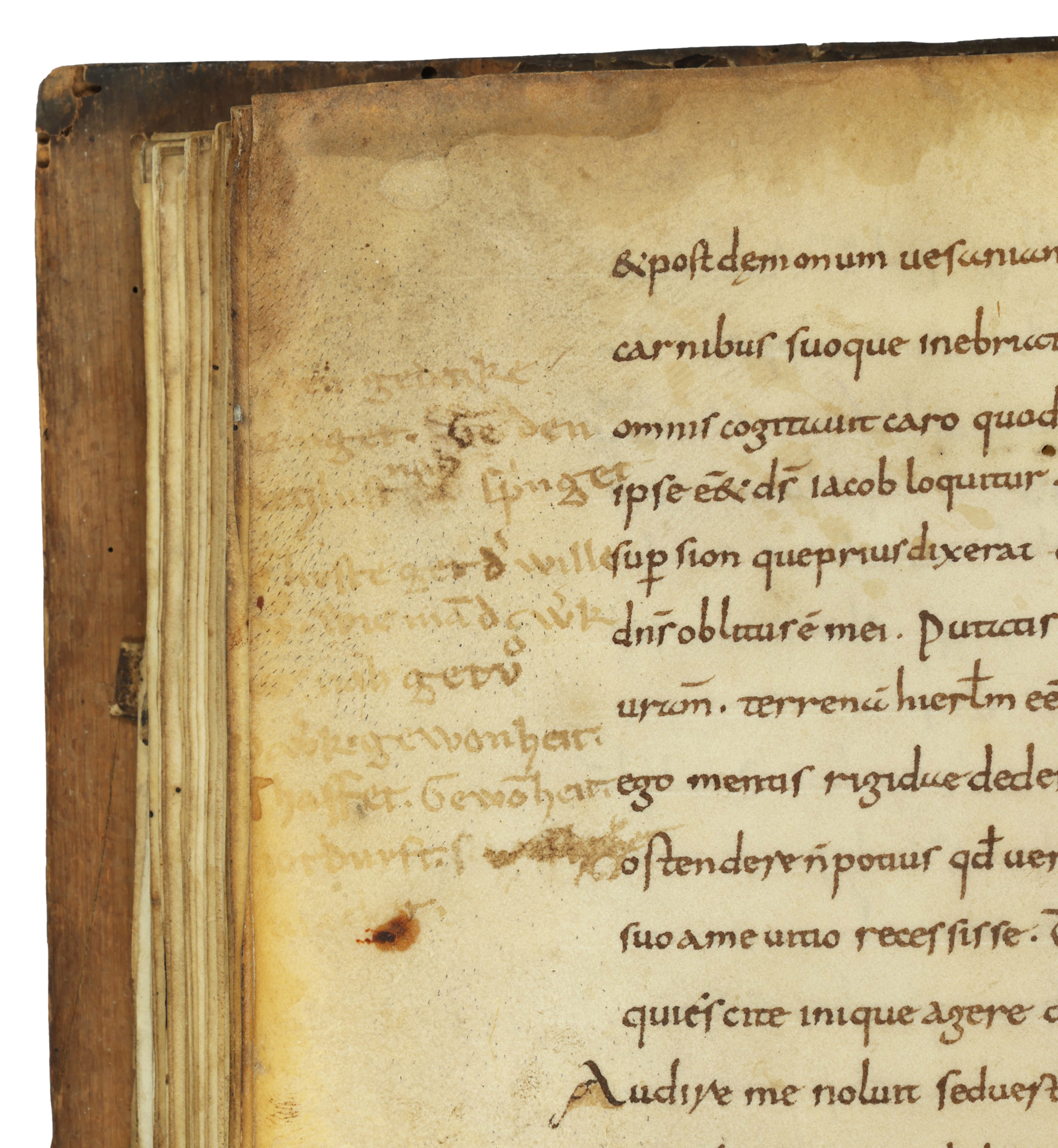
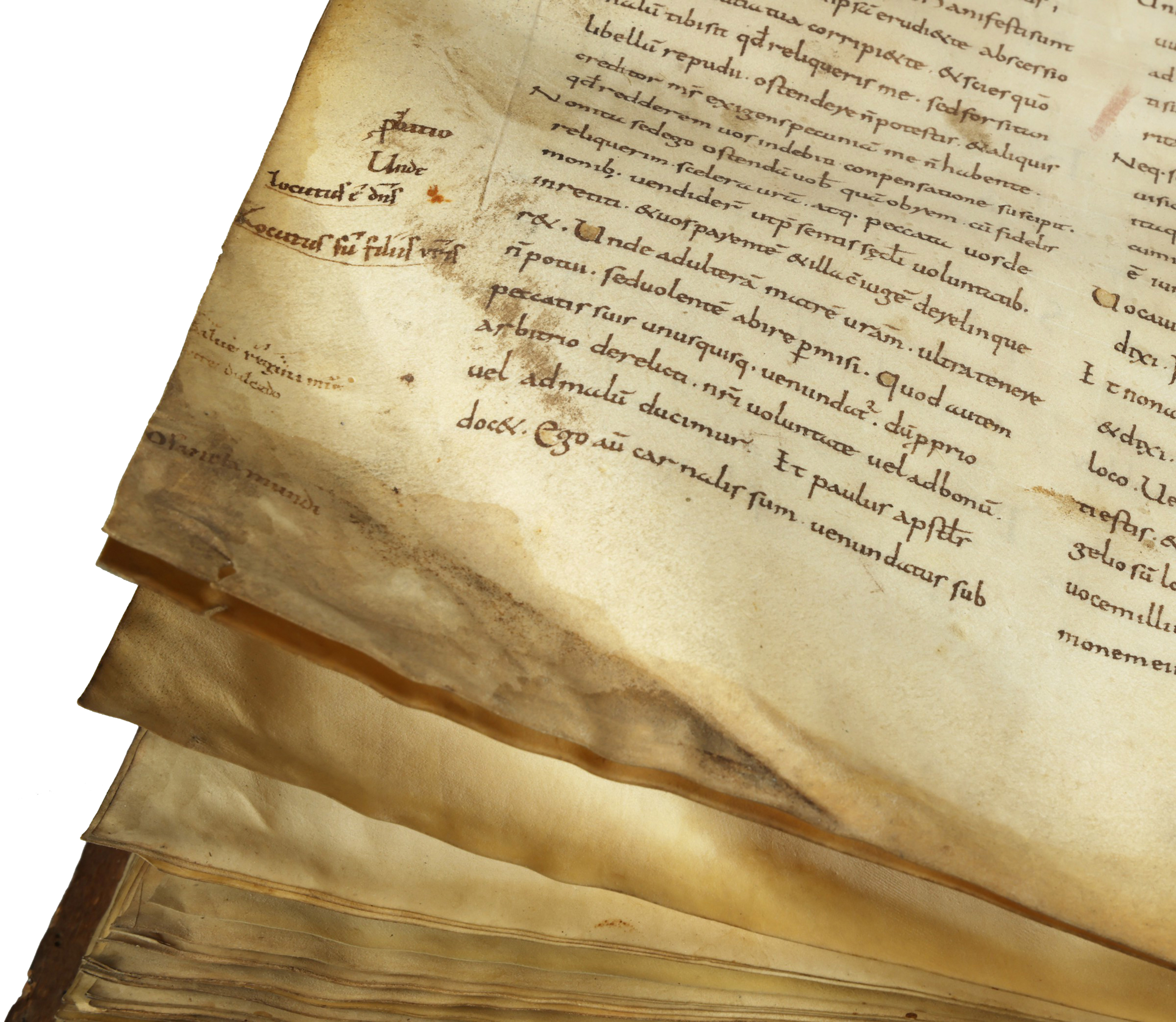
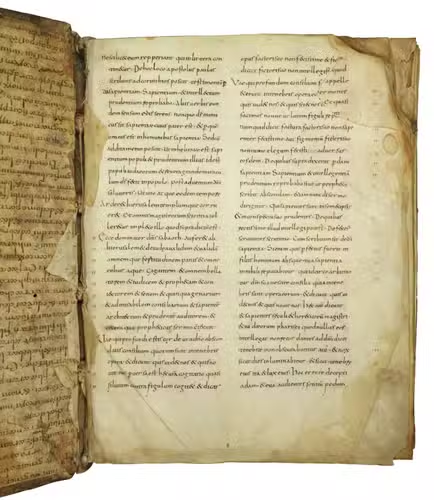
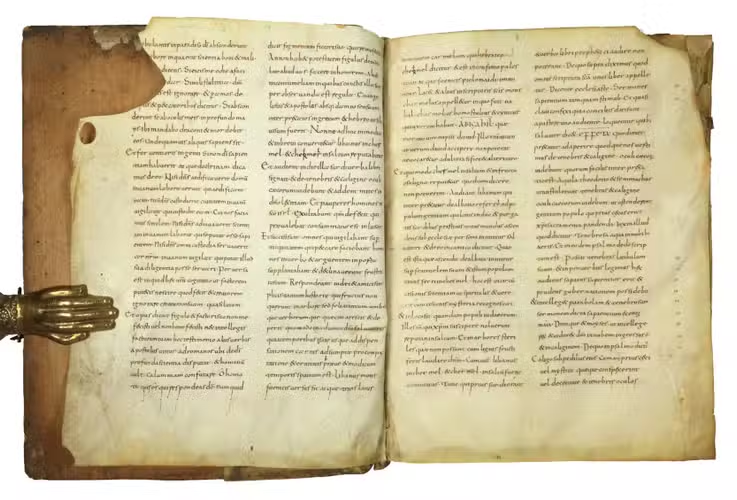
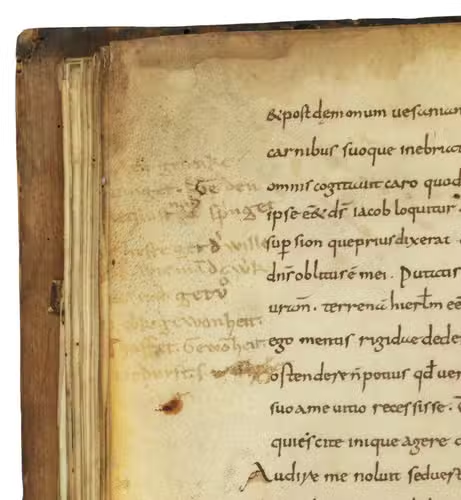
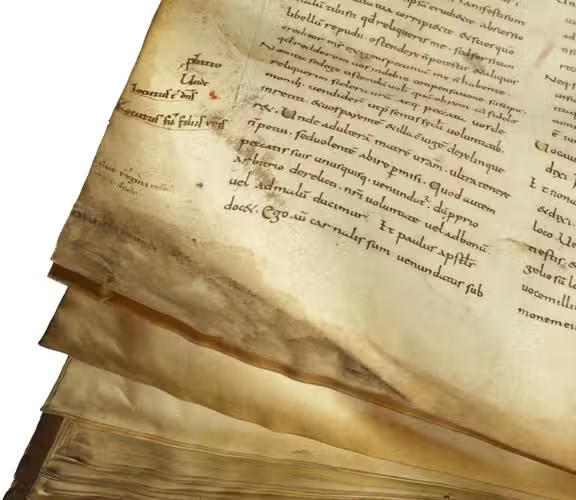
Written in an admirably elegant, clear Caroline minuscule, most of the internal pages are still bright and clear, with the original prickings and rulings still visible, attesting to an authentic, unrestored state. Medieval marginalia in at least three different hands show use by attentive and often enthusiastic readers over several centuries, one of whom adds in handsome capitals: "Optime dixisti, Sancte Ieronime dulcis!" ("You said it best, sweet Saint Jerome!", fol. 10v). The remains of leather place-markers similarly point to a volume that was once frequently consulted.
Independent expert examinations by Dr. Tino Licht of the University of Heidelberg and Dr. Philipp Lenz of the Stiftsbibliothek St. Gallen concur in dating the script to the second quarter of the ninth century, and the origins as the southwestern region of Germany, very possibly in the monastery of Lorsch or Reichenau, or Weissenburg in Alsace.
Dr. Licht cites in particular the common use of double-forms and ligatures as decisive in dating the manuscript to the second quarter of the ninth century, no later than 850. The forms of many of the ligatures as well as the display script argue for a provenance from southwestern Germany. The script of the main text is a developed Caroline minuscule, with Dr. Lenz noting relatively long, narrow ascenders and rich use of the ligatures et, ec, ex, ct, st, -re, -ri and -rt, as well as the abbreviation t for -tus, indicating the manuscript can be no later than ca. 850. In addition, we see an alternation between an open-topped and a closed a; a 3-like g; both uncial and half-uncial ds; a t whose bar often curves downwards and inwards on the left; a majuscule U with a descending tail in headers.
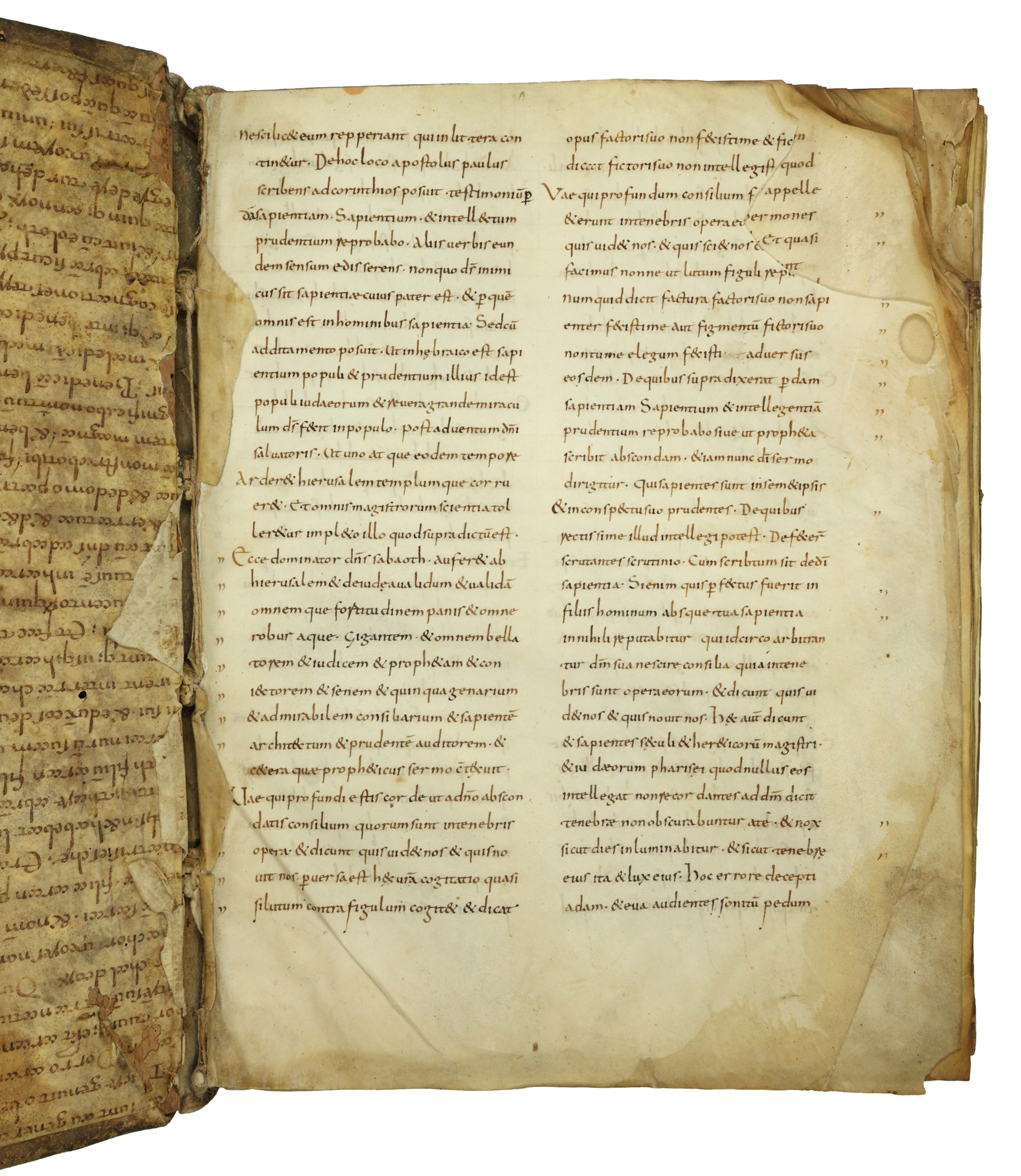
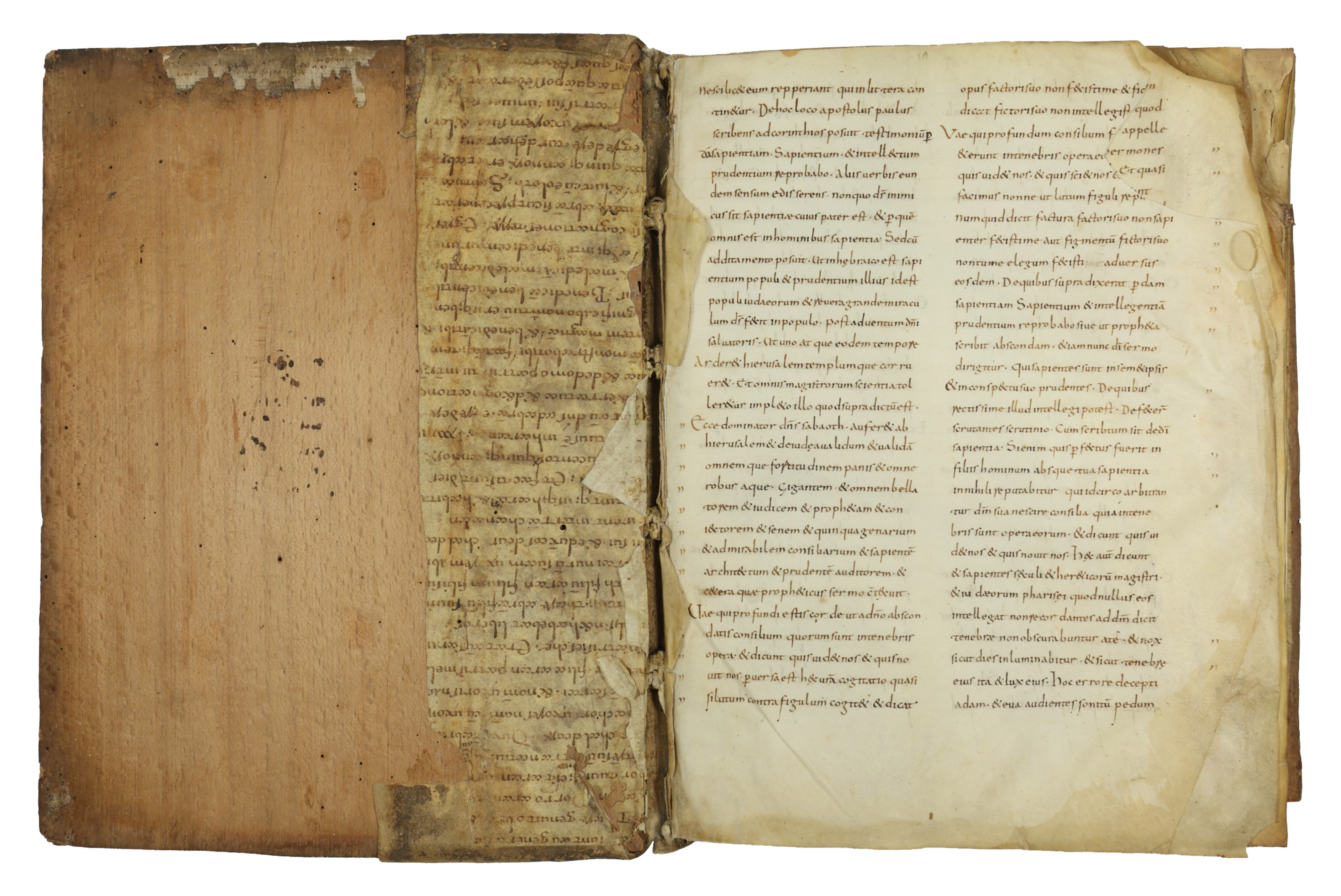
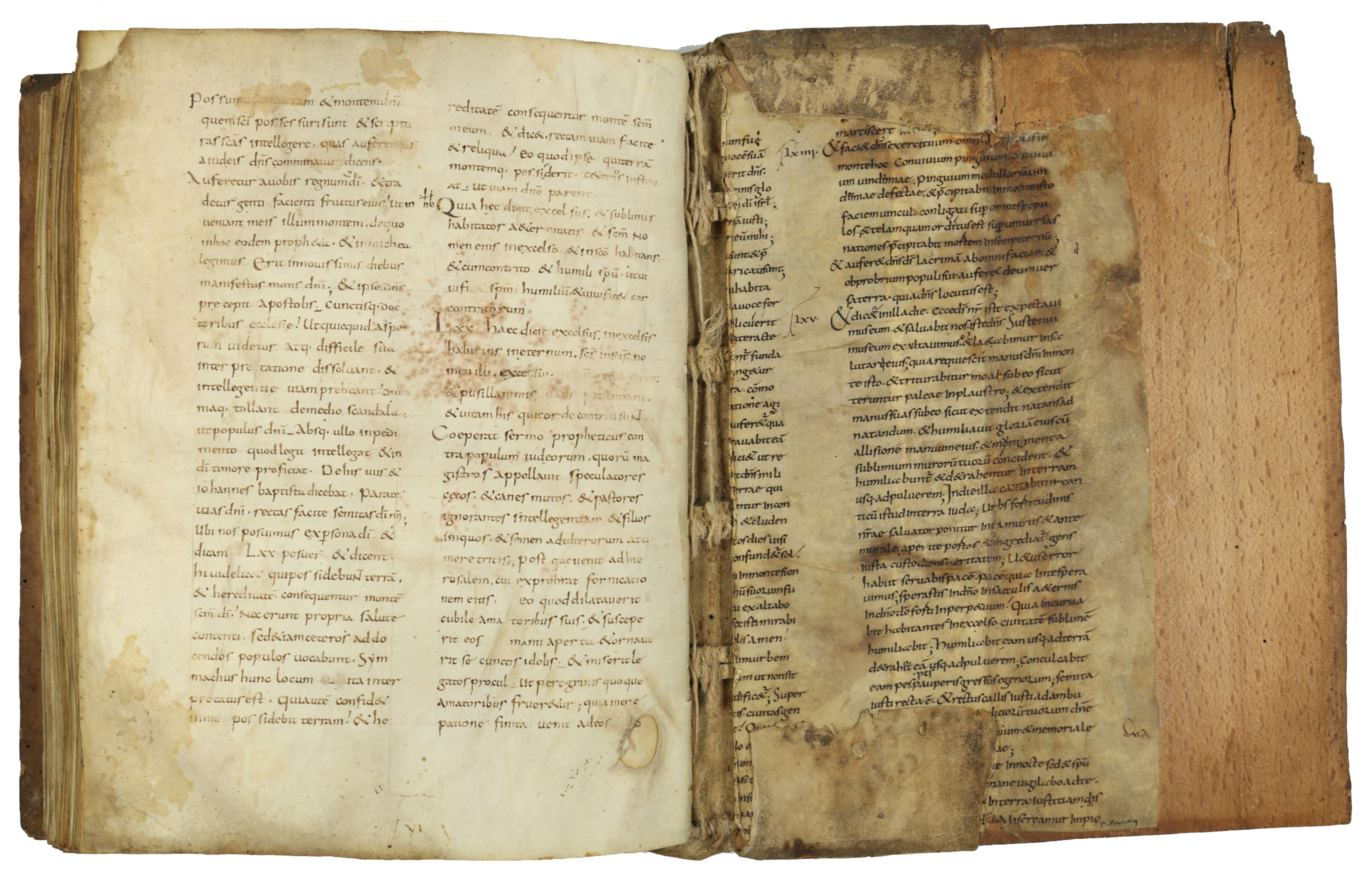
The pastedowns are of considerable age and interest in their own right: the one in the front is from a Vulgate in a hand of ca. 800, containing Genesis from 11:27 onwards ("hae sunt autem generationes Thare").The fragment at the rear is written in a clear Caroline hand of the ninth century featuring open and closed-top a, the t more often straight than with a downward turn to the bar, and with a gentle slant to the right. It is taken from a two-column Bible, with the first fully visible line in the second column beginning with Isaiah 25:6 ("et faciet Dominus exercituum"). The impressive later medieval binding was thus produced at a time when ninth-century Bibles were felt to be obsolete, probably sometime around the fifteenth century, as dated by Dr. Lenz.
A distinctive textual error on fol. 7r, col. b (the addition of the nonsensical "elegum" into "tu non me [...] fecisti") is shared with the roughly contemporary Codex Sangallensis 115, written in Saint Gall ca. 820-840, suggesting that the two shared a common ancestor. This seems to place our manuscript in the Saitnt Gall group (G) of the textual tradition, whose area of diffusion was fairly small, mostly confined to Switzerland and southwestern Germany, matching the palaeographical assessment. The editor of the modern critical edition of Jerome's commentary on Isaiah, Roger Gryson, describes the Saint Gall recension as offering the best version of the text.
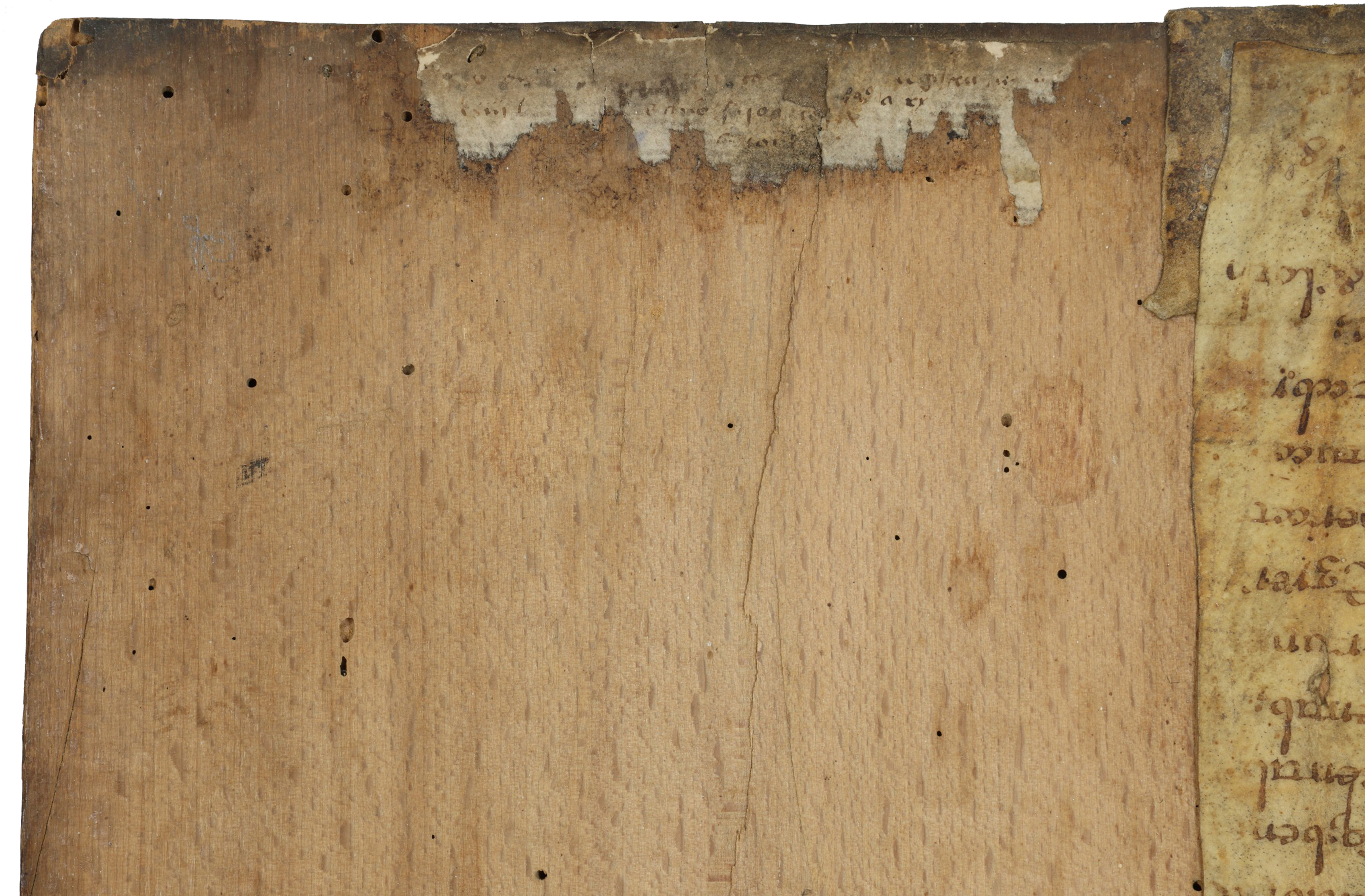
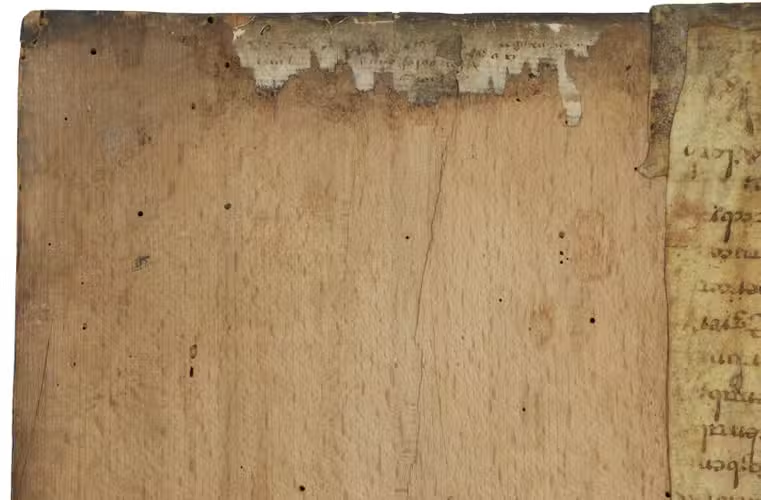
Later medieval marginalia in German on fol. 82v, containing the remark "gewonheit schaffet gewonheit" ("habit makes habit"), demonstrate that this volume remained in the German-speaking area through the Middle Ages. A barely legible inscription to the front board appears to indicate the book came into the possession of a house of Canons Regular (the word "regularum" is decipherable), probably thereafter entering private circulation during the secularisations of the Napoleonic period. An inscription to the rear pastedown ("P. Comby") is probably that of Père Jean Comby, a Jesuit priest and Professor at the Faculty of Theology at the Catholic University of Lyon (1931-2020). Along its way, the book has lost 30 leaves from the quires currently present, plus probably a further quire of 8 covering the end of Book XVI, or slightly more if Books XVII-XVIII (i.e. to the end of Jerome's text) were also originally present. A later medieval foliation written in a hand of ca. 1400, probably roughly contemporary with its present binding, indicates that by that time the volume had not lost any quires from the front and started at the beginning of Book IX.
A largely complete Carolingian codex, still in its medieval binding, is almost unheard of outside institutional holdings. According to data from Sotheby's and Christies, the last ninth-century manuscript of a text by Jerome (excluding the Vulgate) to be sold was a copy of the Life of Mary of Egypt written ca. 840-860, in 1975; only a single other definitively pre-850 non-liturgical book (excluding fragments) in Latin has appeared on the market since 1950, namely the famous Gospels of Theutberga, sold in 1997 and again in 2015.
Few manuscripts embody so completely the intellectual and material culture of the Carolingian Renaissance. Preserved in its medieval binding, enriched by contemporary biblical fragments and eleven centuries of scholarly readership, the present codex survives not merely as a text, but as a remarkably intact historical object.
Provenance
1) Written in southwestern Germany, probably at Lorsch or Reichenau, or Weissenburg in Alsace, between 825 and 850.
2) Inscription in a later medieval hand on remains of a bit of paper on the reverse of the front board, mostly illegible but seemingly containing the word "regularum", probably indicating ownership by a house of Canons Regular.
3) Later medieval German marginalia to fol. 82v suggest this house was in a German-speaking area.
4) Inscription "P. Comby" to back pastedown, probably the Church Historian Père Jean Comby (1931-2020), Professor at the Faculté de théologie at the Université catholique de Lyon.
5) Robert Scharbarg (1924-2020), teacher of Latin and French at l'école Saint-Charles, Saint Brieuc, Brittany, between 1965 and 1990.
6) His son, Christian Scharbarg.
Neat marginalia in medieval hands throughout, in Latin except for one note in German, some text occasionally lost due to trimming of margins. Original rulings and prickings. Boards wormed, a visible but stable crack to teh back board, upper right corner of the back board lost. "Commentaires du prophète Salomon [sic] par Saint Jerome" written on the front board in biro. Remnants of leather placemarks on some leaves. Several leaves missing, cuts, tears leading to some minor loss of text. Some natural holes in the parchment. Staining to later quires, some further staining and soiling, as to be expected in a manuscript of this era. Most leaves clean and clear, overall in remarkably good condition for a manuscript of this age still in its medieval binding. Prof. Dr. Tino Licht, Heidelberg, Gutachten vom 17. Juli 2026. Dr. Philipp Lenz, Stiftsbibliothek St. Gallen, email of 22 July 2026. Not in Bernard Lambert, Bibliotheca Hieronymiana manuscripta II (1959), no. 207, pp. 73-90. Cf. Roger Gryson, "Introduction", in: idem et al. (eds.), Commentaires de Jerome sur le Prophete Isaie, Vol. 1, Vetus Latina: Aus der Geschichte der altlateinischen Bibel, Ergänzungsband 23 (Freiburg, 1993), pp. 1-35, esp. p. 24.
Related Subjects: